
Landing Page Development for Lead Generation
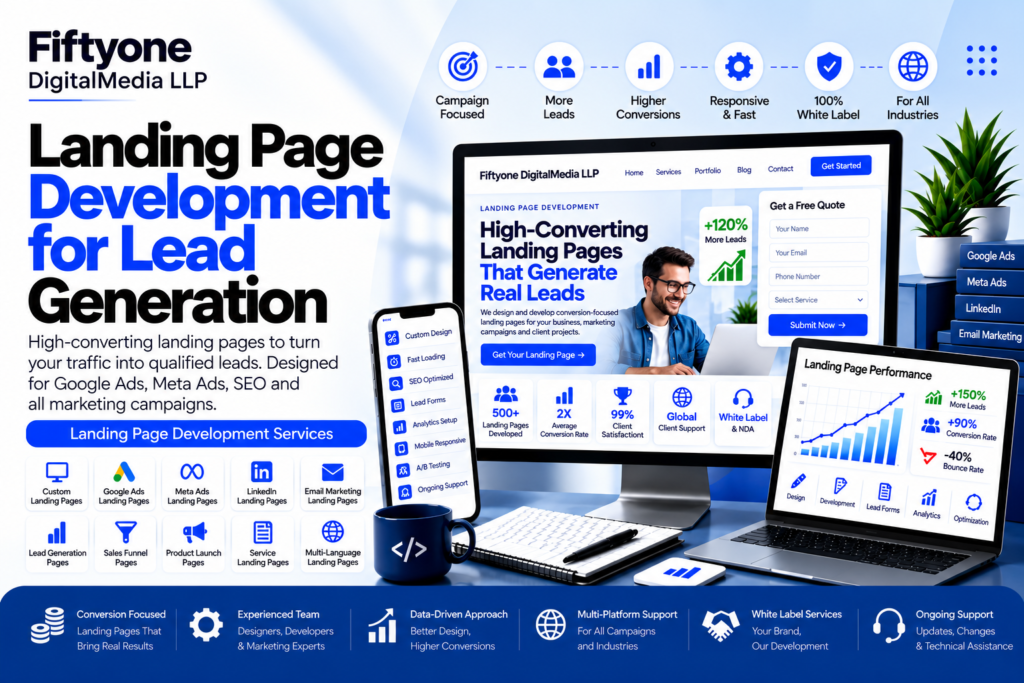

Landing pages have become an important part of digital marketing for businesses that want to generate qualified leads from Google Ads, Meta Ads, LinkedIn campaigns, email marketing, social media, and organic search. Unlike a traditional business website where visitors can explore multiple pages, a lead generation landing page is designed around a specific marketing objective, such as submitting a contact form, requesting a quotation, booking a consultation, downloading a resource, or contacting a business. Effective Landing Page Development for Lead Generation combines design, copywriting, user experience, mobile responsiveness, page speed, tracking, and conversion optimization. Fiftyone Digitalmedia LLP provides landing page development and digital marketing support for businesses and agencies that want to create focused landing experiences designed around specific campaign objectives.
What Is a Lead Generation Landing Page?
A lead generation landing page is a dedicated web page created to encourage visitors to complete a specific action. The page may be connected to an advertising campaign, email campaign, social media promotion, SEO strategy, or other marketing activity. Instead of providing visitors with numerous navigation options, the landing page focuses attention on a particular offer, service, product, or business solution. A well-developed landing page explains the value of the offer, addresses important customer concerns, provides relevant information, and makes it easy for visitors to submit their details or take the desired action.
Why Businesses Need Landing Pages for Lead Generation
A general website may contain multiple services, products, menus, blog articles, and other information, while a dedicated landing page can be created specifically for one audience and campaign. This focused structure makes it easier to align the headline, offer, content, call-to-action, and form with the customer’s search intent. Businesses can create separate landing pages for different services, locations, industries, advertising campaigns, or customer segments. This allows marketing teams to test different messages and identify which pages generate more relevant enquiries.
Landing pages can be used for:
- Lead generation campaigns
- Google Ads
- Meta Ads
- LinkedIn campaigns
- Email marketing
- Service promotions
- Product campaigns
- Webinar registrations
- Consultation bookings
- Free quote requests
Important Elements of a Lead Generation Landing Page
A successful landing page should communicate its value quickly and make the next action obvious. The headline should explain what the visitor can expect, while supporting content should address benefits, features, trust factors, and common objections. A visible call-to-action and simple lead form should make conversion straightforward without requesting unnecessary information. Visual elements, testimonials, statistics, guarantees, case studies, and relevant business information can also help users understand the offer and make a decision. Every element should have a clear purpose rather than adding design features simply for visual appeal.
Important elements include:
- Strong headline
- Clear value proposition
- Relevant supporting content
- Visible call-to-action
- Simple lead form
- Trust signals
- Customer testimonials
- Relevant images or visuals
- Mobile-responsive design
- Fast loading speed
- Contact information
- Conversion tracking
Landing Page Design and User Experience
Landing page design should guide visitors naturally from the initial message toward the desired conversion action. A cluttered layout, confusing navigation, excessive text, weak visual hierarchy, or unclear calls to action can make it difficult for users to understand what they should do next. A professional landing page uses spacing, typography, sections, visuals, buttons, and content hierarchy to create a clear user journey. Fiftyone Digitalmedia LLP develops landing pages with attention to responsive layouts, usability, visual hierarchy, page speed, and conversion-focused structure so that the design supports the marketing objective.
Mobile-First Landing Page Development
A significant amount of digital advertising and social media traffic comes from mobile devices, making mobile usability an important part of landing page development. A page that looks good on desktop but has small buttons, difficult forms, oversized images, or slow-loading sections on mobile can create unnecessary friction. Mobile-first development ensures that headlines remain readable, buttons are easy to tap, forms are usable, and important information remains accessible on smaller screens. Landing pages should be tested across different screen sizes before campaigns are launched.
Landing Pages for Google Ads and Paid Campaigns
Landing pages are frequently used with paid advertising because campaign-specific pages can be aligned closely with the advertisement and search intent. If a visitor clicks an advertisement promoting a particular service, the landing page should immediately communicate that the visitor has reached the relevant destination. Matching the advertisement’s message with the landing page headline, offer, and call-to-action can create a more consistent customer experience. Businesses can also create separate landing pages for different services, keywords, locations, or customer segments rather than directing every advertisement to the homepage.
Landing Page Development for Different Industries
Different industries require different landing page structures because customer expectations, buying processes, and conversion actions vary. A B2B company may focus on consultation requests or quotation forms, while a local service business may prioritize phone calls and appointment bookings. Ecommerce businesses may use product-focused landing pages, while educational institutions may focus on applications, registrations, or enquiry forms. Professional services may require detailed information, testimonials, credentials, and case studies before visitors submit their contact information. A landing page should therefore be designed around the actual customer journey rather than using the same template for every industry.
Landing pages can be developed for:
- B2B companies
- SaaS businesses
- Real estate companies
- Healthcare services
- Educational institutions
- Digital marketing agencies
- Web development companies
- Professional consultants
- Ecommerce businesses
- Local service businesses
Lead Forms and Conversion Optimization
The lead form is one of the most important components of a lead generation landing page because it directly collects visitor information. Forms should request only the information necessary for the sales or follow-up process. A long form may discourage some visitors, while an extremely short form may provide insufficient information for qualification. Businesses should test different field combinations, button text, placement, and surrounding messaging to understand what works for their audience. Form submissions should also be connected to appropriate email, CRM, analytics, or automation systems so leads can be processed efficiently after submission.
Landing Page Speed and Performance
Page speed can affect both user experience and campaign performance. Visitors may leave a page if important content takes too long to appear, particularly when accessing the page through mobile devices or paid advertisements. Large images, unnecessary scripts, excessive animations, third-party tracking tools, and poorly optimized code can increase loading time. Professional landing page development should therefore include image optimization, efficient code, responsive assets, script management, caching where appropriate, and performance testing. Keeping the page focused can also reduce unnecessary technical overhead.
Tracking and Analytics for Lead Generation
A landing page should not simply collect leads without measuring campaign performance. Analytics and conversion tracking can help businesses understand where visitors are coming from and how they interact with the page. Important measurements can include traffic sources, form submissions, button clicks, conversion rates, device usage, and campaign performance. Businesses can connect landing pages with tools such as Google Analytics, advertising platforms, CRM systems, email marketing platforms, and other lead management systems. Accurate tracking allows marketing teams to make decisions based on actual campaign data.
How to Choose a Landing Page Development Company
Choosing a landing page development company requires evaluating more than design quality. Businesses should look for a team that understands conversion optimization, responsive development, SEO, analytics, integrations, page speed, and digital marketing. The development partner should understand the campaign objective before designing the page and should be able to explain why specific sections, forms, calls to action, and content structures are being used. Agencies should also evaluate the company’s ability to create multiple landing pages for different campaigns and make future changes quickly.
Important factors include:
- Landing page development experience
- UI/UX expertise
- Conversion-focused design
- Mobile responsiveness
- Page speed optimization
- Analytics integration
- CRM integration
- Advertising campaign experience
- A/B testing support
- SEO knowledge
- Ongoing maintenance
Common Landing Page Development Mistakes
Many businesses create landing pages that look attractive but are not designed around a clear conversion objective. Common problems include multiple competing calls to action, unclear messaging, lengthy forms, weak headlines, poor mobile layouts, slow page speed, irrelevant stock images, and excessive navigation. Another mistake is sending all advertising traffic to a generic homepage instead of creating campaign-specific landing pages. Businesses should also avoid launching campaigns without proper conversion tracking because without reliable data it becomes difficult to understand whether the landing page is generating meaningful results.
Why Choose Fiftyone Digitalmedia LLP for Landing Page Development?
A successful landing page requires the combination of design, development, marketing, user experience, and technical performance.Fiftyone Digitalmedia LLP provides landing page development support for businesses and agencies that need focused pages for lead generation, paid advertising, service campaigns, product promotions, and other marketing activities. Landing pages can be developed with responsive layouts, clear calls to action, lead forms, analytics integration, CRM connectivity, performance optimization, and campaign-specific content. The development approach can be customized according to the target audience, marketing channel, industry, offer, and conversion objective.
Frequently Asked Questions
What is landing page development for lead generation?
Landing page development for lead generation involves creating a focused web page designed to encourage visitors to complete an action such as submitting a form, requesting a quote, booking a consultation, or contacting a business.
Why are landing pages important for lead generation?
Landing pages provide a focused experience that can align the page content, offer, call-to-action, and form with a specific marketing campaign and audience.
Can landing pages be used with Google Ads?
Yes. Businesses can create campaign-specific landing pages for Google Ads and align the page content with the relevant advertisement and customer search intent.
Should landing pages be mobile responsive?
Yes. Landing pages should work effectively across smartphones, tablets, and desktop devices because visitors can arrive from different devices and marketing channels.
Can landing pages connect to a CRM?
Yes. Landing pages can be integrated with CRM systems, email platforms, automation tools, and other systems so submitted leads can be managed and followed up.
How can landing page conversion rates be improved?
Businesses can test headlines, offers, calls to action, forms, page layouts, testimonials, visuals, and other elements to identify improvements based on actual visitor and conversion data.
Can one business have multiple landing pages?
Yes. Businesses can create separate landing pages for different services, locations, campaigns, industries, products, or customer segments.
Conclusion
Landing Page Development for Lead Generation requires more than creating a visually attractive webpage. A successful landing page needs a clear objective, relevant messaging, strong user experience, mobile responsiveness, fast performance, simple lead capture, accurate tracking, and a conversion-focused structure. Businesses can use dedicated landing pages for Google Ads, social media campaigns, email marketing, SEO, service promotions, and other customer acquisition activities.
The right development partner can help businesses turn marketing traffic into meaningful enquiries by creating landing experiences aligned with specific campaign objectives. Fiftyone Digitalmedia LLP can support businesses and agencies with landing page design, development, responsive optimization, lead forms, analytics integration, performance improvements, and ongoing landing page support.
