
Outsourced Web Development Project Management: How Agencies Keep Projects on Track

Your Development Team Is Not the Only Thing You Need to Manage
Imagine your agency has three active website projects.
One client is waiting for a homepage redesign. Another has requested changes to a Shopify store. A third project is ready for development, but the client has not supplied the required content.
Your external developers are working, but nobody has a complete picture of what is ready, what is blocked, and what should be delivered next.
This is where outsourced web development project management becomes important.
The challenge is not simply finding developers who can complete technical work. It is creating a delivery system in which every project has a clear owner, every task has a next action, and every delay becomes visible before it affects the client.
For digital agencies, the goal should be to manage project delivery without becoming the communication bottleneck for every small development decision.
The Real Problem: Work Gets Lost Between Teams
Most outsourced development problems happen in the gaps between people.
Consider a typical situation:
- The sales team promises a delivery date before technical estimation.
- The account manager sends requirements through multiple messages.
- The developer starts work using an outdated design.
- The client requests an additional feature during development.
- The project manager assumes the feature is included.
- The developer completes the original scope.
- The client rejects the result because expectations were different.
No single task necessarily failed. The delivery system failed.
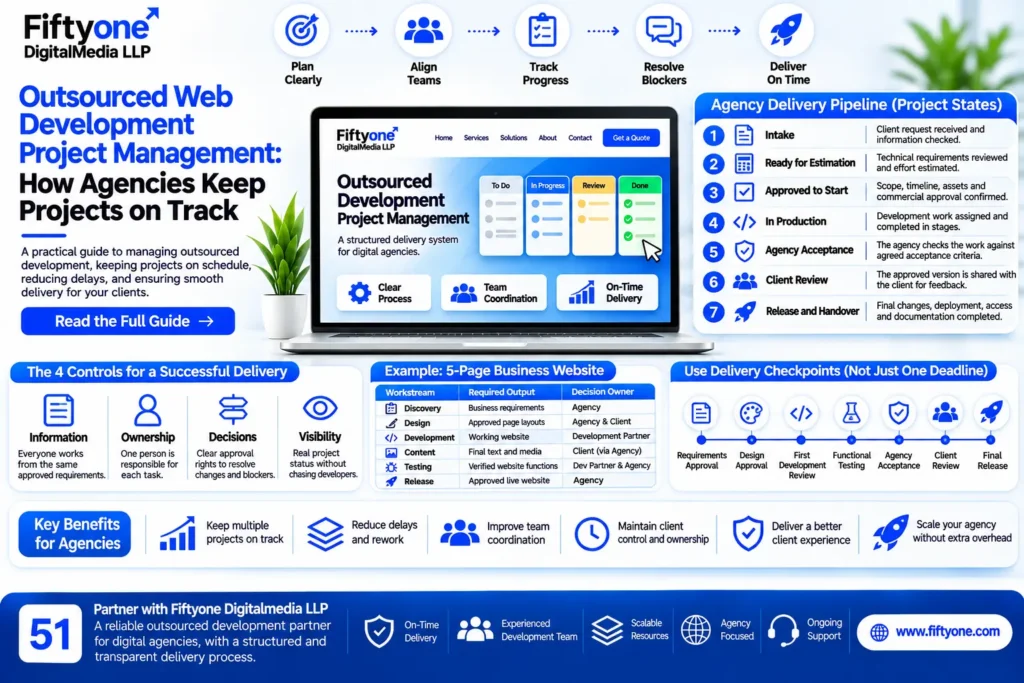
A useful project management model must control four things:
Information: Does everyone work from the same approved requirements?
Ownership: Is one person responsible for moving each task forward?
Decisions: Who can approve changes, resolve blockers, and accept deliverables?
Visibility: Can the agency identify the real project status without asking every developer individually?
These four controls should shape the agency’s operating process.Build a Delivery System Around Project States
Instead of treating a project as one large assignment, manage it through defined states. Each state should have an entry condition and an exit condition.
<text weight=”semibold”>A practical agency delivery pipeline</text>
<box border radius=”lg” padding={3} gap={3}> <list connector=”solid” marker=”number” gap={2}> <list-item> **Intake**
  Client request received. Project manager checks whether the information is complete.
</list-item>
<list-item>
  **Ready for Estimation**

  Technical requirements are reviewed and effort is estimated.
</list-item>
<list-item>
  **Approved to Start**

  Scope, timeline, assets, and commercial approval are confirmed.
</list-item>
<list-item>
  **In Production**

  Development work is assigned and completed in agreed stages.
</list-item>
<list-item>
  **Agency Acceptance**

  The agency checks the work against the agreed acceptance criteria.
</list-item>
<list-item>
  **Client Review**

  The approved version is shared with the client for feedback.
</list-item>
<list-item>
  **Release and Handover**

  Final changes, deployment, access, and documentation are completed.
</list-item>
</list> </box>
The important detail is that a project should not move forward simply because someone changes its status in a project management tool.
For example, a project should not enter “Approved to Start” until the design, content responsibilities, scope, and required access have been confirmed.
This prevents developers from beginning work on incomplete information.
A Realistic Example: Managing a 5-Page Business Website
Consider an agency handling a five-page WordPress website for a business client.
The agency manages the client relationship, while an external development team handles implementation.
Here is how the work could be divided:
| Workstream | Required output | Decision owner |
|---|---|---|
| Discovery | Business requirements | Agency |
| Design | Approved page layouts | Agency and client |
| Development | Working website | Development partner |
| Content | Final text and media | Client, coordinated by agency |
| Testing | Verified website functions | Development partner and agency |
| Release | Approved live website | Agency |
This arrangement exposes dependencies that a simple task list can hide.
For example, homepage development may be ready, but the inner pages could remain blocked by missing content. Instead of marking the entire project as delayed, the project manager can identify exactly which work can continue and which work is waiting.
That distinction helps agencies make better delivery decisions.
Stop Using One Deadline for Everything
A single project deadline gives very little information about actual progress.
Agencies should use internal delivery checkpoints.
For example, a project schedule might contain:
- Requirements approval
- Design approval
- First development review
- Functional testing
- Agency acceptance
- Client review
- Final release
These checkpoints are not promises that every project follows the same number of days. They are control points where the project manager verifies whether the next stage can begin.
There is another important rule: client waiting time and development time should be tracked separately.
If a project is waiting for client content for four days, the agency should not report that as four days of developer inactivity.
Track at least three categories:
- Active work: A team member is completing an assigned task.
- Internal dependency: Work is waiting for another team member or technical decision.
- External dependency: Work is waiting for the client, approval, content, or access.
This creates a more accurate view of project performance.
Introduce a Decision Log, Not Just a Task Board
Task boards show what needs to be done. They do not always explain why a decision was made.
This becomes a problem when a client changes a design direction or the agency approves a technical alternative.
Maintain a short decision log for important project decisions.
| Date | Decision | Approved by | Impact |
|---|---|---|---|
| 12 Nov | Use existing WordPress theme | Agency | No custom theme development |
| 13 Nov | Add an additional landing page | Client | Scope and estimate review required |
| 14 Nov | Change contact form fields | Agency | Development task updated |
The entries above are illustrative examples, not actual project records.
A decision log helps the agency answer questions such as:
- Was this feature part of the original scope?
- Who approved the change?
- Which design version is final?
- Why was the original implementation changed?
- Does the new request affect delivery?
For projects involving several stakeholders, this record can be more useful than long conversations spread across different messaging platforms.
Give Developers Clear Boundaries for Decisions
Developers should not need permission for every small technical choice. At the same time, they should not independently approve changes that affect client expectations.
Divide decisions into three categories.
Technical decisions
Examples include code structure, implementation methods, internal debugging, and development-level improvements that stay within the approved requirements.
The development partner can generally manage these decisions.
Delivery decisions
Examples include task sequencing, resource allocation, estimates, blockers, and milestone risks.
These should be coordinated between the development lead and agency project manager.
Commercial and client decisions
Examples include extra features, new pages, additional costs, delivery date changes, and changes to approved designs.
These should remain with the agency and client according to the project agreement.
This separation gives developers room to work while protecting the agency from unauthorized scope changes.
What Happens When a Project Goes Off Track?
A project manager needs an escalation process before a problem occurs.
Waiting until a deadline is missed is not project management.
Use a simple escalation model:
<box border radius=”lg” padding={3} gap={3}> <box gap={1}> <badge color=”success”>Level 1</badge> **Minor issue**
A task needs clarification but the delivery date is not affected.

Action: Resolve through the assigned task owner.
</box> <divider color=”subtle”/> <box gap={1}> <badge color=”warning”>Level 2</badge> **Delivery risk**
A dependency or technical problem may affect a milestone.

Action: Notify the project manager, identify alternatives, and update the delivery forecast.
</box> <divider color=”subtle”/> <box gap={1}> <badge color=”danger”>Level 3</badge> **Critical issue**
A major requirement cannot be delivered, a production issue occurs, or the agreed deadline is no longer realistic.

Action: Escalate to the agency lead and development lead. Agree on a recovery plan before communicating a revised commitment.
</box> </box>
The purpose is not to create more meetings. It is to make sure the right person gets involved at the right time.
Protect Profitability While Managing Delivery
A project can be technically successful and still be unprofitable for the agency.
This happens when the agency underestimates management time, allows unlimited revisions, or accepts additional requirements without adjusting the project agreement.
Consider a simplified example.
<text color=”secondary” size=”xs”>Illustrative figures only, not a Fiftyone Digitalmedia LLP price quotation.</text>
| Project item | Amount |
|---|---|
| Client project fee | $1,500 |
| External development cost | $650 |
| Design and other delivery costs | $200 |
| Agency project management cost | $150 |
| Remaining gross contribution | $500 |
The remaining contribution is not automatically net profit. Other business expenses, taxes, and overheads may still apply.
The lesson is straightforward: project management time is a real delivery cost. If the agency ignores it, its margin calculations are inaccurate.
Track these items for every project:
- Original estimated delivery cost
- Actual development cost
- Agency management hours
- Number of revision cycles
- Approved additional work
- Final contribution after direct delivery costs
After several projects, this information can reveal which services are profitable and which consistently consume more time than expected.
Create a Weekly Delivery Review That Takes 20 Minutes
A weekly meeting should not become a developer-by-developer activity report.
Review the projects that need a decision.
For each active project, answer five questions:
- What was expected to be completed this week?
- What was actually completed?
- What is currently blocked?
- Which decision or approval is needed?
- Has the expected delivery date changed?
Keep the meeting focused on exceptions, not tasks that are already progressing normally.
After the review, record the owner and next action for every unresolved issue. If a task has no owner or next action, it is not being managed properly.
The Agency’s Project Control Dashboard
A useful dashboard should show the information required to make delivery decisions, not every available project metric.
| Dashboard field | Why it matters |
|---|---|
| Active projects | Shows current delivery workload |
| Projects awaiting client input | Identifies external delays |
| Projects at delivery risk | Highlights potential missed commitments |
| Tasks overdue | Shows execution problems |
| Pending agency approvals | Reveals internal bottlenecks |
| Scope changes awaiting approval | Protects project margins |
| Projects ready for release | Shows work close to completion |
This dashboard can be created in tools such as ClickUp, Asana, Trello, or another system the agency already uses.
The tool is secondary. The quality of the information and the discipline of updating it matter more.
When an Agency Should Change Its Outsourcing Model
Not every delivery problem requires another project management tool or more meetings.
Sometimes the operating model itself is wrong.
If the agency has a predictable number of fixed-scope projects, milestone-based external development may be sufficient.
If the agency handles continuous development requests, recurring maintenance, and changing priorities, a dedicated development arrangement may be more appropriate.
Before changing the model, examine:
- Whether the workload is predictable
- Whether projects require different technical skills
- How frequently priorities change
- How much time agency staff spend coordinating development
- Whether the current partner can handle overlapping deadlines
- Whether the cost of additional capacity is justified
For a broader comparison of outsourcing arrangements, see Web Development Outsourcing: How Agencies Can Scale Faster.
For a related discussion of retaining agency ownership of client communication and approvals, read Outsource Web Development Without Losing Client Control.
Frequently Asked Questions
What is the biggest challenge in managing outsourced web development?
The biggest operational challenge is maintaining a shared understanding of scope, ownership, priorities, and project status between the agency and its external development team.
Should agencies assign a project manager to outsourced work?
Yes, when project volume or complexity justifies the role. One person should be accountable for coordinating requirements, tracking dependencies, handling escalations, and reporting delivery status.
How can agencies track outsourced developer performance?
Evaluate completed work against agreed requirements, delivery commitments, defect trends, communication expectations, and quality standards. Do not judge performance only by the number of tasks marked complete.
What should an agency do when a client keeps changing requirements?
Record each request, assess its effect on scope and cost, and obtain approval before assigning additional work. Keep new requirements separate from defects in the originally agreed deliverables.
Can small agencies use this project management model?
Yes. Smaller agencies can use a simple task board, one project owner, written requirements, and a decision log. They do not need an elaborate project management department.
Conclusion
Outsourced development becomes difficult when agencies manage tasks but fail to manage decisions, dependencies, and accountability.
A better delivery model gives every project a clear path from intake to release. It separates technical decisions from client and commercial decisions, records important approvals, tracks waiting time, and measures the real cost of delivery.
Digital agencies do not need to supervise every development activity. They need enough visibility to identify risks, make timely decisions, and protect the quality and profitability of the work.
That is the difference between simply assigning development tasks to an external team and operating a managed outsourced development process.
Fiftyone Digitalmedia LLP works with agencies that need web development support aligned with defined project requirements and delivery expectations. The right engagement should begin with a clear discussion of scope, responsibilities, communication, and approval processes.