How to Outsource Website Maintenance Without Losing Client Control
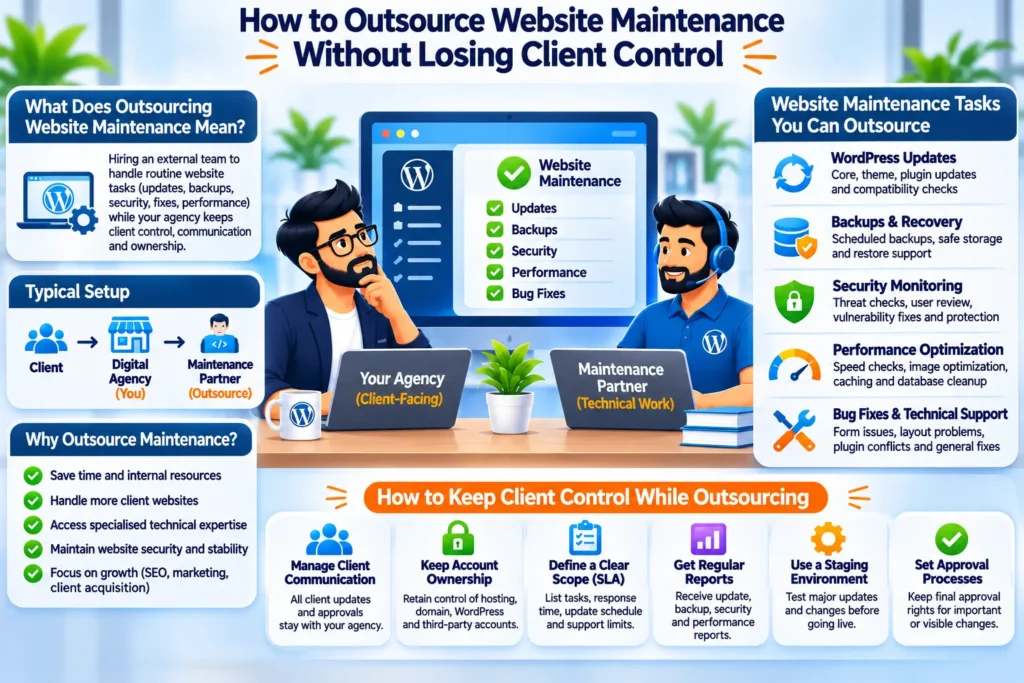
Managing multiple client websites can become difficult as a digital agency grows. WordPress updates, plugin compatibility issues, website backups, security checks, broken forms, and unexpected technical problems require ongoing attention.
For agencies handling several websites, these responsibilities can consume hours that could otherwise be spent on client acquisition, SEO, design, and business development.
Outsourcing website maintenance allows an agency to delegate routine technical work to an external team while continuing to manage client relationships, pricing, approvals, and website ownership.
However, outsourcing without a proper system can create problems. Clients may become confused about who manages their website, developers may receive conflicting instructions, and important website accounts may end up under the wrong ownership.
The solution is to outsource maintenance tasks while keeping control of the accounts, communication, approvals, and final decisions.
This guide explains how digital agencies can outsource website maintenance without losing control of their clients or their websites.
What Does Outsourcing Website Maintenance Mean?
Outsourcing website maintenance means hiring an external developer or technical team to manage agreed website-related tasks instead of handling everything internally.
For example, a digital marketing agency may manage 20 client websites. Each website needs regular WordPress updates, backups, security checks, performance monitoring, and occasional bug fixes.
Instead of assigning these responsibilities to an internal developer, the agency can work with an external maintenance partner.
The agency remains responsible for client communication, commercial agreements, and service management. The external team handles the technical tasks according to the agreed maintenance plan.
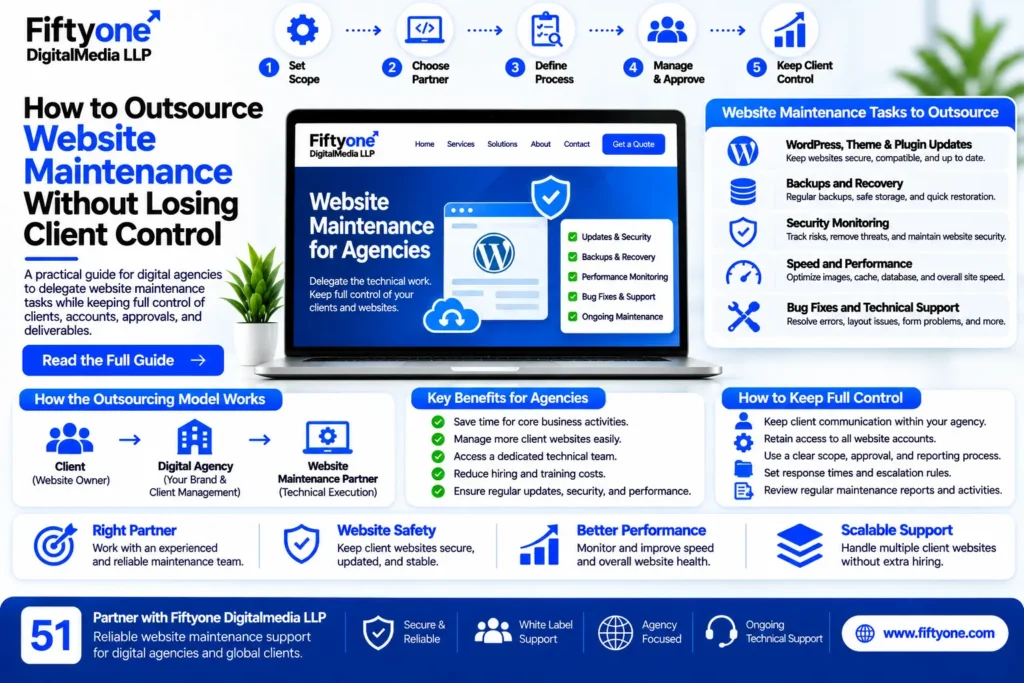
A typical arrangement looks like this:
Client → Digital Agency → Website Maintenance Partner
The client communicates with the agency, and the agency coordinates the technical work.
This approach can help agencies manage more websites without immediately hiring additional full-time developers.
Which Website Maintenance Tasks Can Agencies Outsource?
Not every website-related responsibility needs to be outsourced. Agencies should separate routine technical work from decisions that affect the client’s business, branding, and website ownership.
Here are the main tasks that can be delegated.
1. WordPress Core, Theme, and Plugin Updates
WordPress websites require regular updates to maintain compatibility, improve functionality, and address security issues.
A maintenance partner can manage:
- WordPress core updates.
- Theme updates.
- Plugin updates.
- Compatibility checks.
- Update-related troubleshooting.
- Post-update functionality testing.
Updates should not be applied blindly to every live website.
A safer process involves creating a backup, reviewing compatibility, testing important functionality, and then applying approved changes.
2. Website Backups and Recovery
Backups are essential when a website experiences unexpected problems.
An external maintenance team can manage scheduled backups of website files and databases.
The maintenance agreement should specify:
- Backup frequency.
- Backup storage location.
- Retention period.
- Access permissions.
- Restore procedures.
- Backup verification schedule.
A backup is useful only when it can be restored successfully.
Agencies should periodically request evidence of successful backup and recovery tests rather than assuming that an automated backup plugin is working correctly.
3. Website Security Monitoring
Security maintenance involves more than installing a security plugin.
Depending on the website and hosting environment, an external team can help with:
- Monitoring suspicious activity.
- Reviewing administrator accounts.
- Checking outdated software.
- Identifying vulnerable plugins.
- Removing unauthorized users.
- Reviewing file changes.
- Investigating suspicious redirects.
- Implementing agreed security improvements.
The agency should also define how security incidents are reported and who has authority to approve emergency changes.
4. Website Speed and Performance Monitoring
A website may become slower because of oversized images, unnecessary scripts, excessive plugins, hosting limitations, or database-related problems.
A maintenance partner can review performance and implement agreed improvements.
Typical tasks include:
- Image optimization.
- Cache configuration.
- Database cleanup.
- Unnecessary plugin identification.
- CSS and JavaScript optimization.
- Broken resource checks.
- Performance monitoring.
Performance changes should be tested carefully. Removing scripts or changing caching settings without testing can break forms, shopping carts, and other important website functions.
5. Bug Fixes and Technical Support
Client websites often require small technical corrections after launch.
Examples include:
- Broken contact forms.
- Incorrect button links.
- Layout issues.
- Plugin conflicts.
- Missing images.
- Mobile display problems.
- WooCommerce checkout errors.
- Unexpected WordPress errors.
An outsourced maintenance team can investigate and fix these issues under an agreed support arrangement.
For ecommerce clients, problems involving payments and checkout functionality need particular attention. Our guide on how to fix WooCommerce checkout errors covers common issues that can interrupt the customer purchasing process.
How to Outsource Website Maintenance Without Losing Client Control
The biggest mistake agencies make is delegating technical responsibilities without defining who controls the website and the client relationship.
A maintenance partner should execute approved tasks, not automatically become the owner of the client’s digital assets.
Use the following process to maintain control.
1. Keep Domain and Hosting Ownership With the Client or Agency
Domain and hosting ownership should never depend entirely on an external maintenance provider.
Before starting the partnership, identify who owns:
- Domain registration.
- Hosting accounts.
- DNS management.
- WordPress administrator access.
- Premium plugin licences.
- Website backups.
- Analytics accounts.
- Business email services.
Where possible, these accounts should remain under the client’s or agency’s control.
The maintenance partner should receive the access required to perform the agreed work.
For example, if a developer needs to update WordPress plugins, they may need administrator access to the WordPress installation. That does not mean they need ownership of the domain registration or hosting billing account.
This separation makes it easier to change providers without losing access to the website.
2. Create Individual User Accounts for Developers
Never make shared administrator credentials the standard way of managing outsourced work.
If several developers use the same login, the agency may not know who made a particular change.
Instead:
- Create individual accounts.
- Assign permissions based on responsibilities.
- Use strong authentication.
- Restrict access to unnecessary systems.
- Review user accounts periodically.
- Remove access when a developer leaves the project.
For tasks that do not require administrator permissions, use a lower access level where practical.
This creates a clearer security and accountability process.
3. Keep Client Communication Under Your Agency
Your agency should remain the primary contact for the client.
The external maintenance team can report technical problems and completed tasks internally. Your agency can then communicate the relevant information to the client.
A simple communication process looks like this:
Client Request → Agency Review → Maintenance Task → Developer → Agency Verification → Client Update
This prevents clients from receiving conflicting technical explanations or unexpected messages from external developers.
If a technical meeting is necessary, the agency can arrange it and remain involved.
4. Use a Centralized Maintenance Request System
Do not allow maintenance requests to arrive through several disconnected channels.
If clients send requests through email, WhatsApp, phone calls, and different team members, tasks can easily be missed or duplicated.
Use a centralized project management system such as Trello, Asana, ClickUp, or Jira.
Each maintenance request should include:
- Client or website name.
- Description of the problem.
- Relevant page URL.
- Screenshot, if necessary.
- Priority level.
- Assigned person.
- Expected completion date.
- Approval status.
The maintenance partner should work from this approved task list.
This gives the agency a record of what was requested, what was completed, and what remains pending.
5. Define Which Changes Need Client Approval
Not every maintenance task requires client approval.
Routine updates and agreed technical checks can usually follow a predefined process.
However, changes that affect the website’s appearance, business content, functionality, or customer experience may require approval.
For example:
| Maintenance Task | Approval Approach |
|---|---|
| Scheduled plugin updates | Follow agreed maintenance policy |
| Routine backups | Included in maintenance scope |
| Broken link correction | Agency approval, depending on scope |
| Homepage redesign | Client approval |
| New website functionality | Scope and price approval |
| Major database changes | Technical and agency approval |
| Emergency security response | Follow agreed emergency procedure |
The agency should define these boundaries before maintenance begins.
This avoids situations where a developer makes a major website change without the agency or client’s knowledge.
6. Require Maintenance Reports
A maintenance report helps the agency verify that the outsourced work has actually been completed.
Ask the provider to submit a report at an agreed frequency.
A useful report should include:
- Websites maintained.
- WordPress updates completed.
- Theme and plugin updates.
- Backup status.
- Security checks.
- Performance issues identified.
- Bugs fixed.
- Pending tasks.
- Issues requiring approval.
- Recommended next actions.
Avoid accepting reports that only say “maintenance completed.”
The report should provide enough detail to verify the work.
For example, if a plugin update caused a conflict, the report should explain what happened, how it was handled, and whether the affected functionality was tested afterward.
What Should Your Website Maintenance Agreement Include?
A written agreement reduces misunderstandings between the agency and the external provider.
Before outsourcing maintenance, document the following areas.
Scope of Services
List the exact maintenance tasks included in the agreement.
For example, a basic agreement may include scheduled updates, backups, uptime checks, and small bug fixes.
Custom development, redesigns, new integrations, and major functionality changes may require separate estimates.
Response and Resolution Expectations
Define how quickly the provider should acknowledge and investigate requests.
Separate normal maintenance requests from urgent incidents.
Do not promise clients guaranteed resolution times unless the technical team can realistically meet them.
Client Confidentiality
The provider may need access to client credentials, databases, business information, and website files.
Use suitable confidentiality terms and define how information must be handled.
Ownership of Website Data and Work
Specify who owns the website, custom code, design files, backups, and other deliverables.
The agency or client should retain the access and rights agreed upon in the commercial arrangement.
Payment and Additional Charges
Clarify monthly fees, billing dates, included maintenance hours, additional work charges, and payment responsibilities.
Termination and Access Removal
Define how the partnership can be ended and how website files, credentials, documentation, and access will be transferred.
The agency should be able to move to another provider without depending on the previous provider for essential website access.
How to Choose the Right Website Maintenance Partner
The cheapest provider is not automatically the best choice.
A maintenance partner will be working on websites that affect your agency’s reputation and your clients’ businesses.
Evaluate potential providers on the following factors.
WordPress experience: Check whether the team understands WordPress core, themes, plugins, WooCommerce, backups, and troubleshooting.
Security practices: Ask how they manage credentials, user permissions, backups, and suspicious activity.
Testing process: Confirm whether they test important website functionality after updates.
Reporting: Request a sample maintenance report to understand how completed tasks are documented.
Communication: Check whether the provider can deliver clear technical updates and communicate issues before they become larger problems.
Scalability: Ask how the team will handle additional websites if your agency grows.
Exit process: Confirm whether the provider will return access, documentation, and project files when the partnership ends.
A small trial involving a limited number of websites can help you evaluate the working relationship before outsourcing your entire maintenance workload.
How Can Agencies Calculate the Profitability of Outsourced Website Maintenance?
Outsourcing should improve your agency’s operational capacity without making maintenance services financially unviable.
Consider this hypothetical example:
| Item | Monthly Amount |
|---|---|
| Client maintenance revenue | $1,000 |
| External maintenance partner | $450 |
| Agency coordination cost | $150 |
| Other operational expenses | $50 |
| Estimated monthly profit | $350 |
Calculation:
$1,000 − $450 − $150 − $50 = $350
In this example, the agency earns an estimated $350 before wider business overhead and applicable taxes.
These figures are illustrative, not standard market prices.
When calculating your own maintenance pricing, consider the number of websites, their complexity, ecommerce functionality, expected support requests, backup requirements, security needs, and response expectations.
Do not sell unlimited maintenance at a fixed low price without defining what is included.
Common Mistakes to Avoid When Outsourcing Website Maintenance
Even experienced agencies can create problems if they delegate maintenance without a structured process.
Avoid these mistakes:
Giving the provider ownership of the domain: The domain should remain under the client’s or agency’s control.
Sharing one administrator login: Individual user accounts make access management and accountability easier.
Not defining maintenance scope: Without clear boundaries, small maintenance requests can turn into unlimited development work.
Skipping backup verification: Automated backup settings do not prove that recovery will work.
Allowing unapproved changes: Establish which changes are routine and which require approval.
Ignoring maintenance reports: Agencies need records to verify completed work and identify recurring issues.
Not testing after updates: A website may appear normal while its forms, checkout, or other important functions are broken.
Failing to plan provider exit: Access removal and project handover should be defined before the partnership begins.
When Should an Agency Outsource Website Maintenance?
Outsourcing becomes worth considering when website maintenance starts consuming time needed for more valuable agency activities.
It may be suitable when:
- Your agency manages several WordPress websites.
- Routine updates are taking too much internal time.
- You receive recurring technical support requests.
- You do not have a dedicated maintenance specialist.
- You want to offer monthly maintenance packages.
- You need additional technical capacity without hiring immediately.
However, outsourcing is not automatically the right answer for every agency.
If you manage only one or two simple websites and can maintain them efficiently, an external arrangement may introduce more coordination than it removes.
Evaluate the actual workload before deciding.
Frequently Asked Questions
Can a digital agency outsource website maintenance?
Yes. A digital agency can outsource WordPress updates, backups, security monitoring, performance checks, bug fixes, and other agreed maintenance tasks to an external technical team.
How can I outsource website maintenance without losing control?
Keep domain and hosting ownership with the client or agency, use individual developer accounts, centralize maintenance requests, define approval rules, and review regular maintenance reports.
Should I give an outsourced developer full WordPress administrator access?
Only when the assigned work requires it. Give developers individual accounts and the minimum permissions necessary. Review and revoke access when it is no longer required.
What is included in a website maintenance package?
A package may include WordPress updates, plugin and theme updates, backups, uptime monitoring, security checks, performance reviews, and limited bug fixes. Exact inclusions depend on the agreement.
How much does outsourced website maintenance cost?
There is no single fixed price. Costs depend on the number of websites, platform, website complexity, ecommerce functionality, maintenance frequency, support requirements, and service-level expectations.
Can I offer white label website maintenance to my clients?
Yes. An agency can sell website maintenance under its own brand while an external provider handles the technical work. The agency remains responsible for client communication, service expectations, and final quality checks.
What happens if I want to change my maintenance provider?
Your agreement should cover access transfer, backup delivery, documentation, credentials, and removal of the previous provider’s accounts. Keep essential website ownership and billing accounts under your control to make the transition easier.
Conclusion
Outsourcing website maintenance can help digital agencies manage more client websites without building a large internal technical team.
However, successful outsourcing depends on maintaining control over the right things. Your agency should retain ownership oversight, client communication, approvals, pricing, and service quality while the external team handles the agreed technical responsibilities.
Start with a clear maintenance scope, individual access permissions, verified backups, centralized task management, and regular reports.
The objective is not to manage every technical update yourself. It is to build a maintenance process that allows your agency to delegate routine work without losing control of its clients or their websites.