
Offshore SEO Agency: Complete Guide
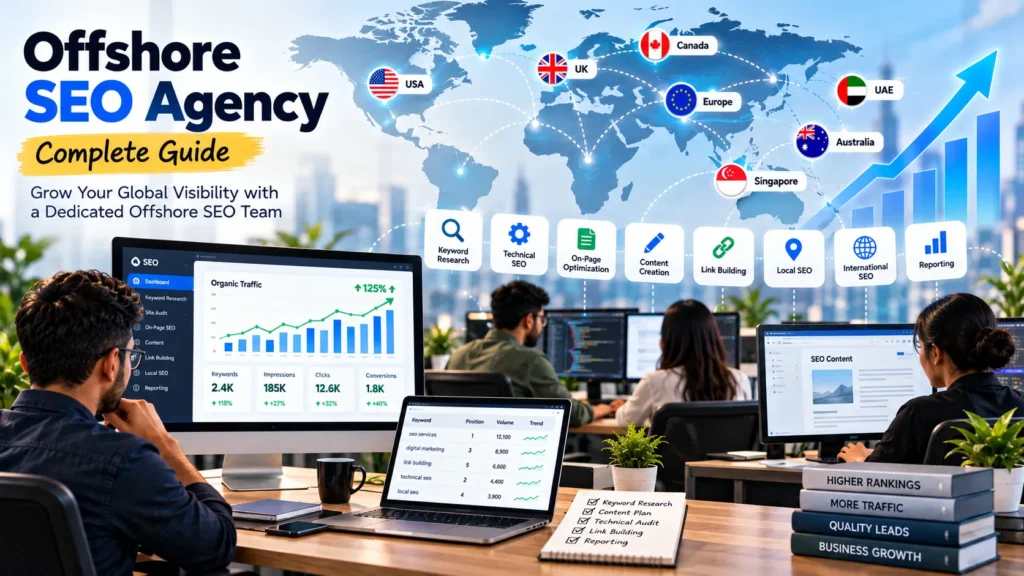
Businesses targeting international customers need a search strategy that goes beyond basic keyword optimization. Their websites must compete with established companies, address different customer expectations, and maintain visibility across multiple search markets.
Managing these requirements internally can demand several specialists, SEO tools, content resources, and continuous campaign management. An offshore SEO agency provides another option by allowing businesses to work with an external SEO team located outside their primary market.
For companies in the USA, UK, Canada, Australia, New Zealand, Europe, and UAE, this arrangement can provide additional SEO expertise and execution capacity without requiring every activity to be managed by an internal department.
However, offshore SEO is not simply about assigning work to a remote team. Businesses need to understand how the agency operates, which responsibilities it handles, how international campaigns are managed, and how performance is evaluated.
What Is an Offshore SEO Agency?
An offshore SEO agency provides search engine optimization services to businesses located in another country.
For example, a company operating in the United States may work with an SEO agency based in India to manage its website optimization, content planning, technical SEO, and organic search campaigns.
The agency works remotely and follows an agreed scope of work, communication process, and reporting arrangement.
Depending on the business requirements, an offshore SEO partnership can involve:
- Managing an ongoing SEO campaign
- Supporting an internal marketing department
- Handling technical SEO projects
- Researching international search opportunities
- Optimizing existing website pages
- Providing SEO fulfillment for digital agencies
- Supporting website migrations and organic growth projects
The level of involvement depends on the agreement between the business and the provider.
Why Do Businesses Work With Offshore SEO Agencies?
Businesses consider offshore SEO when they need specialist support, additional delivery capacity, or a more flexible way to manage search optimization.
The decision is usually connected to operational requirements rather than location alone.
Access to Different SEO Specializations
SEO involves several areas of expertise. Technical optimization, international keyword research, content planning, link acquisition, and analytics require different skills.
An offshore agency may provide access to multiple specialists through one working relationship.
This can be useful for businesses that do not need to employ every specialist permanently.
Flexible Campaign Resources
SEO workload can change throughout the year.
A business launching a new website, entering another country, or expanding its service offerings may temporarily require more SEO resources.
An offshore arrangement can provide additional capacity according to the agreed project scope.
Reduced Internal Hiring Requirements
Building an in-house SEO department involves recruitment, salaries, training, management, and software expenses.
Outsourcing selected activities can provide an alternative to maintaining every SEO role internally.
However, the actual financial benefit depends on the scope, provider quality, management requirements, and amount of work involved. Offshore SEO should not automatically be treated as the cheapest option.
More Time for Business Priorities
Internal teams can continue focusing on product development, customer relationships, sales, and business operations while an external SEO team handles assigned optimization activities.
This arrangement works best when both teams understand their responsibilities.
Offshore SEO for International Markets
An offshore SEO agency working with international businesses must understand that search behavior differs between countries.
A keyword strategy that works in one market should not automatically be applied to another.
United States
The US is a competitive search market across industries such as technology, ecommerce, professional services, and digital marketing.
Businesses targeting American customers need research into competing websites, commercial search intent, and the content expectations of their target audience.
United Kingdom
UK campaigns may require different terminology, spelling, and service-related search phrases.
Content should reflect how local customers search rather than simply adapting American website copy.
Canada
Canadian campaigns may need country-specific content and, depending on the audience, English and French language considerations.
Businesses should identify which provinces, regions, and customer segments are relevant before developing localized pages.
Australia and New Zealand
Companies targeting these markets should research local search demand, competitor websites, and relevant service terminology.
Using the same content across Australia and New Zealand without examining market differences can limit its relevance.
Europe
European SEO campaigns can involve multiple countries, languages, and regional search requirements.
Businesses with multilingual websites should consider URL structure, localized content, and appropriate hreflang implementation.
United Arab Emirates
The UAE market can involve English-speaking and Arabic-speaking audiences, depending on the industry and customer base.
Businesses should plan their language and location targeting around the customers they actually want to reach.
A useful offshore SEO strategy considers each target market individually rather than treating international traffic as one audience.
What Services Does an Offshore SEO Agency Provide?
The scope of work depends on the website, industry, and campaign objectives. A business may need a complete SEO campaign or support with specific activities.
Keyword Research and Search Intent
Keyword research identifies the searches that are relevant to a company’s products, services, and target audience.
For international businesses, this process should include country-specific search behavior, commercial intent, keyword variations, and competitor analysis.
The agency should also map keywords to appropriate website pages to reduce unnecessary content overlap.
Technical SEO
Technical SEO focuses on helping search engines crawl, index, and understand website content.
Typical activities include:
- Website architecture analysis
- Indexing and crawlability checks
- XML sitemap review
- Robots.txt validation
- Canonical tag analysis
- Redirect checks
- Mobile usability
- Page performance
- Structured data validation
Technical recommendations should explain the problem, its impact, and the priority of implementation.
On-Page SEO
On-page optimization improves individual pages so they better match their intended search queries and user needs.
It may involve title tags, meta descriptions, heading structure, content relevance, image optimization, internal linking, and page organization.
The objective is not to repeat keywords throughout a page. It is to make the content useful and relevant to its intended audience.
SEO Content Planning
Content planning helps businesses identify which topics and landing pages deserve attention.
An effective approach starts with reviewing existing content, identifying gaps, understanding search intent, and mapping topics to business objectives.
Publishing more articles is not automatically a successful strategy. Similar pages can compete with each other when they target the same search intent without offering distinct value.
Link Building and Authority Development
An offshore SEO agency may support relevant backlink acquisition through outreach, digital PR opportunities, and other appropriate authority-building activities.
Businesses should understand where links come from and how their relevance is evaluated.
Link quality and relevance should take priority over promises of large backlink quantities.
For more information, explore Best Link Building Strategies for Agency Websites.
Local and International SEO
Local SEO helps businesses improve visibility for relevant geographic searches.
International SEO focuses on reaching audiences across countries and languages.
Depending on the project, these activities may involve business profile optimization, location-specific landing pages, localized content, international URL structures, and hreflang implementation.
SEO Reporting and Analysis
Reporting gives businesses visibility into campaign activity and organic search performance.
A useful report can include:
- Organic clicks and impressions
- Search queries and average positions
- Landing-page performance
- Organic traffic by country
- Technical SEO improvements
- Content updates
- Backlink activity
- Leads and conversions where tracking is available
Reports should explain what changed, why it matters, and what the team plans to do next.
Offshore SEO vs In-House SEO
Businesses often compare offshore SEO with hiring an internal team before deciding how to manage their campaigns.
| Factor | Offshore SEO Agency | In-House SEO |
|---|---|---|
| Recruitment | Managed by the provider | Managed by the business |
| Specialist access | Depends on provider capabilities | Depends on internal hiring |
| Scalability | External support can be adjusted | Additional hiring may be required |
| Daily management | Shared responsibilities | Direct internal management |
| Business knowledge | Must be communicated | Develops internally |
| Operational control | Defined by agreement | More direct control |
| Cost structure | Based on service scope | Salaries and operating expenses |
Neither model is automatically better for every business.
An in-house team may be suitable when SEO requires continuous involvement with internal departments. An offshore agency may be useful when a business needs specialist expertise or additional campaign capacity.
Some companies combine both models by retaining strategy internally while outsourcing selected execution activities.
Offshore SEO vs White Label SEO
Offshore SEO and white label SEO are related, but they describe different aspects of a service arrangement.
Offshore SEO describes the location of the SEO provider relative to the client.
White label SEO describes delivering SEO services under another company’s brand.
For example, a digital marketing agency in Australia may work with an SEO provider in India. If the Australian agency delivers that work to its customers under its own brand, the arrangement is both offshore and white label.
A business can also hire an offshore SEO agency directly without using a white label arrangement.
Understanding this distinction helps digital agencies choose the right fulfillment model.
How to Choose an Offshore SEO Agency
Choosing an offshore SEO agency should involve more than comparing monthly packages.
Businesses should examine how the provider approaches actual campaign requirements.
Review Relevant Industry Experience
Ask whether the agency has worked with websites in your industry or with similar business models.
Experience with international campaigns can also help the provider understand differences in target markets and competitor behavior.
Examine Its Research Process
Ask how the agency identifies keywords, evaluates search intent, studies competitors, and prioritizes existing website pages.
The answer should explain how research becomes an actionable SEO plan.
Understand the Technical Capabilities
If the website has indexing issues, migration requirements, complex architecture, or performance problems, confirm that the provider can handle those specific requirements.
Check Reporting Standards
A report should contain useful performance information and clear explanations.
Businesses should be able to understand which tasks were completed, what results changed, and which improvements are planned.
Evaluate Communication
Discuss the communication channel, response expectations, meeting frequency, approval process, and escalation arrangements before starting.
Review the Proposed Scope
A professional proposal should clearly explain deliverables, responsibilities, pricing, additional work, and support arrangements.
Avoid agreements that promise SEO growth without defining what work will actually be performed.
Managing Communication Across Different Time Zones
An offshore SEO partnership may involve teams working several hours apart.
This can be managed through documented workflows and agreed communication expectations.
Businesses should establish:
- A primary communication channel
- Scheduled project review meetings
- Response expectations
- Content approval timelines
- Technical change approval procedures
- Reporting frequency
- Escalation contacts
A shared project management system can also help both teams track responsibilities, deadlines, completed work, and pending approvals.
Written documentation is particularly important when several people are involved in a campaign.
Common Mistakes When Working With an Offshore SEO Agency
Even a capable SEO provider can struggle when the working relationship lacks clear expectations.
Choosing only by price: A low quotation does not guarantee good work. Compare the complete scope and quality standards.
Expecting guaranteed rankings: Search performance depends on competition, website condition, implementation quality, and other factors. Guaranteed ranking claims should be treated cautiously.
Ignoring existing content: Publishing new articles without reviewing existing pages can create keyword overlap and unnecessary maintenance.
Giving uncontrolled website access: Access should match the responsibilities assigned to the provider.
Skipping content approval: Important content and technical changes should follow an agreed review process.
Measuring only keyword positions: Organic visibility should also be evaluated through relevant clicks, qualified traffic, leads, and conversions where tracking is available.
How to Manage a Long-Term Offshore SEO Partnership
An ongoing SEO relationship needs regular planning and review.
The business should share changes in its products, services, target countries, competitors, and marketing priorities.
The agency should use this information to adjust campaign activities rather than continuing with an outdated plan.
For a long-term engagement, establish three review levels.
Monthly Execution Review
Check completed activities, pending tasks, technical changes, content updates, and delivery quality.
Quarterly Strategy Review
Reassess target keywords, landing-page priorities, competitor activity, country-level performance, and upcoming opportunities.
Business Performance Review
Evaluate whether organic search is attracting the intended audience and contributing to business objectives.
This approach makes SEO an ongoing business activity rather than a repetitive list of monthly tasks.
For digital agencies that need additional fulfillment capacity, SEO Outsourcing Services for Growing Agencies explains how external SEO resources can support agency operations.
Offshore SEO for Digital Marketing Agencies
Digital agencies may need external SEO support when client demand grows faster than their internal delivery capacity.
An offshore SEO partner can support selected fulfillment activities while the agency maintains control over client communication, account management, and business relationships.
Depending on the agreement, the external team may handle:
- SEO audits
- Keyword research
- Content optimization
- Technical recommendations
- On-page improvements
- Internal linking
- Link-building support
- Campaign reporting
The agency should establish quality checks before work is shared with clients.
Client confidentiality, access permissions, branding requirements, and responsibility for final approvals should also be documented.
Why Fiftyone Digitalmedia LLP?
Fiftyone Digitalmedia LLP provides SEO and digital marketing support for businesses and agencies working with international markets.
Its SEO support includes keyword research, technical SEO, on-page optimization, content strategy, internal linking, link-building support, international SEO, and performance reporting.
For agencies, offshore and white label fulfillment can provide additional execution capacity while allowing them to maintain their own client relationships and branding.
The scope of support can be discussed according to the website, target markets, campaign requirements, and business objectives.
Visit Fiftyone Digitalmedia LLP to explore its digital marketing and SEO solutions.
Frequently Asked Questions
1. What is an offshore SEO agency?
An offshore SEO agency provides search engine optimization services to businesses located in another country. It may handle individual SEO projects or support ongoing organic search campaigns.
2. Can an offshore SEO agency manage international SEO campaigns?
Yes. An offshore agency can support campaigns across multiple countries when its research and optimization activities account for local search behavior, language, competition, and market requirements.
3. Is offshore SEO suitable for small businesses?
It can be suitable when a small business needs specialist SEO support but does not require a complete internal team. The service scope should match the available budget and business priorities.
4. What is the difference between offshore SEO and SEO outsourcing?
Offshore SEO refers to working with a provider located in another country. SEO outsourcing refers more broadly to assigning SEO activities to an external provider, which may be located locally or internationally.
5. Can an offshore SEO agency work with an existing marketing team?
Yes. The external team can handle selected SEO activities while the internal team manages strategy, brand direction, customer knowledge, and approvals.
6. How should businesses evaluate offshore SEO performance?
Review organic clicks, impressions, search queries, landing-page performance, completed activities, technical improvements, and relevant conversions where tracking is available.
7. Does offshore SEO include white label services?
Not automatically. Some offshore SEO providers offer white label fulfillment, but this should be confirmed in the service agreement.
Conclusion
An offshore SEO agency can help international businesses and digital marketing agencies access additional SEO expertise without building every specialist capability internally.
However, choosing the right partner requires understanding the service model, campaign responsibilities, technical capabilities, communication process, and reporting standards.
Businesses targeting the USA, UK, Canada, Australia, New Zealand, Europe, and UAE should also ensure that SEO strategies reflect the search behavior and competition of each market.
A successful offshore partnership should provide more than completed SEO tasks. It should support the business through structured execution, clear communication, continuous improvement, and measurable campaign objectives.
Fiftyone Digitalmedia LLP provides offshore SEO support for businesses and agencies looking to manage and expand their organic search activities across international markets.