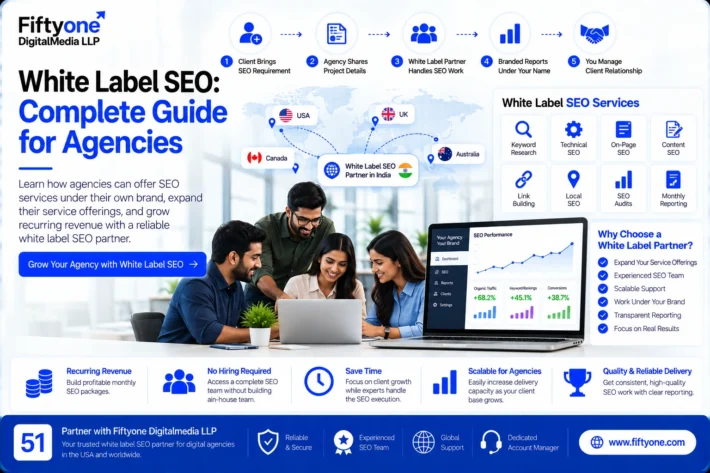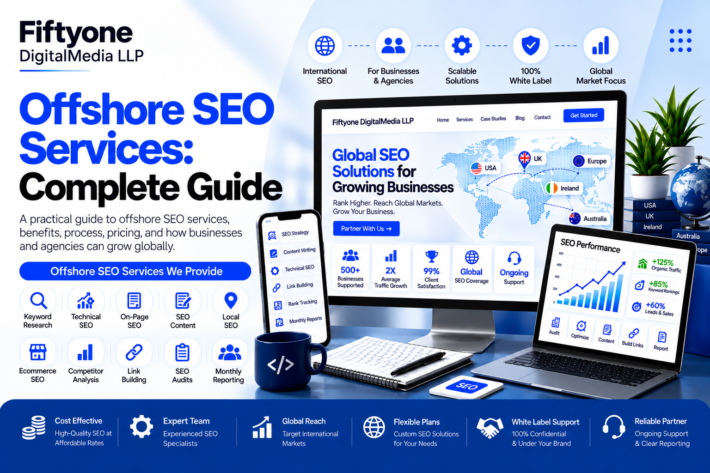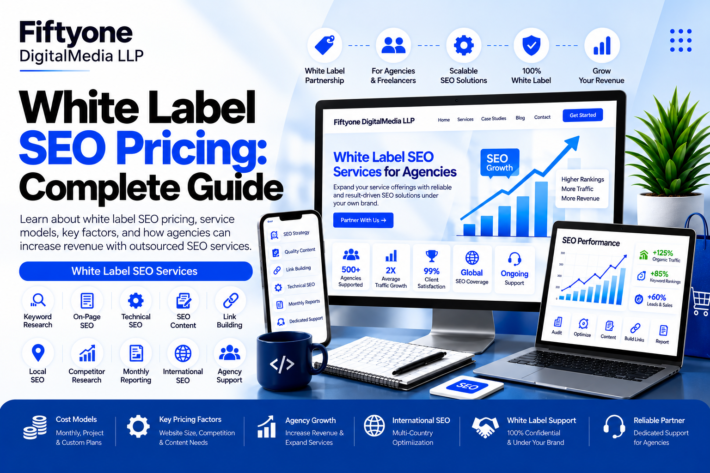
SEO Outsourcing Services for Growing Agencies

Introduction
Growing digital agencies eventually face a capacity problem. Winning more SEO clients increases revenue potential, but every new account also creates additional keyword research, technical audits, content optimization, competitor analysis, reporting, link acquisition, and campaign management work. When internal resources cannot keep pace with sales, delivery quality starts declining.
Hiring additional full-time SEO specialists is one solution, but recruitment, salaries, training, tools, management, and long-term employment costs can make rapid expansion expensive. SEO Outsourcing Services for Growing Agencie provide an alternative by allowing agencies to increase execution capacity without building every SEO function internally.
Fiftyone Digitalmedia LLP supports agencies that need additional SEO resources while maintaining control over their client relationships, strategy, pricing, and brand positioning.
What Are SEO Outsourcing Services?
SEO outsourcing means assigning some or all search engine optimization activities to an external specialist or agency. The outsourcing provider can handle specific execution tasks or operate as an extended SEO department depending on the agency’s requirements.
An agency might retain strategy and client communication internally while outsourcing technical audits, keyword research, content briefs, on-page optimization, link building, and reporting. Other agencies may outsource almost the complete campaign while maintaining account management internally.
The correct structure depends on the agency’s existing capabilities. Outsourcing should fill genuine resource or expertise gaps rather than adding another unnecessary management layer.
Why Growing Agencies Outsource SEO
Agency workloads do not increase evenly. One new client may require a relatively small local SEO campaign, while another can involve hundreds of pages, technical problems, aggressive competitors, and substantial content requirements.
Maintaining enough permanent employees for maximum workload creates unnecessary fixed costs during slower periods. Outsourcing gives agencies greater control over how resources are allocated.
Major reasons include:
- Increasing client workloads
- Limited internal SEO capacity
- Expensive recruitment
- Need for specialized expertise
- Growing content requirements
- Technical SEO demands
- Increasing reporting workloads
- Need for scalable resources
- Pressure to meet deadlines
- Expansion into additional SEO services
The model becomes particularly useful when sales growth is stronger than the agency’s existing delivery capacity.
Scale SEO Capacity Without Continuous Hiring
Recruitment is slow compared with client acquisition. An agency can close several new SEO contracts within weeks but may need significantly longer to recruit, evaluate, hire, and train suitable SEO specialists.
Outsourcing reduces this dependency. Agencies can access additional execution resources according to active client requirements and expand capacity as their account base grows.
This does not mean agencies should eliminate internal expertise. A hybrid model can be stronger, with internal employees controlling strategy, quality, and client communication while an outsourced team handles execution-heavy activities.
Fiftyone Digitalmedia LLP can operate within this structure by supporting recurring SEO activities without requiring agencies to continuously increase permanent headcount.
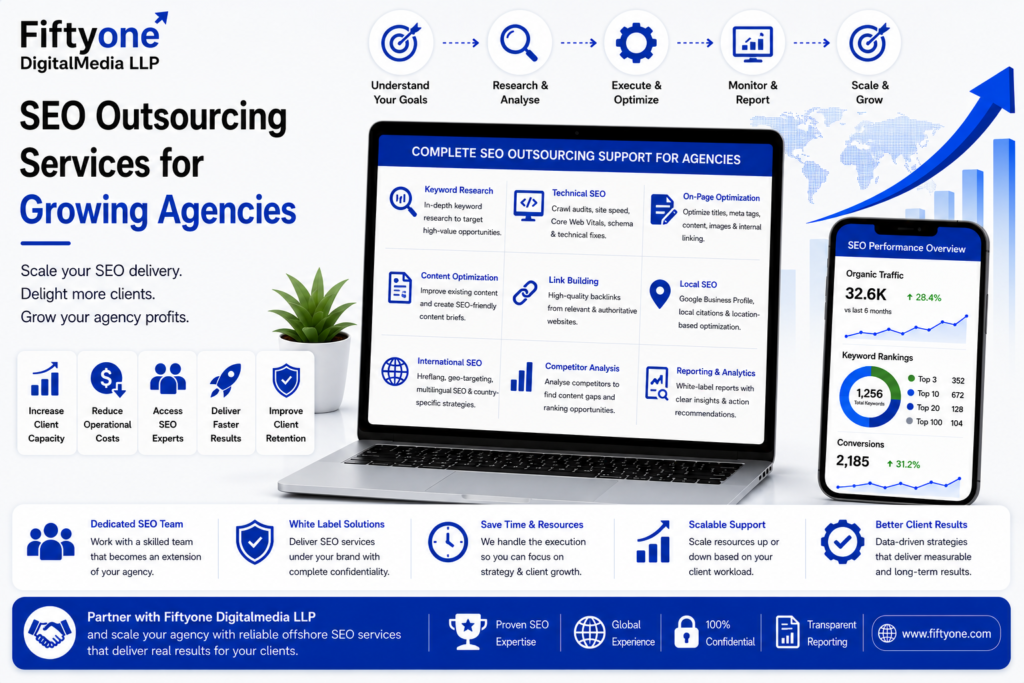
SEO Activities Agencies Can Outsource
SEO contains multiple disciplines, and expecting one employee to perform every function at a high level is unrealistic. Outsourcing allows agencies to distribute specialized work more effectively.
Common outsourced activities include:
- Keyword research
- Competitor analysis
- Technical SEO audits
- On-page SEO
- Content optimization
- SEO content briefs
- Internal linking
- Local SEO
- International SEO
- Link-building support
- SEO reporting
- Website performance analysis
Agencies should decide which responsibilities remain internal before assigning work externally. Unclear ownership creates duplicated work and missed tasks.
Reduce Fixed SEO Operating Costs
Building a complete internal SEO department involves more than employee salaries. Agencies also need SEO software, training, management, recruitment, onboarding, and specialist resources for different campaign requirements.
Outsourcing can convert some of these fixed costs into more flexible campaign expenses. Resources can be allocated according to the number and complexity of active client accounts.
Potential cost efficiencies come from:
- Lower recruitment requirements
- Reduced onboarding expenses
- Flexible resource allocation
- Access to existing SEO tools and processes
- Less internal training
- Reduced specialist hiring
- Better workload distribution
- Lower long-term staffing commitments
Cheap outsourcing is not automatically cost-effective. Poor SEO work that requires internal correction creates additional expense and damages client retention.
Access Specialized SEO Expertise
A growing agency can manage clients from completely different industries. One campaign may require ecommerce SEO, another international optimization, another local search, and another complex technical SEO.
Building internal expertise for every possible scenario requires a large team. Outsourcing gives agencies access to specialists when those capabilities are required.
For example, an agency may need additional expertise for JavaScript SEO, ecommerce architecture, international targeting, technical migrations, structured data, content strategy, or competitor analysis without needing those specialists full time.
Fiftyone Digitalmedia LLP can support agencies across different SEO requirements while allowing internal teams to retain campaign oversight.
Improve SEO Delivery Consistency
Scaling an agency without improving operational systems creates inconsistent service. When SEO specialists become overloaded, audits become rushed, optimization tasks remain incomplete, reports arrive late, and account managers spend more time fixing delivery problems.
A structured outsourcing relationship can distribute workload before internal teams reach that stage. However, the agency must establish clear standards for every outsourced deliverable.
SEO processes should define:
- Required research depth
- Audit standards
- Optimization checklists
- Content requirements
- Link quality standards
- Reporting formats
- Approval procedures
- Delivery deadlines
Standardization allows outsourced specialists to work within the agency’s existing service model rather than producing completely different deliverables for every client.
Protect Client Relationships While Outsourcing SEO
Agencies sometimes avoid outsourcing because they fear losing control over their clients. That risk should be addressed through the structure of the partnership.
The agency can remain responsible for account management, strategy discussions, proposals, pricing, and client communication while the outsourced SEO team works behind the scenes.
Important safeguards include:
- NDA agreements
- Client ownership terms
- Confidentiality requirements
- Controlled account access
- Defined communication procedures
- Data protection practices
- Clear responsibility boundaries
- Agency approval before delivery
A professional outsourcing provider should strengthen the agency’s delivery capability rather than attempt to replace its relationship with the customer.
SEO Outsourcing vs Building an In-House Team
An in-house SEO team can be appropriate when an agency has predictable workloads and enough recurring revenue to support permanent specialists. It provides direct control and can simplify communication.
The limitation appears when workloads change rapidly or clients require expertise outside the team’s capabilities. Hiring every specialist internally increases fixed expenses and management requirements.
SEO outsourcing offers greater resource flexibility. Agencies can maintain a core internal team while using external specialists for additional execution capacity, technical requirements, or periods of unusually high workload.
Neither model should be selected blindly. The correct structure depends on client volume, margins, service complexity, internal expertise, and growth plans.
SEO Outsourcing vs Freelancers
Individual freelancers can work effectively for specific tasks, but using several disconnected freelancers to manage a growing SEO operation creates management problems. Availability varies, processes differ, and quality standards can become inconsistent.
A structured outsourcing company can provide multiple SEO capabilities through a single relationship. This can simplify resource management when the agency handles numerous accounts.
The advantage becomes stronger when campaigns require technical SEO, content optimization, research, reporting, and other activities simultaneously. Agencies need predictable delivery rather than constantly searching for another freelancer whenever requirements change.
Why Fiftyone Digitalmedia LLP
SEO outsourcing needs to solve a capacity problem without creating a quality-control problem. Fiftyone Digitalmedia LLP works with agencies requiring additional SEO execution resources while allowing them to retain ownership of client strategy and relationships.
Support can be structured around technical SEO, research, on-page optimization, content improvement, reporting, and other recurring campaign requirements.
The objective is to provide agencies with scalable SEO capacity that can expand as client workloads increase instead of forcing every stage of growth to depend on permanent recruitment.
How to Build an Effective SEO Outsourcing Workflow
SEO outsourcing becomes inefficient when agencies assign tasks without a defined workflow. Keyword research, technical recommendations, content optimization, link-building activities, approvals, and reporting need clear ownership. Otherwise, internal and external teams duplicate work or assume the other team is responsible.
The agency should decide which activities remain internal and which are handled by the outsourced SEO team. Fiftyone Digitalmedia LLP can work as an extension of an agency’s existing SEO operation, allowing account managers and strategists to retain control while execution tasks are distributed across additional resources.
Maintain Quality While Scaling SEO Campaigns
Adding more SEO resources does not automatically improve campaign performance. Agencies need documented standards that remain consistent regardless of how many client accounts are being managed.
Quality control should cover:
- Keyword relevance and search intent
- Technical SEO recommendations
- On-page optimization
- Content quality
- Internal linking
- Link relevance
- Competitor research
- Reporting accuracy
- Client-specific requirements
- Final deliverable reviews
The agency should review outsourced work until the external team consistently understands its expectations. Removing quality checks too early creates unnecessary client risk.
Create Clear SEO Reporting Standards
Reporting becomes increasingly difficult as an agency adds clients. Every campaign generates ranking data, organic traffic information, conversions, technical issues, completed activities, and future recommendations.
A standardized reporting process can reduce this workload while making campaign performance easier to compare.
Reports should explain:
- Organic clicks and impressions
- Keyword visibility
- Landing-page performance
- Organic conversions
- Technical SEO progress
- Content performance
- Completed optimization work
- Backlink development
- Important changes
- Priorities for the next period
Reports should not be filled with metrics simply to make them appear detailed. Every reported metric should help the agency or client understand performance.
Use Outsourcing to Improve Agency Profitability
Agency growth is useless if delivery expenses increase at the same rate as revenue. Hiring permanent employees for every new SEO account can reduce margins, particularly when workloads fluctuate.
SEO outsourcing allows agencies to align some delivery expenses more closely with active client work. This can create a more flexible cost structure while allowing the agency to continue increasing account capacity.
However, profitability depends on efficiency. Outsourcing work that repeatedly requires internal correction adds another layer of cost rather than reducing it. Fiftyone Digitalmedia LLP can support agencies with recurring SEO execution where responsibilities and quality expectations are established before campaigns scale.
White Label SEO and Agency Branding
Some agencies want outsourced SEO support without introducing another company into the client relationship. White label SEO can support this structure by allowing the external team to work behind the scenes while the agency remains client-facing.
This arrangement can help agencies:
- Maintain their own branding
- Control client communication
- Set their own pricing
- Expand SEO capacity
- Add specialist services
- Handle larger accounts
- Reduce recruitment requirements
- Maintain ownership of customer relationships
Confidentiality and client ownership terms should be documented before work begins.
Common SEO Outsourcing Mistakes
Outsourcing cannot repair a poorly structured agency. If requirements, responsibilities, deadlines, and quality standards are unclear internally, transferring work to another team usually increases confusion.
Another major mistake is choosing providers based exclusively on price. Cheap SEO services can involve weak content, irrelevant backlinks, automated audits, and generic optimization that provides little value.
Agencies should avoid:
- Unrealistic ranking guarantees
- Unclear deliverables
- Poor communication
- Generic SEO strategies
- Low-quality backlinks
- Keyword stuffing
- Unreviewed content
- Weak technical analysis
- Inconsistent reporting
- No quality assurance
A provider should be able to explain what it is doing, why the activity matters, and how the work fits into the campaign strategy.
How to Choose an SEO Outsourcing Partner
An SEO outsourcing provider should be evaluated as a long-term delivery partner rather than a temporary source of cheap labour. Technical knowledge matters, but communication, reliability, transparency, and scalability are equally important when the provider will support multiple client accounts.
Evaluate:
- SEO experience
- Technical SEO capability
- Content standards
- Link-building methods
- Reporting processes
- Communication quality
- Confidentiality
- Resource capacity
- Turnaround times
- Pricing transparency
- Scalability
- Long-term support
Agencies should also review sample deliverables before committing several client campaigns to the same provider.
Communication Between Internal and Outsourced Teams
Good outsourcing requires predictable communication rather than constant meetings. Everyone involved should know where tasks are assigned, where requirements are documented, who approves completed work, and how urgent problems are escalated.
One primary contact on each side can prevent contradictory instructions. Agencies should also use consistent task-management and reporting processes instead of spreading project information across multiple communication channels.
As the relationship develops, Fiftyone Digitalmedia LLP can become familiar with the agency’s preferred processes, reducing repeated explanations across recurring SEO campaigns.
When Should a Growing Agency Outsource SEO?
Agencies should consider outsourcing before delivery problems become severe. Waiting until internal employees are overloaded can result in missed deadlines, rushed optimization, weak reporting, and declining client satisfaction.
SEO outsourcing becomes particularly relevant when:
- New client acquisition is increasing
- Internal specialists are overloaded
- Reporting deadlines are being missed
- Technical SEO requirements are increasing
- Content workloads are expanding
- Specialist skills are unavailable internally
- Recruitment is taking too long
- SEO margins are declining
- The agency wants to expand services
Outsourcing should solve an identified capacity or expertise problem. It should not be introduced simply because outsourcing is cheaper in theory.
Building Long-Term SEO Outsourcing Relationships
Switching SEO providers repeatedly creates its own operational cost. Every new team needs to understand the agency’s processes, clients, reporting requirements, quality standards, and communication expectations.
A long-term outsourcing relationship can become more efficient because the external team develops knowledge of how the agency operates. Repeated tasks become easier to standardize, turnaround expectations become clearer, and less management time is required for routine execution.
Fiftyone Digitalmedia LLP focuses on providing scalable SEO support that can operate alongside an agency’s internal resources as campaign volume increases.
Frequently Asked Questions
What are SEO outsourcing services?
SEO outsourcing involves assigning SEO activities such as keyword research, technical optimization, content improvement, reporting, and other campaign tasks to an external SEO team.
Why do growing agencies outsource SEO?
Growing agencies use outsourcing to increase delivery capacity, access specialized expertise, reduce recruitment pressure, and manage increasing client workloads.
Can agencies outsource SEO without losing clients?
Yes. Responsibilities, confidentiality, client ownership, and communication procedures should be clearly defined before the outsourcing relationship begins.
Is SEO outsourcing cheaper than hiring internally?
It can reduce fixed recruitment and staffing requirements, but actual savings depend on workload, provider pricing, campaign complexity, and internal management requirements.
What SEO tasks can agencies outsource?
Keyword research, technical SEO, competitor research, on-page optimization, content optimization, link-building support, local SEO, international SEO, and reporting can all be outsourced.
Conclusion
SEO Outsourcing Services for Growing Agencie can provide the additional execution capacity required to manage increasing client workloads without making every stage of agency growth dependent on permanent recruitment.
The model works when agencies maintain control over strategy and quality while establishing clear processes for outsourced execution. Communication, technical capability, content standards, reporting, confidentiality, and accountability should all be evaluated before selecting a provider.
A properly structured outsourcing relationship can help agencies increase account capacity while maintaining a more flexible operational model.
Scale Your SEO Delivery Capacity
Fiftyone Digitalmedia LLP provides SEO outsourcing support for agencies requiring additional resources across technical SEO, research, optimization, content, reporting, and recurring campaign execution. The goal is to expand delivery capacity while allowing the agency to retain control over its clients, strategy, and brand.