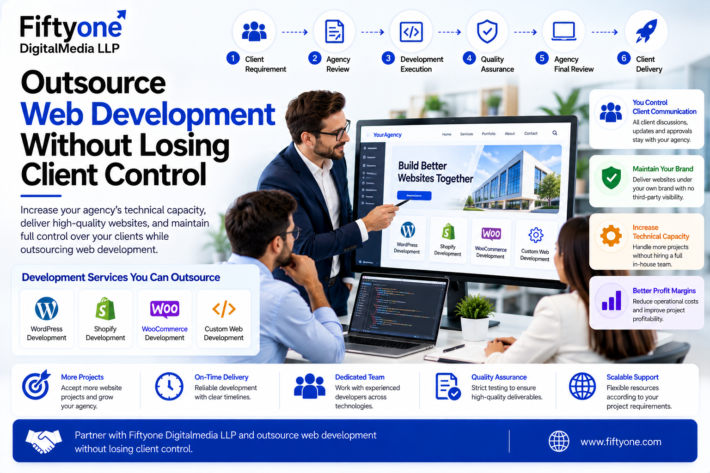
Offshore Web Development Company in India: What US/UK Businesses Should Check Before Hiring


Introduction
Hiring an offshore web development company in India can give businesses in the United States and United Kingdom access to additional technical expertise without building an entire development team internally. However, choosing the right partner requires more than comparing hourly rates or reviewing a company’s website.
The wrong development partner can create problems such as missed deadlines, unclear communication, poor code quality, unexpected costs, security risks, and difficulties after launch.
Before signing an agreement, businesses should evaluate the company’s technical capabilities, previous work, project management process, security practices, ownership terms, and ongoing support.
This guide explains 10 important checks US and UK businesses should complete before hiring an offshore web development company in India.
1. Check Whether the Company Has Relevant Project Experience
A development company may have an impressive portfolio, but that does not automatically mean it has experience with your type of project.
For example, a company that mainly develops WordPress business websites may not be the right choice for a complex ecommerce platform or a custom web application.
Look for experience that matches your actual requirements.
Before hiring, check:
- Similar projects completed in your industry
- Experience with your required technology
- Examples of custom functionality
- Ecommerce or third-party integration experience, if required
- Responsive website development
- Experience handling ongoing development and maintenance
Ask the company to explain its role in the projects shown in its portfolio. Find out which features were developed internally, what challenges were handled, and what responsibilities were managed by the client.
Do not judge a development partner only by the number of portfolio items. Relevant experience is more useful than a large collection of unrelated screenshots.
2. Verify Technical Expertise Before Assigning the Project
Your development partner should have the technical skills required to build and maintain the website.
Different projects require different technologies. A WordPress website, Shopify store, Laravel application, and React-based web application do not have identical development requirements.
Ask the company which technologies it uses and whether the proposed team has practical experience with your project requirements.
Depending on your project, relevant skills may include:
- WordPress and WooCommerce
- Shopify and custom ecommerce development
- PHP and Laravel
- React and JavaScript
- HTML5 and CSS3
- API and third-party integrations
- Database development
- Website security and performance optimization
Do not accept a technology list as proof of expertise.
Ask technical questions related to your project. You can also request a small paid technical assessment or review a relevant development sample before committing to a larger engagement.
The objective is to verify that the team can solve your actual technical problems rather than simply claim experience with popular technologies.
3. Review the Development Process and Project Management System
A reliable development company should be able to explain how a project moves from the initial discussion to final delivery.
If the development process is unclear, it becomes difficult to understand responsibilities, monitor progress, or identify delays.
Before hiring, ask the company to explain its workflow.
A structured development process should generally include:
- Requirement discussion and project discovery.
- Scope definition and technical planning.
- Design approval and development preparation.
- Frontend and backend development.
- Regular progress reviews.
- Quality assurance and testing.
- Client review and feedback.
- Final deployment and handover.
- Post-launch support, according to the agreement.
Also ask how tasks are assigned and tracked.
Tools such as Jira, Trello, Asana, or similar project management platforms can help make project progress visible. The particular tool matters less than having a consistent process that both parties understand.
You should know what is completed, what is pending, who is responsible, and whether the project remains on schedule.
4. Confirm Communication and Time-Zone Overlap
Communication is one of the most important factors when working with an offshore development company.
Businesses in the US and UK may have working hours that differ significantly from those of their Indian development partners. Without agreed communication arrangements, questions and approvals can take longer than expected.
Before hiring, confirm:
- Who will be your main point of contact?
- What communication channels will be used?
- How frequently will progress updates be shared?
- Which hours will overlap with your business hours?
- How quickly will urgent issues be acknowledged?
- Who handles technical questions and project escalations?
For example, a US business may need a scheduled daily overlap window, while a UK business may prefer regular meetings during compatible working hours.
Do not rely on statements such as “We provide 24/7 support” unless the company explains what that actually includes.
Agree on communication hours, response expectations, meeting frequency, and escalation procedures before development begins.
5. Check NDA, Data Security, and Confidentiality Practices
Your development partner may need access to source code, hosting accounts, customer information, business documents, and other sensitive project resources.
This makes security and confidentiality important parts of the hiring decision.
Before sharing access, ask how the company protects project information.
Review the following areas:
- Non-disclosure agreement (NDA)
- Access permissions for team members
- Secure password and credential sharing
- Repository access controls
- Data backup procedures
- Employee and contractor access policies
- Procedures for removing access after a project ends
- Incident reporting and security responsibilities
US and UK businesses should also review the data protection requirements applicable to their own operations and the information being handled.
For example, if personal data is processed for UK customers, determine whether UK GDPR requirements apply and clarify the respective responsibilities of the business and its service provider. For US projects, applicable federal and state privacy requirements may differ depending on the data and business activities.
Do not assume that signing an NDA automatically makes a development arrangement compliant with every applicable privacy or security requirement.
Document who can access the data, why access is required, how it is protected, and what happens when the engagement ends.
6. Clarify Source Code Ownership and Intellectual Property Rights
One of the most important issues to resolve before hiring an offshore web development company is ownership of the completed work.
A website project may include source code, design files, graphics, database structures, documentation, custom plugins, and other development assets.
If ownership terms are unclear, transferring the project to another development team later can become difficult.
Your agreement should clearly explain:
- Who owns the source code?
- Who owns custom designs and development assets?
- When does ownership transfer?
- Will the client receive repository access?
- Are third-party libraries or licensed components being used?
- Will the company provide technical documentation?
- What happens to project files after contract termination?
For US and UK businesses, the contract should clearly address intellectual property assignment and any relevant third-party licensing restrictions.
Do not assume that paying the final invoice automatically resolves every ownership question.
Ask for written confirmation of ownership and handover requirements before the project begins.
7. Understand Pricing, Scope, and Additional Development Costs
A low initial quotation does not always mean a lower final project cost.
Development costs can change when requirements are unclear, additional features are requested, integrations become more complicated, or revisions fall outside the original agreement.
Before approving a quotation, check what is actually included.
| Pricing element | What you should confirm |
|---|---|
| Initial development | Features and deliverables included |
| Design | Number of pages and design revisions |
| Integrations | Third-party services and API work |
| Testing | Browser, device, and functionality testing |
| Content | Who provides and uploads content |
| Deployment | Hosting setup and website launch |
| Maintenance | Included support period and exclusions |
| Additional work | Hourly rates or change-request charges |
Ask whether the company charges hourly, monthly, or through a fixed-price project agreement.
A fixed-price model can work when requirements are clearly defined. A dedicated team may be more suitable when development priorities are expected to change regularly.
For a more detailed comparison, read our guide on Offshore Web Development: Dedicated Team vs Fixed Price Projects.
Compare the complete commercial arrangement rather than selecting a provider only because its starting quotation is lower.
8. Evaluate Quality Assurance and Testing Standards
A website that looks complete during a demonstration may still contain problems that affect real users.
Broken forms, incorrect layouts, payment issues, browser compatibility problems, and integration errors can create difficulties after launch.
Ask the development company how it tests projects before delivery.
A suitable testing process should consider:
- Desktop and mobile responsiveness
- Major browser compatibility
- Forms and enquiry submissions
- Navigation and internal links
- Ecommerce checkout and payment workflows
- API and third-party integrations
- Page functionality
- Basic security checks
- Performance issues
- Error handling
For complex applications, testing should also cover user permissions, database operations, authentication, and important business workflows.
Ask whether defects are documented, how they are prioritized, and what happens when a problem is discovered after client approval.
A development company should be able to explain how it verifies that the agreed requirements have been completed.
9. Confirm Delivery Timelines, Milestones, and Revision Rules
A development company should not provide a delivery date without understanding the project scope.
Timelines depend on the number of pages, design complexity, functionality, integrations, content readiness, approval cycles, and testing requirements.
Before starting, ask for a project timeline with clearly defined milestones.
For example:
| Project stage | Expected activity |
|---|---|
| Discovery | Requirements and scope approval |
| Design | Wireframes and visual design |
| Development | Frontend and backend implementation |
| Testing | Functionality and responsive checks |
| Review | Client feedback and agreed revisions |
| Deployment | Final launch and handover |
The actual schedule should be agreed according to the project.
Also clarify:
- How many revision rounds are included?
- What counts as a scope change?
- What happens if the client delays approvals?
- How are unexpected technical issues handled?
- What happens if a milestone is missed?
- Who approves each stage?
A written milestone plan reduces misunderstandings and gives both parties a common reference for project progress.
10. Check Post-Launch Support and Long-Term Availability
Launching a website is not necessarily the end of development work.
After launch, businesses may need bug fixes, security updates, feature improvements, performance monitoring, hosting assistance, or integration changes.
Before hiring, understand what support the company provides after delivery.
Ask these questions:
- Is a post-launch warranty included?
- How long does the included support period last?
- Which issues are covered?
- Are new features charged separately?
- Is ongoing maintenance available?
- How are urgent problems handled?
- Can the original development team continue supporting the project?
Also confirm whether the business can access the website, hosting environment, domain, source code, and other essential accounts independently.
A good handover process should not make your business permanently dependent on a single provider.
Red Flags to Watch for Before Hiring an Offshore Development Company
Even when a company offers attractive pricing, certain warning signs should make you investigate further.
Watch for these issues:
- Guaranteed delivery dates without reviewing project requirements.
- Extremely low quotations with no clear scope.
- No relevant portfolio or verifiable project examples.
- Refusal to explain who will actually work on your project.
- No written agreement covering deliverables and ownership.
- Unclear security and confidentiality procedures.
- No structured testing or quality assurance process.
- Vague communication and inconsistent progress updates.
- No clear handover process.
- Pressure to make a large payment before agreeing on project details.
One warning sign does not automatically prove that a company is unreliable. However, several of these issues together indicate that you should not proceed without further verification.
Offshore Web Development Company Hiring Checklist
Use this checklist before signing an agreement with an offshore development partner.
- Reviewed relevant portfolio projects.
- Verified experience with the required technology.
- Understood the development workflow.
- Identified the project manager or main contact.
- Agreed on communication hours and reporting.
- Reviewed NDA and security procedures.
- Confirmed source code and intellectual property ownership.
- Received a detailed quotation and project scope.
- Agreed on testing and quality standards.
- Defined milestones and revision terms.
- Confirmed post-launch support.
- Reviewed the contract before making payment.
If important items remain unanswered, resolve them before transferring project access or approving the engagement.
Why Consider Fiftyone Digitalmedia LLP for Offshore Web Development?
Fiftyone Digitalmedia LLP provides offshore web development support for businesses and agencies looking for technical resources in India.
Depending on project requirements, development support can include:
- WordPress website development
- WooCommerce development
- Shopify development
- Custom website development
- Laravel development
- React development
- API and third-party integrations
- Website maintenance and technical support
The engagement structure should depend on the project’s scope, required skills, timeline, and expected workload.
Businesses should discuss their requirements, review relevant work, clarify deliverables, and understand the proposed development process before starting a project.
The objective is to establish a development arrangement with clear responsibilities, communication, quality expectations, and ownership terms.
Frequently Asked Questions
Why do US and UK businesses hire offshore web development companies in India?
Businesses may consider offshore development to access technical expertise, add development capacity, and manage project costs without immediately building a larger internal team. The suitability of the model depends on project requirements, provider quality, communication, and management.
How do I choose an offshore web development company in India?
Review the company’s relevant experience, technical capabilities, portfolio, project management process, communication standards, security practices, ownership terms, pricing, testing procedures, and post-launch support before signing an agreement.
Is offshore web development suitable for small businesses?
It can be suitable for small businesses that need website development or specialist technical support without hiring a permanent internal team. The project scope and budget should be clearly defined before work begins.
How can I protect my website source code when working with an offshore company?
Use a written agreement that clearly defines intellectual property ownership, source code transfer, repository access, third-party licensing, confidentiality, and project handover requirements.
What should an offshore web development contract include?
A contract should explain the project scope, deliverables, payment terms, milestones, responsibilities, revision limits, intellectual property rights, confidentiality, security obligations, termination terms, and post-launch support.
How do time-zone differences affect offshore development?
Time-zone differences can affect meetings, feedback, and approvals if communication arrangements are not planned. Agreed overlap hours, scheduled updates, documentation, and a dedicated point of contact can make collaboration easier.
Should I choose a fixed-price project or a dedicated development team?
A fixed-price project is generally more appropriate when the requirements and deliverables can be defined in advance. A dedicated team may be more suitable when development is ongoing and priorities change. The decision should depend on the project’s scope and expected workload.
What happens after an offshore development project is completed?
The provider should complete the agreed handover, transfer the required project assets and access, document relevant technical details, and provide any post-launch support included in the contract.
Conclusion
Choosing an offshore web development company in India requires more than comparing prices, portfolios, or promised delivery timelines.
US and UK businesses should carefully evaluate technical experience, communication, project management, data security, intellectual property ownership, testing standards, contractual terms, and post-launch support.
The most suitable development partner is one that understands your requirements, explains its process clearly, documents responsibilities, and provides a reliable way to monitor project progress.
Before making a hiring decision, use the checklist in this guide to compare potential providers and identify risks before they become expensive problems.
Fiftyone Digitalmedia LLP supports businesses and agencies with offshore web development services across different technologies and project requirements. Discuss your project scope and expectations before choosing an engagement model.