White Label SEO Agency for Digital Agencies

Introduction
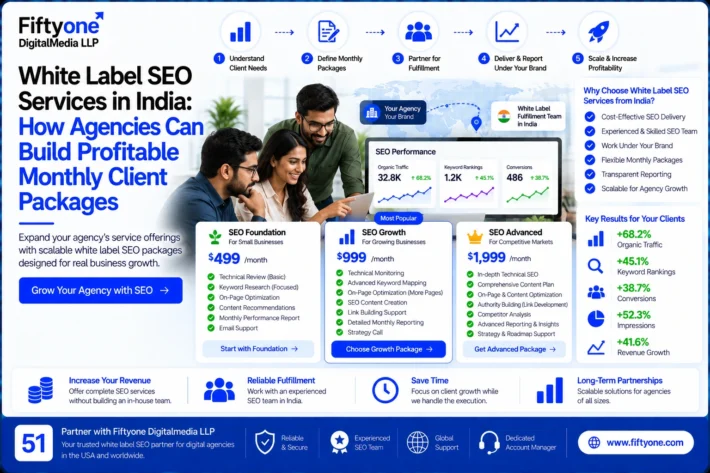
Digital agencies often reach a point where acquiring new SEO clients becomes easier than delivering consistent results across every account. Each new campaign requires keyword research, technical SEO, competitor analysis, content optimization, reporting, link building, and continuous monitoring. When internal SEO resources are limited, increasing client volume can quickly create delivery problems.
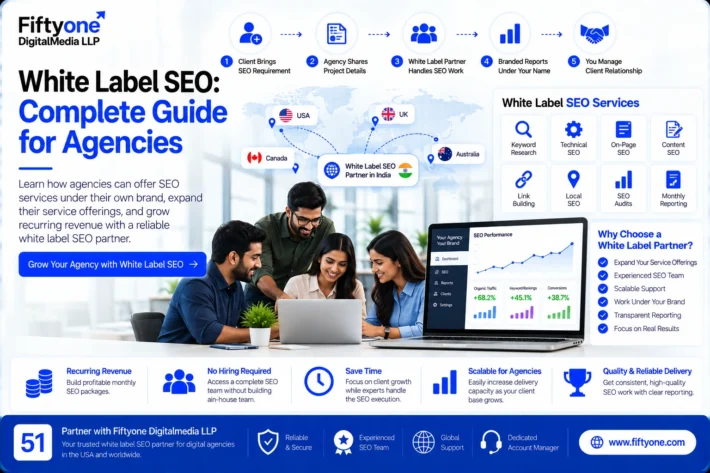
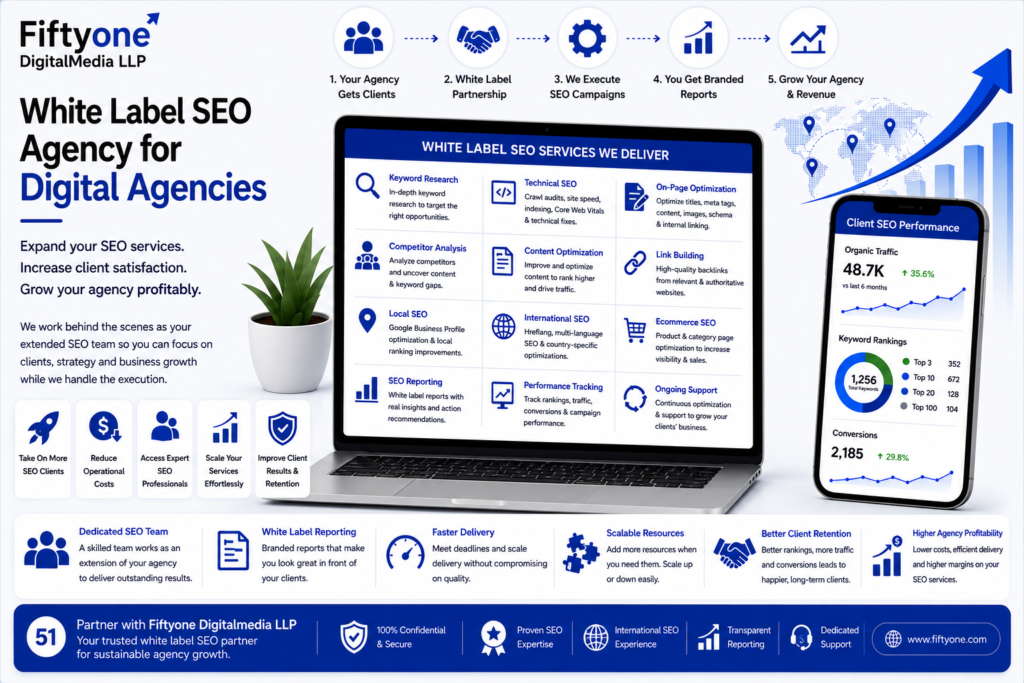
Working with a White Label SEO Agency for Digital Agencies allows agencies to expand their SEO capabilities without building a large internal department. The white label team handles agreed SEO activities behind the scenes while the digital agency retains its branding, pricing, strategy, and client relationships.
Fiftyone Digitalmedia LLP supports digital agencies with scalable SEO execution designed to increase delivery capacity without forcing agencies to continuously recruit additional SEO specialists.
What Is a White Label SEO Agency?
A white label SEO agency provides search engine optimization services that another digital agency can sell under its own brand. The end client continues working with the digital agency while the white label partner performs some or all of the SEO work behind the scenes.
The arrangement can be customized according to existing internal resources. Some agencies outsource technical SEO and content optimization while maintaining strategy internally. Others use a white label team for complete campaign execution and retain only account management and client communication.
The objective is not to remove the agency from the SEO process. It is to provide additional execution capacity while allowing the agency to maintain ownership of the customer relationship.
White Label SEO Services Agencies Can Outsource
A capable white label SEO partner should support multiple areas of organic search rather than relying on a single standardized package.
- Keyword research
- Competitor analysis
- Technical SEO audits
- On-page optimization
- Content optimization
- SEO content planning
- Internal linking
- Local SEO
- Ecommerce SEO
- International SEO
- Link-building support
- SEO reporting
Agencies should determine exactly which responsibilities are outsourced before campaigns begin. Clear ownership prevents duplicated tasks and missed deliverables.
Why Digital Agencies Choose White Label SEO
Building an internal SEO department requires specialists across several disciplines. Technical SEO, content strategy, keyword research, analytics, outreach, and account management require different skills. Hiring enough employees to cover every capability can become expensive, particularly when client workloads fluctuate.
White label SEO gives agencies access to additional resources according to actual campaign demand. The agency can increase capacity as new clients arrive without immediately creating permanent staffing commitments.
This approach can help agencies:
- Accept more SEO clients
- Expand their SEO services
- Reduce recruitment pressure
- Access specialized expertise
- Improve delivery capacity
- Manage peak workloads
- Maintain agency branding
- Reduce fixed operating expenses
- Support larger SEO accounts
- Build recurring service revenue
Maintain Complete Control of Your Agency Brand
The defining feature of white label SEO is that the digital agency remains the client-facing business. The external SEO provider operates behind the scenes according to the agreed partnership structure.
The agency can continue controlling proposals, pricing, strategy discussions, account management, and customer communication. Reports and deliverables can then be reviewed before they are presented to clients.
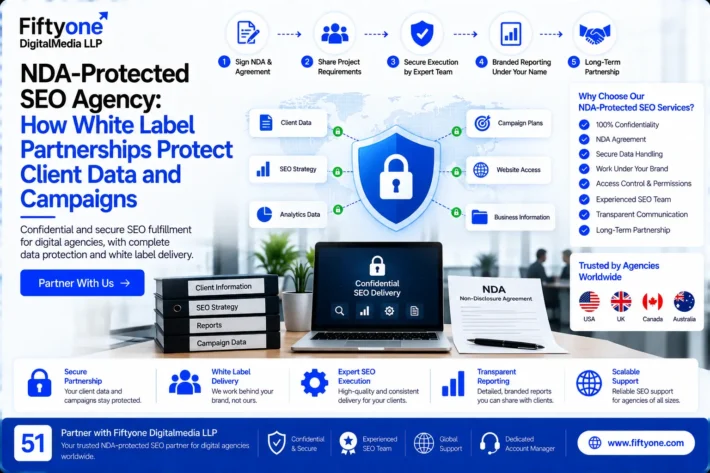
Confidentiality should be established contractually. NDAs, client ownership clauses, access permissions, and communication procedures reduce the risk of confusion between the agency, white label provider, and end customer.
Fiftyone Digitalmedia LLP can work within this type of agency-controlled structure, providing SEO execution while the digital agency retains its market identity.
Scale SEO Services Without Continuous Recruitment
Recruiting SEO specialists takes time. Agencies need to advertise positions, review candidates, conduct interviews, complete onboarding, provide tools, and train employees according to internal processes. These expenses occur before the new employee becomes fully productive.
White label SEO reduces dependency on that recruitment cycle. Agencies can access established SEO resources and allocate work according to campaign requirements.
This becomes particularly useful when growth is unpredictable. An agency may acquire several SEO accounts within one month and very few during another. Maintaining maximum internal capacity throughout the year can reduce profitability.
White label resources provide a more flexible structure where SEO capacity can expand alongside active client workloads.
White Label SEO vs In-House SEO Teams
An in-house SEO team provides direct control and can be effective for agencies with stable client volumes. Employees become familiar with internal processes and can collaborate closely with account managers.
The problem appears when workloads increase faster than recruitment or when campaigns require specialist knowledge unavailable internally.
White label SEO can complement rather than completely replace an internal team. Agencies can maintain strategists and senior SEO professionals internally while outsourcing execution-heavy activities.
This hybrid model can provide:
- Internal strategic control
- External execution capacity
- Flexible specialist access
- Reduced recruitment requirements
- Better workload distribution
- Greater scalability
The correct structure depends on agency size, client volume, margins, internal expertise, and long-term growth plans.
White Label SEO vs Freelancers
Freelancers can be effective for specific SEO tasks, but depending on several independent freelancers creates operational complexity as an agency grows. Different professionals may use different tools, processes, reporting formats, and quality standards.
Availability is another problem. A freelancer who supports an agency today may not have enough capacity when several new client campaigns begin simultaneously.
A structured white label SEO agency provides multiple SEO capabilities through one relationship. This can simplify project management and create more consistent standards across keyword research, technical SEO, optimization, content, and reporting.
Quality Control in White Label SEO
The digital agency remains responsible for what its clients receive. Outsourcing SEO does not transfer reputational risk to the white label provider.
Agencies therefore need quality-control procedures before client delivery.
Important areas include:
- Keyword relevance
- Search intent
- Technical recommendations
- Content accuracy
- On-page implementation
- Internal linking
- Link quality
- Reporting accuracy
- Client-specific requirements
- Final campaign reviews
White label deliverables should initially be reviewed closely. As the external team becomes familiar with agency standards, routine execution can become more efficient.
Protect Client Relationships and Confidential Information
A white label partner may receive access to websites, analytics accounts, Search Console, SEO tools, client documentation, content systems, and other business information.
Agencies should establish:
- NDA requirements
- Client ownership terms
- Account permissions
- Secure credential sharing
- Confidentiality procedures
- Data-access restrictions
- Communication boundaries
- Access removal procedures
A professional white label SEO provider should understand that protecting the agency-client relationship is part of the service.
Why Fiftyone Digitalmedia LLP
A white label SEO partnership needs to provide additional capacity without creating additional management problems. Fiftyone Digitalmedia LLP works with agencies requiring scalable SEO execution across research, technical optimization, content improvement, on-page SEO, reporting, and other recurring campaign activities.
The agency can retain strategic control and direct customer relationships while Fiftyone Digitalmedia LLP provides agreed SEO resources behind the scenes.
This structure is designed for agencies that want to expand SEO delivery without making permanent recruitment the only option whenever client demand increases.
White Label SEO Pricing Models
White label SEO pricing should match the way an agency sells and manages its client services. A fixed monthly model can work for recurring SEO campaigns, while task-based pricing may be more suitable for technical audits, keyword research, content optimization, or one-time projects. Dedicated-resource models become useful when an agency has enough recurring work to require continuous SEO execution.
The cheapest package is not automatically the most profitable. Agencies need to calculate management time, revisions, quality control, tools, communication, and reporting alongside the outsourcing fee. A slightly higher-cost partner that consistently delivers usable work can produce better margins than a cheap provider whose work needs constant correction.
White Label SEO Reporting for Clients
Reporting is one of the most visible parts of an SEO service because clients use it to understand whether their investment is producing progress. White label reports should therefore be accurate, understandable, and aligned with the agency’s branding.
Reports can include:
- Organic clicks and impressions
- Keyword visibility
- Organic conversions
- Landing-page performance
- Technical SEO improvements
- Content performance
- Completed SEO activities
- Backlink development
- Important ranking changes
- Priorities for the next period
Reports should explain what changed and why it matters. Sending clients large amounts of data without interpretation does not demonstrate SEO value.
Building an Efficient White Label SEO Workflow
A structured workflow prevents outsourced SEO from becoming another management burden. The agency and white label provider should know who handles strategy, research, implementation, content, approvals, reporting, and client communication.
Campaign requirements should be documented before execution begins. Tasks can then move through research, implementation, internal review, agency approval, and final delivery without repeatedly asking who is responsible.
Fiftyone Digitalmedia LLP can work within an agency’s existing SEO workflow, allowing internal teams to retain strategic and client-facing responsibilities while additional execution is handled behind the scenes.
How White Label SEO Can Improve Agency Profitability
Increasing revenue does not automatically create a profitable agency. If every additional SEO client requires another full-time employee, fixed operating expenses can rise almost as quickly as sales.
White label SEO can create a more flexible cost structure because agencies can allocate external resources according to active client requirements. This becomes particularly useful when workloads change throughout the year.
Potential financial advantages include:
- Reduced recruitment costs
- Lower onboarding expenses
- Flexible resource allocation
- Access to specialist skills
- Reduced permanent staffing commitments
- Better management of peak workloads
- Ability to accept additional clients
- Lower training requirements
- More predictable delivery costs
The model only improves margins when outsourced work meets the agency’s required quality standards.
Delivering SEO Under Your Own Brand
White label SEO allows agencies to expand their search marketing capabilities without introducing another provider into every client relationship. The agency remains responsible for positioning, pricing, account management, strategy discussions, and final delivery.
This structure can be particularly valuable for web design, development, branding, PPC, and social media agencies that want to introduce SEO without immediately creating a complete internal search department.
Fiftyone Digitalmedia LLP can provide behind-the-scenes SEO execution while the agency maintains control over its brand and customer relationships. Clear confidentiality and communication procedures should be established before client campaigns are transferred.
Common White Label SEO Mistakes
White label SEO fails when agencies treat outsourcing as a shortcut for avoiding campaign management. The external team still requires clear objectives, access, requirements, priorities, and quality expectations.
Avoid:
- Choosing entirely on price
- Accepting ranking guarantees
- Using low-quality backlinks
- Publishing unreviewed content
- Ignoring search intent
- Using identical strategies for every client
- Weak technical SEO analysis
- Unclear campaign ownership
- Inconsistent reporting
- Poor communication
- No quality assurance
- Undefined client confidentiality
A white label provider should be able to explain its processes rather than hiding campaign activity behind vague monthly reports.
How to Choose the Right White Label SEO Agency
Before selecting a partner, evaluate the company based on the work it will actually perform. Sales presentations and large service lists are irrelevant when the delivery team cannot maintain consistent quality.
Review technical SEO knowledge, content standards, keyword research processes, link-building methods, reporting quality, communication, turnaround times, confidentiality procedures, and capacity to support additional clients.
A strong provider should also be transparent about limitations. No legitimate SEO company can guarantee a specific Google position, and providers making aggressive ranking guarantees should be rejected.
Start With a Controlled SEO Project
Giving a new provider ten major client accounts immediately is unnecessary risk. Start with a controlled campaign or a limited group of deliverables and evaluate how the team performs.
Check:
- Requirement understanding
- Research quality
- Technical accuracy
- Communication speed
- Deadline management
- Content standards
- Reporting quality
- Response to feedback
- Attention to client requirements
Actual delivery provides far more useful information than promises made during the sales process.
Scaling Multiple SEO Client Accounts
As agencies grow, operational consistency becomes increasingly important. Ten SEO accounts can often be managed informally, but significantly larger client portfolios require documented processes, standardized reporting, quality controls, and predictable workflows.
A white label SEO team can provide additional resources as account volume increases. Internal strategists can focus on campaign direction and client relationships while repetitive execution tasks are distributed across external specialists.
Fiftyone Digitalmedia LLP supports agencies that need scalable SEO resources across multiple campaigns without continuously expanding internal headcount.
White Label SEO and Long-Term Client Retention
Client retention depends on more than rankings. Clients expect consistent communication, clear reporting, completed deliverables, strategic recommendations, and evidence that their campaigns are actively managed.
A white label partner should therefore help the agency maintain delivery consistency rather than simply completing isolated SEO tasks. Late reports, inconsistent optimization, and poor-quality content eventually become client-management problems.
Long-term partnerships become more efficient when the external team understands the agency’s processes, reporting standards, quality expectations, and recurring campaign requirements.
When Should an Agency Use White Label SEO?
White label SEO makes sense when an agency has client demand but lacks sufficient internal resources or specialist capabilities to deliver the required work efficiently.
It is particularly useful when:
- SEO leads are increasing
- Internal specialists are overloaded
- Recruitment is too slow
- Client reporting consumes excessive time
- Technical requirements are increasing
- The agency wants to add SEO services
- Existing clients need broader services
- Workloads fluctuate
- Specialist SEO knowledge is required
- The agency wants to protect margins
White label SEO is not a replacement for basic agency management. Agencies still need clear services, pricing, processes, and client expectations.
Why Work With Fiftyone Digitalmedia LLP
A reliable white label relationship should increase delivery capacity without reducing the agency’s control. Fiftyone Digitalmedia LLP provides SEO support for agencies that need additional resources across technical optimization, keyword research, content improvement, on-page SEO, reporting, and ongoing campaign execution.
The agency remains client-facing while Fiftyone Digitalmedia LLP operates as an additional SEO resource behind the scenes. This allows agencies to expand their services while maintaining their own positioning, pricing structure, and customer relationships.
Frequently Asked Questions
What does a white label SEO agency do?
A white label SEO agency performs SEO work that another digital agency sells and delivers under its own brand. Services can include technical SEO, research, content optimization, link-building support, and reporting.
Can small digital agencies use white label SEO?
Yes. It can allow smaller agencies to offer broader SEO services without immediately hiring a complete internal SEO department.
Can white label SEO reports use agency branding?
Yes. Reporting can be structured so the client receives deliverables under the digital agency’s branding, depending on the partnership arrangement.
Is white label SEO the same as SEO outsourcing?
They are related, but white label SEO specifically emphasizes delivering outsourced SEO services under another agency’s brand.
How should agencies evaluate a white label SEO partner?
Evaluate technical expertise, content quality, link-building practices, reporting, communication, confidentiality, scalability, turnaround times, and quality assurance.
Conclusion
Choosing a White Label SEO Agency for Digital Agencies can provide a scalable way to increase SEO capacity without making continuous recruitment the only option for growth. Agencies can expand their services, access specialist expertise, handle larger client portfolios, and maintain their own branding while an external team supports execution.
The partnership still requires strict quality control. Agencies should evaluate SEO processes, communication, reporting, confidentiality, technical expertise, and scalability before transferring important client campaigns.
A structured white label relationship can become a long-term extension of an agency’s SEO department rather than simply another outsourcing vendor.
Scale Your SEO Services
Fiftyone Digitalmedia LLP provides white label SEO support for digital agencies requiring additional campaign capacity while maintaining ownership of their clients and brand. The right delivery structure can help agencies manage more SEO accounts without creating unnecessary internal overhead.