
Outsource Website Development Without Hiring Developers
Introduction
Growing a digital agency or business often creates a difficult problem: more website projects come in, but the internal development team does not have enough capacity to handle them.
The obvious solution is hiring more developers. However, recruitment takes time, salaries create fixed costs, and workload is not always predictable.
Outsourcing website development provides another option. Instead of building a larger in-house team, businesses and agencies can work with external developers when projects require additional capacity.
This model allows companies to access development skills without committing to full-time hiring for every new project. The approach can work particularly well for agencies handling WordPress, Shopify, ecommerce, custom websites, landing pages, and ongoing development requirements.
Why Hiring Developers Is Not Always the Best Option
Hiring makes sense when development demand is stable and long-term. But many agencies experience changing workloads.
One month may bring several new website projects, while the next may have fewer requirements. Hiring permanent developers for every increase in demand can create unnecessary fixed costs.
Recruitment also creates additional responsibilities. Agencies need to find suitable candidates, conduct interviews, manage onboarding, provide tools, and handle ongoing employment costs.
Outsourcing gives businesses a more flexible alternative.
The company pays for development capacity when it is needed instead of expanding its permanent team immediately.
What Website Development Can You Outsource?
Outsourcing does not have to mean transferring every technical responsibility to another company.
Businesses can outsource complete projects or specific development tasks.
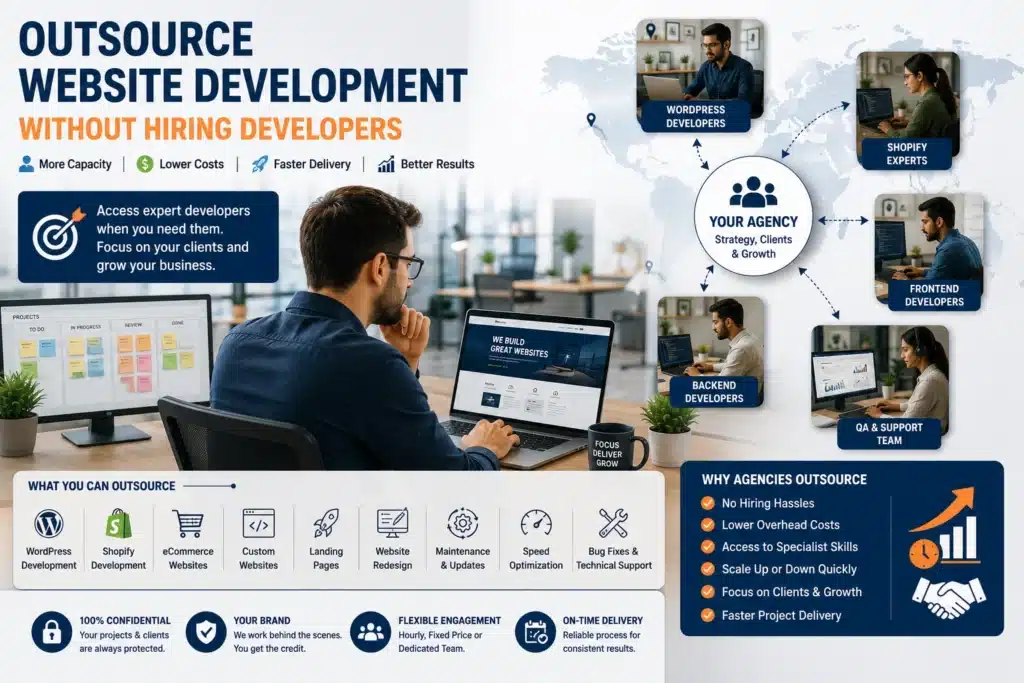
Common requirements include:
- WordPress website development
- Shopify development
- Ecommerce websites
- Custom website development
- Landing pages
- Website redesigns
- Front-end development
- Back-end development
- Website maintenance
- Speed optimization
- Bug fixes and technical support
The right approach depends on the internal team’s capabilities and the project’s complexity.
Keep Project and Client Control Internal
Outsourcing development does not require giving up control of the project.
Agencies can continue managing the client relationship, project requirements, pricing, timelines, and approvals.
The external development team focuses on execution.
This structure works particularly well for agencies because the agency remains the primary contact for the client while gaining access to additional technical capacity behind the scenes.
A similar model is explained in White Label Website Development Services for Agencies where agencies can expand development delivery while maintaining their own brand.
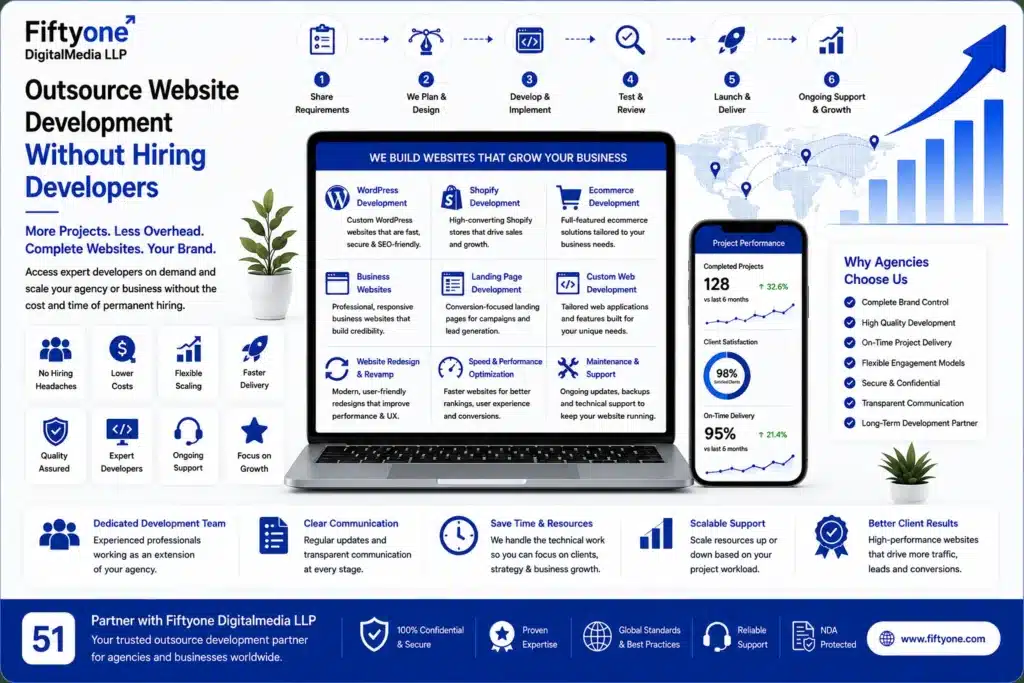
How Website Development Outsourcing Works
A successful outsourcing process starts with a clear project brief.
The business or agency should define the website’s purpose, required features, preferred technology, timeline, and expected outcomes before development begins.
A simple process can look like this:
Project Brief → Requirements → Development → Testing → Review → Launch
The clearer the requirements, the easier it becomes for the external team to estimate the project and deliver the expected result.
Poor briefs are one of the biggest reasons outsourced projects experience delays and revisions. Saying that a website should look “modern” or “professional” is not a useful technical requirement.
Clear examples, references, features, and business objectives produce better results.
Outsourcing vs Hiring an In-House Developer
The main difference comes down to flexibility and long-term commitment.
An in-house developer becomes part of the permanent team. This provides direct control but also creates fixed employment costs.
Outsourcing allows businesses to access specialists according to project demand.
For example, an agency may need a Shopify developer for one project, a WordPress developer for another, and a custom developer for a more complex website. Hiring all of these specialists internally may not be financially practical.
An outsourcing partner can provide access to different skills without requiring the agency to build every capability internally.
For businesses comparing these models, Outsourcing vs Hiring Full-Time Developers: Which Is Better for Global Businesses? covers the differences in more detail.
Reduce Fixed Development Costs
Website development outsourcing can help reduce the fixed costs associated with maintaining a larger internal team.
However, choosing the cheapest developer is usually a mistake.
The real cost of a website project includes development quality, revisions, project management, testing, maintenance, and future technical issues.
A poorly built website may cost less initially but require expensive fixes later.
The goal should be to find reliable development capacity at a sustainable cost rather than simply selecting the lowest quote.
Access More Technical Skills
One major advantage of outsourcing is access to specialist skills.
A growing agency may not have internal expertise across every platform or technology.
External development teams can support projects involving WordPress, Shopify, WooCommerce, custom development, ecommerce functionality, integrations, and website optimization.
This allows agencies to accept a wider range of projects without hiring a specialist every time a new technical requirement appears.
The agency can focus on sales, client management, strategy, and project coordination while experienced developers handle technical execution.
Build a Scalable Development Model
The strongest outsourcing relationships operate as an extension of the internal team rather than as disconnected vendors.
The agency should establish clear communication, project workflows, quality standards, and review processes.
As more projects are added, the same system can be used repeatedly.
A scalable model usually separates responsibilities clearly.
The agency handles client communication, project management, pricing, and approvals. The development partner handles coding, testing, technical implementation, and agreed support.
This reduces confusion and makes it easier to manage multiple projects simultaneously.
Quality Control Still Matters
Outsourcing development does not remove the need for quality checks.
Before a website is delivered, important areas should be reviewed, including:
- Mobile responsiveness
- Website speed
- Browser compatibility
- Functionality
- Forms and integrations
- Basic SEO setup
- Security
- User experience
The agency or business remains responsible for the final result, regardless of who writes the code.
A reliable outsourcing partner should have its own quality assurance process, but final project review should still remain part of the workflow.
When Should You Outsource Website Development?
Outsourcing can be useful when the business has more development work than its internal team can handle.
It can also make sense when a project requires specialist skills that are not available internally.
Common situations include rapid growth, temporary workload increases, new service offerings, ecommerce projects, platform-specific requirements, and international client projects.
The model is particularly useful when hiring full-time developers would create costs that are difficult to justify based on current project volume.
Common Website Development Outsourcing Mistakes
The most common mistake is choosing a development partner based only on price.
Other problems include unclear project requirements, poor communication, unrealistic deadlines, skipping quality checks, and failing to define ownership of code and project assets.
Businesses should also avoid outsourcing complex projects without assigning someone internally to make decisions and approve important changes.
An external development team can handle execution, but the project still requires clear ownership.
Why Agencies Use Offshore Development Teams
Offshore development gives agencies access to skilled developers while maintaining flexibility around team size and project volume.
Instead of hiring permanent developers for every new requirement, agencies can scale external capacity based on active projects.
This model can support agencies serving clients in the US, UK, Canada, Australia, Europe, and other international markets.
For agencies looking at offshore delivery more broadly, How Offshore Development Saves 60% Project Costs explains how external development models can reduce operational costs compared with building a larger internal team.
Why Fiftyone Digital Media
Fiftyone Digital Media supports agencies and businesses that need additional website development capacity without expanding their internal team.
Development support can include WordPress, Shopify, ecommerce websites, custom development, website redesigns, maintenance, optimization, and other technical requirements.
The objective is to provide scalable development support while clients maintain control over their projects, brand, and customer relationships.
Frequently Asked Questions
Can I outsource website development instead of hiring developers?
Yes. Businesses and agencies can work with external development teams for complete projects or specific technical requirements without hiring full-time developers.
Is outsourcing website development cheaper than hiring?
It can reduce fixed employment costs and provide more flexibility. However, the real comparison should include development quality, management time, revisions, and long-term maintenance.
What types of websites can be outsourced?
WordPress websites, Shopify stores, ecommerce websites, custom websites, landing pages, redesigns, and ongoing maintenance can all be outsourced.
Can agencies outsource development under their own brand?
Yes. White label development allows agencies to use external technical teams while maintaining their own branding and client relationships.
Conclusion
Outsourcing website development gives agencies and businesses a practical way to increase technical capacity without making permanent hiring the only option.
The right model allows companies to access specialist developers when needed while keeping project strategy, client relationships, and business decisions under their control.
Success depends on choosing the right development partner, creating clear project requirements, maintaining quality control, and building a repeatable workflow.
For growing agencies, outsourcing can make it possible to take on more website projects without increasing internal headcount at the same rate.
