Outsourcing vs Hiring Full-Time Developers: Which Is Better for Global Businesses?

Introduction
As businesses expand internationally, technology becomes one of the biggest drivers of growth. Websites, ecommerce platforms, SaaS products, mobile applications, and custom business software all require skilled developers. The challenge is deciding whether to hire full-time developers or outsource development to an experienced external team.
Both approaches can deliver successful projects, but they differ significantly in cost, flexibility, scalability, recruitment effort, and long-term business impact. The right choice depends on project requirements, budget, growth plans, and internal technical capabilities.
Fiftyone Digitalmedia LLP works with global businesses that require flexible development resources through offshore outsourcing while allowing companies to maintain complete control over their products and business strategy.
Understanding the Two Development Models
Hiring full-time developers means building an internal team that works exclusively for your company. You manage recruitment, onboarding, salaries, training, equipment, and long-term employment.
Outsourcing involves partnering with an external development company that provides experienced developers according to your project requirements. The business receives technical expertise without managing every aspect of recruitment and team expansion.
Neither model is universally better. Each solves different business challenges and should be evaluated according to commercial objectives instead of assumptions.
Hiring Full-Time Developers
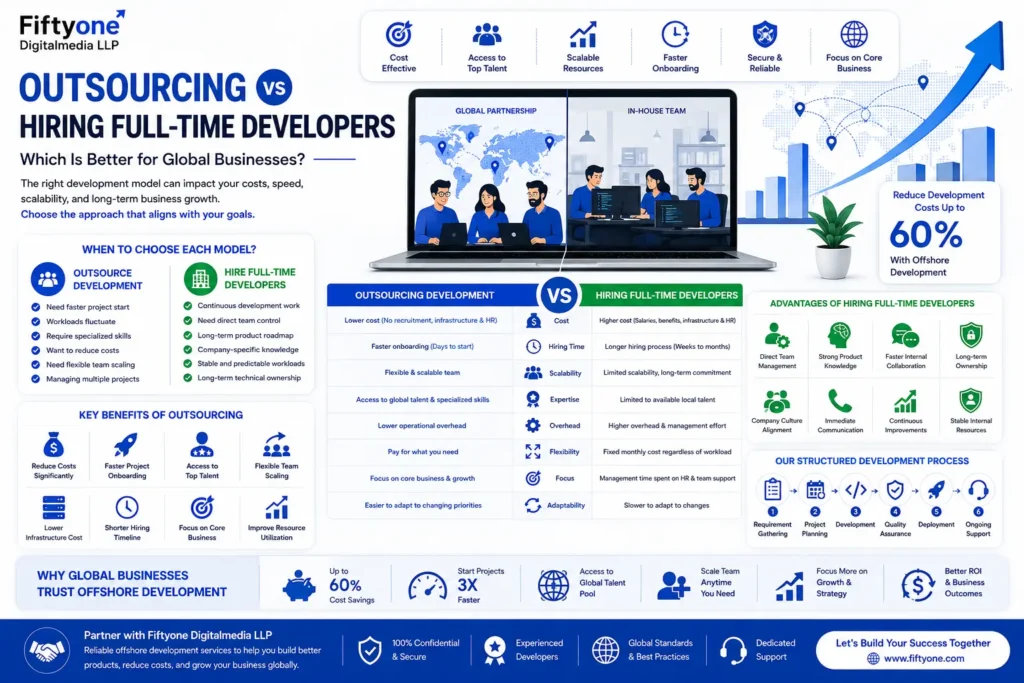
An internal development team gives businesses direct control over developers, daily communication, company culture, and long-term product knowledge. This model is often preferred by organizations with continuous development work and predictable workloads.
Advantages include:
- Direct team management
- Strong product knowledge
- Faster internal collaboration
- Long-term technical ownership
- Better alignment with company culture
- Immediate communication
- Continuous product improvements
- Stable internal resources
However, these advantages come with higher long-term commitments and operational responsibilities.
Outsourcing Development Services
Outsourcing provides businesses with access to experienced developers without building a large permanent technical department. Resources can be increased or reduced according to project requirements.
This model is particularly valuable for companies experiencing rapid growth, changing workloads, or projects requiring specialist technical expertise.
Benefits include:
- Faster project onboarding
- Lower recruitment costs
- Flexible team scaling
- Access to specialized developers
- Reduced infrastructure costs
- Shorter hiring timelines
- Lower operational overhead
- Easier resource management
Rather than replacing internal teams, outsourcing often complements them by providing additional development capacity.
Cost Comparison
One of the biggest differences between the two approaches is the total cost of ownership. Businesses often compare salaries alone, but internal hiring includes many additional expenses beyond monthly payroll.
Full-time hiring generally involves recruitment, office infrastructure, employee benefits, software licenses, equipment, HR management, and continuous training. Outsourcing reduces many of these operational expenses because the development company already maintains its own infrastructure and technical workforce.
The financial comparison should therefore consider the complete operating cost instead of hourly development rates alone.
Recruitment and Hiring Time
Recruiting experienced developers has become increasingly competitive. Businesses may spend weeks reviewing candidates, conducting interviews, negotiating offers, and completing onboarding before development even begins.
Outsourcing eliminates much of this process because development teams are already established. Companies can begin projects much sooner by working with experienced external developers.
Fiftyone Digitalmedia LLP supports businesses requiring immediate access to technical resources without lengthy recruitment cycles.
Scalability and Flexibility
Development workloads rarely remain constant throughout the year. Large product launches, ecommerce upgrades, website redesigns, and software releases may require additional developers for limited periods.
An outsourced development model allows businesses to increase or reduce resources based on active workloads.
This flexibility helps companies:
- Handle seasonal demand
- Support multiple projects
- Reduce idle resources
- Expand technical capacity
- Launch projects faster
- Control development costs
- Adapt to changing priorities
- Improve resource utilization
Internal hiring can provide stability, but outsourcing offers greater flexibility when workloads fluctuate.
Access to Specialized Skills
Modern development projects often require expertise across multiple technologies. A single project may involve WordPress, Shopify, React, Laravel, Node.js, APIs, cloud services, security, and performance optimization.
Hiring specialists for every technology can become expensive and difficult, particularly when those skills are not required continuously.
Outsourcing allows businesses to access specialists only when their expertise is needed. This creates a more efficient resource structure while maintaining development quality.
Which Model Works Best for Global Businesses?
Global businesses frequently operate across several markets while managing multiple digital products and changing customer requirements. Development priorities can shift quickly as new services, integrations, or regional expansions occur.
Many international companies therefore combine internal leadership with outsourced execution. Internal teams maintain strategic direction while external specialists provide additional technical capacity.
Businesses expanding internationally can also read How Offshore Development Saves 60% Project Costs, which explains how offshore development can reduce operational expenses while supporting scalable growth.
Why Fiftyone Digitalmedia LLP
Choosing between outsourcing and hiring is not about replacing one model with another. It is about selecting the structure that best supports business growth.
Fiftyone Digitalmedia LLP provides offshore development services for businesses that require experienced developers across websites, ecommerce, custom applications, integrations, and ongoing technical support. Companies gain access to scalable development resources while maintaining ownership of their products and customer relationships.
Productivity and Development Speed
The success of a development model depends on how efficiently projects move from planning to deployment. Internal developers already understand company processes and products, but project delivery can slow when the team becomes overloaded.
An outsourced development team can immediately increase technical capacity, allowing several projects to progress simultaneously. Instead of waiting to recruit additional employees, businesses can allocate experienced developers to high-priority work.
Fiftyone Digitalmedia LLP helps businesses improve development speed by providing scalable technical resources that integrate with existing workflows instead of replacing internal teams.
Project Management and Collaboration
Effective collaboration is essential regardless of the hiring model. Businesses should define responsibilities, milestones, approvals, communication channels, and delivery schedules before development begins.
A structured workflow generally includes:
- Requirement gathering
- Project planning
- Resource allocation
- Development
- Quality assurance
- Client review
- Revisions
- Final deployment
- Ongoing maintenance
A documented workflow reduces misunderstandings and keeps projects moving efficiently even when internal and outsourced teams work together.
Communication and Time Zone Management
Many businesses hesitate to outsource because they assume communication will become difficult. In reality, communication problems are usually caused by poor project management rather than geographical location.
Businesses should establish:
- Dedicated project managers
- Regular progress meetings
- Shared project documentation
- Defined approval processes
- Task management systems
- Response expectations
- Escalation procedures
- Delivery timelines
Clear communication creates predictable project execution regardless of where developers are located.
Security and Confidentiality
Development teams often receive access to sensitive business information including source code, customer databases, hosting environments, APIs, and internal systems. Security should therefore be part of the evaluation process before selecting any development partner.
Important security measures include:
- NDA agreements
- Controlled system access
- Secure credential sharing
- Intellectual property ownership
- Data protection policies
- Source code ownership
- Backup procedures
- Access removal policies
Businesses should verify these practices before transferring important projects.
Which Model Delivers Better ROI?
Return on investment should be measured through business outcomes rather than hourly development costs. A lower hourly rate provides little value if projects are delayed or require repeated redevelopment.
Businesses should evaluate:
- Development quality
- Delivery speed
- Recruitment costs
- Operational expenses
- Resource flexibility
- Project scalability
- Long-term maintenance
- Business growth support
- Time-to-market
- Customer satisfaction
The strongest ROI usually comes from choosing the model that aligns with the company’s growth strategy instead of automatically selecting the cheapest option.
Common Mistakes Businesses Make
Many organizations choose a hiring model without evaluating future business requirements. As projects grow, these decisions can increase costs and reduce development efficiency.
Avoid these common mistakes:
- Hiring before defining project requirements
- Choosing outsourcing only because it is cheaper
- Ignoring communication processes
- Hiring specialists without continuous workloads
- Weak project documentation
- No quality assurance process
- Unrealistic delivery deadlines
- Poor resource planning
- Ignoring scalability
- Selecting partners without technical evaluation
These issues can delay projects regardless of whether developers are internal or outsourced.
When Hiring Full-Time Developers Is Better
Hiring permanent developers is often the better option when businesses have continuous development work, long-term product roadmaps, and sufficient budgets to support a growing technical department.
It works well when:
- Development work is continuous
- Internal collaboration is critical
- Long-term product ownership is required
- Company-specific knowledge is essential
- Stable workloads exist
- Permanent technical leadership is needed
For businesses meeting these conditions, internal hiring can provide consistency and long-term technical continuity.
When Outsourcing Is the Better Choice
Outsourcing becomes a stronger option when workloads change frequently or specialist expertise is required for limited periods. It also supports businesses expanding into new markets without immediately increasing permanent staffing costs.
Outsourcing is particularly useful when:
- Projects have fixed timelines
- Workloads fluctuate
- Specialist technologies are required
- Recruitment takes too long
- Development costs must remain flexible
- Multiple projects run simultaneously
- International expansion is planned
- Technical resources need to scale quickly
Businesses comparing offshore development models can also read Best Offshore Development Partner in India for Agencies to understand how agencies use offshore teams to increase delivery capacity.
Hybrid Development Model
Many successful global businesses combine both approaches. Internal developers manage product strategy, architecture, and business-critical systems, while outsourced specialists support implementation, integrations, maintenance, and project expansion.
This hybrid structure provides:
- Strategic internal control
- Flexible development resources
- Faster project execution
- Access to specialist skills
- Better scalability
- Lower operational pressure
- Improved resource utilization
- Balanced development costs
Fiftyone Digitalmedia LLP works with businesses following this model by providing experienced offshore developers that complement internal technical teams.
Choosing the Right Development Partner
Selecting the right outsourcing company is more important than deciding whether to outsource. A reliable partner should demonstrate technical capability, structured project management, communication standards, and long-term scalability.
Businesses should evaluate:
- Technical expertise
- Industry experience
- Project portfolio
- Communication quality
- Development process
- Security practices
- Resource availability
- Quality assurance
- Post-launch support
- Pricing transparency
Companies evaluating offshore partners should also read How to Choose the Right Offshore Development Partner for Long-Term Success, which explains the major factors businesses should review before making a long-term partnership.
Why Choose Fiftyone Digitalmedia LLP
Every business has different development requirements. Some need a dedicated internal engineering team, while others benefit from flexible offshore resources that scale with project demand.
Fiftyone Digitalmedia LLP provides offshore development services for global businesses requiring websites, ecommerce platforms, custom software, integrations, maintenance, and dedicated technical support. The objective is to provide scalable development resources that support business growth without unnecessary operational overhead.
Frequently Asked Questions
Is outsourcing cheaper than hiring full-time developers?
In many cases, outsourcing reduces recruitment, infrastructure, and operational costs, but the overall value depends on project scope and development quality.
Can outsourced developers work with internal teams?
Yes. Many global businesses successfully combine internal product teams with outsourced development specialists.
Which option is better for startups?
Startups often choose outsourcing because it provides faster access to technical expertise while keeping fixed operating costs lower during early growth.
Is outsourcing secure?
It can be secure when businesses work with reputable partners that use NDAs, controlled access, secure infrastructure, and clear intellectual property agreements.
What is the best model for growing businesses?
Many growing companies use a hybrid approach, combining internal leadership with outsourced execution to improve flexibility and scalability.
Conclusion
There is no universal answer to the debate between outsourcing and hiring full-time developers. The right decision depends on business goals, project complexity, available resources, recruitment capability, and long-term growth plans.
Internal hiring provides stability and direct control, while outsourcing offers flexibility, specialist expertise, faster scaling, and lower operational commitments. Many international businesses achieve the strongest results by combining both approaches through a hybrid development model.
Scale Development With Confidence
Fiftyone Digitalmedia LLP helps global businesses build scalable development teams through offshore development services tailored to changing business requirements. Whether supporting internal teams or managing complete development projects, the focus remains on quality, efficiency, and sustainable business growth.