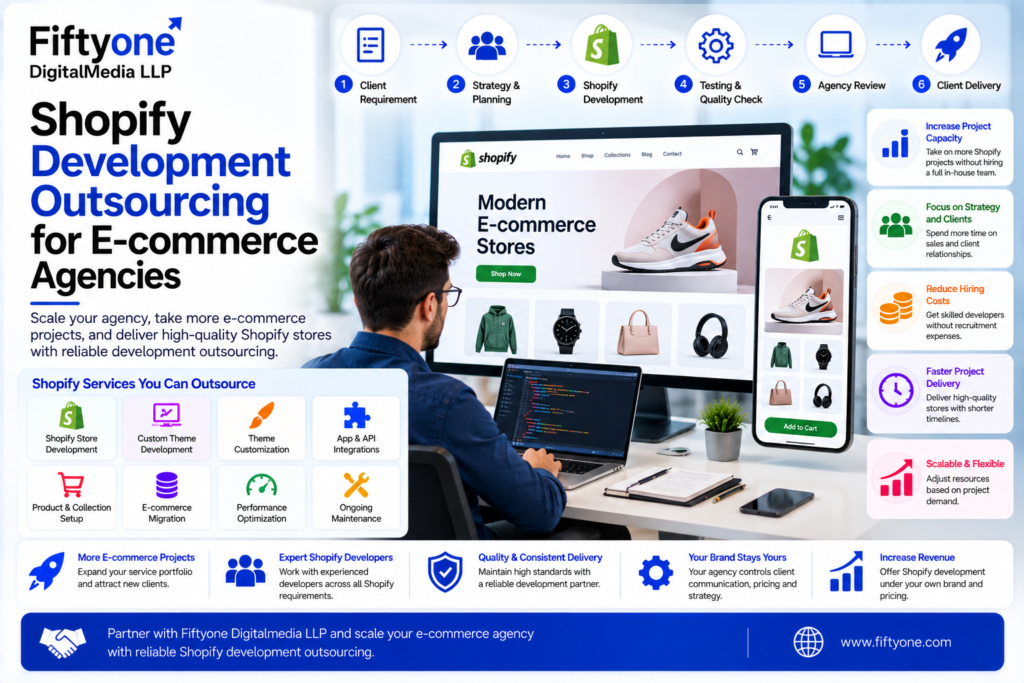
Shopify Development Outsourcing for E-commerce Agencies

Introduction
E-commerce agencies are constantly expected to deliver faster, better, and more technically advanced online stores. Clients want attractive storefronts, mobile-friendly experiences, custom features, integrations, optimized product pages, and smooth checkout experiences.
For agencies handling multiple Shopify projects at the same time, managing all development work internally can quickly become difficult.
Hiring additional Shopify developers is one option, but it also creates recruitment costs, salaries, training requirements, management responsibilities, and long-term commitments.
Shopify development outsourcing gives e-commerce agencies another way to increase technical capacity.
Instead of building a large Shopify development department internally, an agency can work with an external development team that handles technical execution while the agency continues managing the client relationship, strategy, pricing, and project direction.
This model can help growing agencies accept more Shopify projects without allowing development capacity to become a major bottleneck.
What Is Shopify Development Outsourcing?
Shopify development outsourcing means hiring an external Shopify development team to handle some or all of the technical work involved in building and maintaining Shopify stores.
The agency remains responsible for the client-facing relationship while the outsourcing partner works according to the agency’s requirements.
Depending on the project, outsourced Shopify development can include:
- Shopify store setup
- Custom Shopify theme development
- Theme customization
- Shopify app integrations
- Product and collection setup
- Custom sections
- Third-party integrations
- Payment and shipping configuration
- Store migration
- Performance optimization
- Ongoing maintenance
For e-commerce agencies, this creates a flexible delivery model where development capacity can increase when project demand increases.
Why E-commerce Agencies Outsource Shopify Development
Shopify projects can appear straightforward at first, but larger stores often require significant technical work.
An agency may have designers, marketers, SEO specialists, and account managers but not enough developers to handle several Shopify projects simultaneously.
This creates a capacity gap.
Outsourcing can help agencies fill that gap without immediately expanding their permanent workforce.
More Project Capacity
Agencies can take on additional Shopify projects without assigning every task to an already overloaded internal developer.
Lower Hiring Pressure
Instead of recruiting a new specialist every time demand increases, agencies can use external technical resources according to project requirements.
Faster Service Expansion
An agency that already provides ecommerce strategy, branding, SEO, or paid advertising can add Shopify development without building a completely new department.
Flexible Resources
Project requirements change from month to month. Outsourcing allows agencies to adjust technical capacity according to workload.
More Focus on Clients
Internal teams can spend more time on strategy, sales, account management, and client relationships while developers focus on implementation.
Which Shopify Services Can Agencies Outsource?
Not every Shopify project requires the same level of development support. A reliable outsourcing partner should be able to handle different project types.
Shopify Store Development
A development team can build new Shopify stores based on approved designs, brand guidelines, and functional requirements.
Custom Theme Development
Agencies can outsource the development of custom storefront experiences instead of relying entirely on pre-built themes.
Shopify Theme Customization
Existing themes can be modified to match a client’s branding, layout, functionality, and conversion requirements.
App and API Integrations
Many Shopify stores require integrations with marketing platforms, CRMs, inventory systems, shipping tools, payment systems, or other third-party applications.
Ecommerce Migration
Businesses moving from another ecommerce platform may require product, customer, order, design, and functionality migration.
Shopify Maintenance
Ongoing technical support can include updates, bug fixes, improvements, new sections, integrations, and other development tasks.
This range allows agencies to build Shopify packages around different client requirements.
Shopify Outsourcing vs. Hiring an In-House Developer
Before outsourcing, agencies should compare the two models based on their project volume and long-term plans.
| Factor | Shopify Outsourcing | In-House Shopify Team |
|---|---|---|
| Recruitment | Not always required | Required |
| Initial Investment | Lower | Higher |
| Scalability | Flexible | Based on team capacity |
| Specialist Access | Through partner | Depends on employees |
| Fixed Payroll | Lower | Higher |
| Project Flexibility | High | Moderate |
| Service Expansion | Faster | Requires additional hiring |
| Management | Shared | Internal |
| Capacity Changes | Easier | Slower |
For agencies with consistently high Shopify demand, building an internal team may eventually make sense.
However, agencies dealing with fluctuating project volumes can benefit from the flexibility of outsourced development.
How Shopify Outsourcing Can Improve Agency Profitability
Outsourcing should not only be viewed as a way to reduce development costs.
The larger opportunity is to create a repeatable and profitable Shopify service model.
An agency can create packages based on different client requirements while using an external development team for fulfillment.
For example:
| Shopify Package | Client Requirement | Development Support |
|---|---|---|
| Starter Store | New ecommerce business | Store setup + theme configuration |
| Growth Store | Growing brand | Custom theme + sections |
| Conversion Store | Existing Shopify brand | UX improvements + custom development |
| Integration Package | Complex operations | Apps + API integrations |
| Migration Package | Moving platforms | Store and data migration |
| Maintenance | Ongoing support | Updates + technical fixes |
The agency controls its client pricing and service positioning, while development fulfillment becomes part of the delivery cost.
The actual margin depends on pricing, scope, fulfillment costs, revisions, project management, and client retention.
How to Outsource Shopify Development Without Losing Client Control
One of the biggest concerns for e-commerce agencies is losing control over the client relationship.
The solution is to establish clear responsibilities from the beginning.
The agency should normally control:
Client communication: All major communication should pass through the agency.
Project strategy: The agency determines the business objectives and project direction.
Pricing: The agency controls its own packages and commercial terms.
Approvals: The agency reviews development before client delivery.
Feedback: Client feedback is collected and organized by the agency.
Final delivery: The agency remains responsible for presenting the completed store.
The development partner focuses on technical implementation.
This creates a simple structure:
Client → E-commerce Agency → Shopify Development Partner
The agency remains the client’s primary partner while the external team works as a technical extension.
Build a Strong Shopify Development Workflow
A structured workflow makes outsourcing much easier to manage.
A practical process can look like:
Client Discovery
Understand the client’s products, target customers, business model, competitors, and ecommerce goals.
- Project Scope
Define pages, features, integrations, functionality, content requirements, and technical expectations.
- Design Approval
Finalize the UI/UX design or theme direction before development begins.
- Development
The Shopify development partner builds the approved experience.
- Internal QA
The agency reviews the store for functionality, design consistency, responsiveness, and client requirements.
Client Review
The agency presents the completed work to the client and collects structured feedback.
- Final Launch
After approval, the store is prepared for launch and any required integrations or configurations are completed.
- Ongoing Support
Maintenance and additional development can continue under a monthly support arrangement.
This workflow reduces confusion and gives the agency visibility throughout the project.
How Agencies Can Maintain Shopify Development Quality
Outsourcing development does not remove the agency’s responsibility for quality.
Before sending a Shopify project to a client, the agency should conduct a structured review.
Important checks can include:
- Mobile responsiveness
- Desktop compatibility
- Navigation
- Product pages
- Collection pages
- Cart functionality
- Checkout flow
- Forms
- Search functionality
- App integrations
- Image optimization
- Page performance
- Tracking setup
- Basic SEO elements
A standard QA checklist can be reused across projects.
This makes quality control more consistent as the agency takes on more Shopify clients.
How to Choose the Right Shopify Development Partner
The development partner you choose can directly affect your agency’s reputation.
A low-cost provider is not necessarily the best choice if projects require constant corrections or miss deadlines.
Look for a partner with:
Shopify Expertise
The team should understand Shopify’s development environment, themes, apps, integrations, and ecommerce workflows.
Clear Communication
You should receive regular updates and have a clear process for discussing technical questions.
Strong QA
Projects should be tested before they are returned to the agency.
Scalable Capacity
The partner should be able to support both smaller stores and more complex ecommerce projects.
Flexible Engagement
Some projects may require fixed-price development, while others may need ongoing technical support.
Confidentiality
Client information, store credentials, source code, designs, and business data should be protected.
Reliable Delivery
Meeting agreed milestones is essential because development delays can directly affect client relationships.
A good Shopify outsourcing partner should make your agency’s delivery process easier rather than creating additional management work.
White Label Shopify Development for Agencies
For agencies that want Shopify development to remain part of their own service offering, white label fulfillment can provide an additional layer of flexibility.
The agency can sell Shopify services under its own brand while an external development team handles the agreed technical work behind the scenes.
This can be particularly useful for agencies that already provide:
- Ecommerce strategy
- SEO
- Paid advertising
- Branding
- UI/UX design
- Social media marketing
- Conversion optimization
Instead of sending clients to different providers, the agency can offer a broader ecommerce solution.
The agency remains focused on the customer while the development partner provides the technical execution.
Why Fiftyone Digitalmedia LLP Can Support Shopify Agency Projects
Fiftyone Digitalmedia LLP offers white-label Shopify development for agencies, including store setup, custom theme work, app integrations, and conversion-focused storefront development. Its white-label solutions are designed for agencies and consultants that want development delivered under their own branding.
The company also describes Shopify development as part of its broader white-label development offering for agencies. This makes Shopify outsourcing relevant for agencies looking to increase ecommerce delivery capacity without building a large internal development team.
For agencies, the objective should be more than simply outsourcing coding. The right partner should fit into the agency’s workflow, respect client ownership, follow project requirements, and provide consistent technical support.
Frequently Asked Questions
1. What is Shopify development outsourcing?
Shopify development outsourcing means hiring an external Shopify development team to handle technical work for an agency or its clients.
2. Why should e-commerce agencies outsource Shopify development?
Outsourcing can help agencies increase project capacity, reduce hiring pressure, access specialized developers, and expand Shopify services without building a large internal team.
3. Can agencies outsource custom Shopify development?
Yes. Agencies can outsource custom themes, sections, integrations, functionality, migrations, and other Shopify development requirements.
4. Can Shopify development be delivered as a white-label service?
Yes. A white-label Shopify development partner can work behind the agency’s brand while the agency manages the client relationship.
5. Will outsourcing Shopify development reduce agency control?
It does not have to. Agencies can retain control over client communication, pricing, strategy, approvals, and final delivery through a clearly defined workflow.
6. Is Shopify outsourcing suitable for small agencies?
Yes. Small agencies can use outsourced Shopify development to offer ecommerce services without immediately hiring full-time developers.
7. Can agencies outsource ongoing Shopify maintenance?
Yes. Maintenance can include bug fixes, theme updates, new features, integrations, performance improvements, and ongoing technical support.
8. How should an agency choose a Shopify development partner?
Evaluate Shopify expertise, communication, QA processes, scalability, confidentiality, delivery reliability, and the partner’s ability to work within your agency’s workflow.
Conclusion
Shopify development outsourcing can help e-commerce agencies increase their technical capacity without making every new project dependent on internal hiring.
With the right development partner, agencies can deliver new Shopify stores, custom themes, integrations, migrations, and ongoing maintenance while continuing to control client relationships and project strategy.
The most effective outsourcing model is built around clear requirements, structured communication, internal QA, defined responsibilities, and reliable technical execution.
For growing e-commerce agencies, Shopify outsourcing is not simply a way to delegate development work. It can become a scalable delivery system that allows the agency to accept more projects, expand its services, and focus on building long-term client relationships.