White Label Web Development for Digital Agencies

Introduction
Digital agencies are under constant pressure to offer more services, manage larger projects, and deliver websites faster. Clients no longer expect agencies to provide only marketing or design services. Many businesses now look for complete digital solutions that include website development, ecommerce, landing pages, custom functionality, and ongoing maintenance.
Building a large in-house development team for every project can be expensive and difficult to manage. Recruitment, salaries, training, software, project management, and employee retention can quickly increase operational costs.
White label web development provides an alternative. Agencies can partner with an experienced development team and deliver website projects under their own brand without building a large technical department internally.
For digital agencies looking to increase their project capacity while maintaining control over client relationships, white label development can become an important part of their growth strategy.
What Is White Label Web Development?
White label web development is a business model where a development partner completes website-related work for an agency, while the agency presents the final service to its client under its own brand.
The agency manages the client relationship, pricing, strategy, and communication, while the development partner handles the technical execution according to the agreed requirements.
Depending on the partnership, services can include:
- WordPress website development
- Shopify development
- WooCommerce development
- Custom website development
- Landing page development
- Website redesign
- Ecommerce development
- Website maintenance
- Front-end and back-end development
The main advantage is flexibility. An agency can sell and manage more development projects without needing to hire a specialist for every technology or project requirement.
Why Digital Agencies Need White Label Web Development
Website development projects can consume significant internal resources. Even agencies with designers and marketers may not have enough developers to handle multiple projects simultaneously.
When demand increases, agencies typically face two choices: hire more developers or outsource selected development work.
Hiring may be the right decision for some agencies, but it also creates long-term commitments. A white label development partnership provides more flexibility when project volume changes.
Agencies can use external development support to:
- Accept more website projects
- Expand their service portfolio
- Handle sudden increases in demand
- Reduce recruitment pressure
- Improve project delivery capacity
- Focus more on sales and client relationships
This creates a scalable model where technical capacity can grow alongside the agency.
How White Label Web Development Works
A successful white label partnership should feel like an extension of the agency’s internal delivery process.
The workflow usually begins when the agency collects the client’s requirements. These requirements are then shared with the development partner through an agreed communication and project-management process.
The development team works according to the agency’s specifications, timelines, branding requirements, and technical standards.
A typical workflow looks like this:
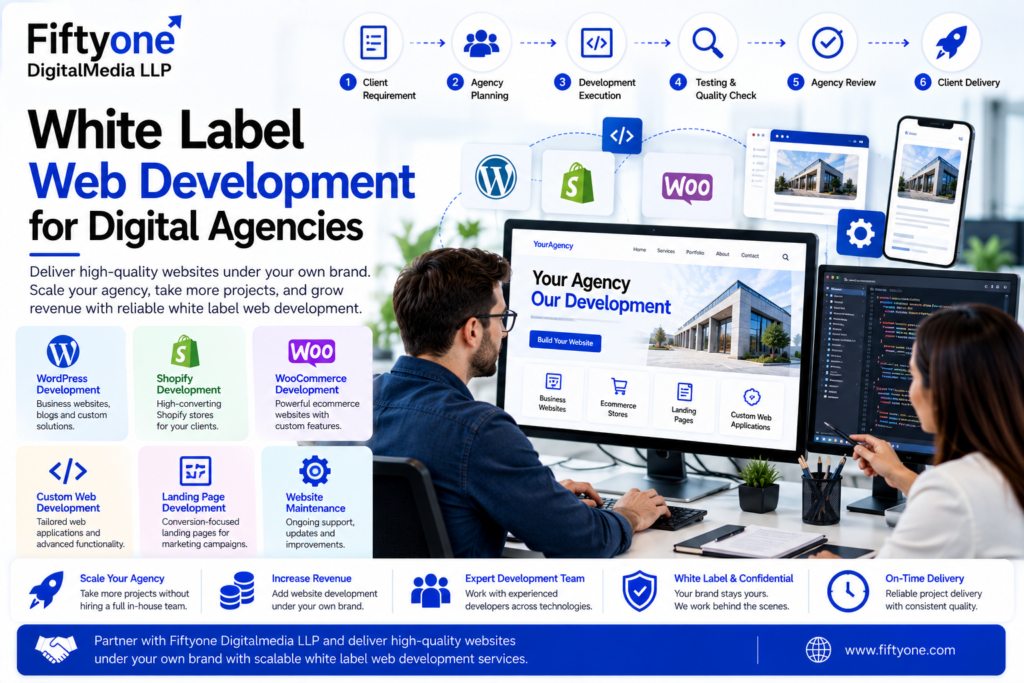
Client Requirement → Agency Planning → Development Partner → Testing → Agency Review → Client Delivery
The agency remains responsible for the client relationship, while the development team focuses on technical execution.
This separation allows agency owners and account managers to spend more time on business development instead of handling every development task themselves.
What Services Can Agencies Offer Through White Label Development?
A strong white label web development partner should be able to support different types of projects rather than only basic websites.
WordPress Development
WordPress remains useful for business websites, blogs, service websites, and content-driven platforms. Agencies can outsource design implementation, custom functionality, theme development, integrations, and maintenance.
Ecommerce Development
Agencies can expand into ecommerce projects without building a large ecommerce development department. Projects may include Shopify stores, WooCommerce websites, product pages, payment integrations, and conversion-focused improvements.
Custom Web Development
Some clients require functionality that cannot be delivered through standard CMS features. Custom web applications, dashboards, APIs, portals, and business systems can be handled through specialized development resources.
Landing Pages and Campaign Websites
Marketing agencies frequently need landing pages for paid campaigns, lead generation, product launches, and promotions. Outsourcing development allows these pages to move from design to production without overloading the internal team.
Website Maintenance
After launch, clients often require updates, bug fixes, security improvements, content changes, and performance optimization. White label maintenance support can create an additional recurring service opportunity for agencies.
White Label Development vs. Hiring an In-House Team
Before choosing a delivery model, agencies should consider their project volume, budget, technical requirements, and long-term goals.
| Factor | White Label Development | In-House Development |
|---|---|---|
| Initial Cost | Usually lower | Higher |
| Recruitment | Not required for each project | Required |
| Scalability | Flexible | Depends on team size |
| Technical Expertise | Access through partner | Limited to hired team |
| Management | Partner-managed delivery | Internal management |
| Project Capacity | Can scale with demand | Limited by available staff |
| Fixed Payroll | Lower commitment | Higher commitment |
| Service Expansion | Faster | Slower |
Neither model is automatically better for every agency. White label development is particularly useful when project demand changes frequently or when an agency wants to expand services without making immediate long-term hiring commitments.
How White Label Web Development Helps Agencies Increase Profitability
The objective of outsourcing should not simply be to reduce development costs. The bigger opportunity is to create a more efficient business model.
An agency can purchase development fulfillment from a partner, package the service according to its own positioning, and charge the client based on the overall value delivered.
For example, an agency may sell a complete website package that combines:
- Strategy
- UI/UX design
- Website development
- SEO setup
- Conversion optimization
- Analytics
- Maintenance
The agency can coordinate these services while its development partner handles the technical implementation.
This allows the agency to focus on acquiring clients, improving its service packages, and building recurring revenue.
How to Choose the Right White Label Web Development Partner
Choosing the cheapest development provider is rarely the best long-term strategy. Agencies should evaluate the partner based on reliability, communication, technical capability, and scalability.
Look for a development partner that provides:
Technical expertise: The team should understand the technologies your clients commonly request.
Consistent quality: Development standards should remain consistent across projects.
Clear communication: You should receive regular updates without constantly chasing the development team.
Scalable capacity: The partner should be able to handle both small websites and larger projects.
Confidentiality: Client information, project details, credentials, and intellectual property should be handled responsibly.
Flexible support: Your agency may need development, maintenance, redesign, or ecommerce support at different times.
Reliable timelines: Missed deadlines can damage your agency’s relationship with its clients, so delivery planning is essential.
A good white label partner should make your agency’s workflow easier, not create another layer of management.
How Agencies Can Maintain Quality With Outsourced Development
Outsourcing does not mean giving up control over quality.
The agency should establish clear processes before development begins. Every project should have documented requirements, design references, technical specifications, deadlines, and approval stages.
A useful quality-control process can include:
- Detailed project requirements
- Design and functionality approval
- Development milestones
- Internal testing
- Mobile and browser testing
- Performance checks
- Agency review
- Final client delivery
Agencies should also maintain a standard checklist for recurring project types. This makes it easier to identify missing functionality before the website reaches the client.
For larger projects, milestone-based reviews can reduce the risk of discovering major issues near the final deadline.
Why White Label Web Development Can Support Long-Term Agency Growth
The biggest benefit of white label development is not simply completing one extra website. It is creating a delivery system that can support repeated growth.
An agency that previously handled five website projects per month may struggle when demand suddenly increases. A reliable development partner can provide additional technical capacity without requiring the agency to immediately expand its permanent workforce.
Over time, agencies can build standardized packages for different client requirements.
For example:
| Package | Typical Client Need | Development Support |
|---|---|---|
| Starter Website | Small business | CMS website |
| Growth Website | Growing business | Custom pages + integrations |
| Ecommerce | Online store | Shopify/WooCommerce |
| Lead Generation | Service business | Landing pages + forms |
| Custom Project | Complex business | Custom development |
| Maintenance | Existing clients | Updates + technical support |
This approach makes service delivery easier to price, sell, manage, and scale.
Why Fiftyone Digitalmedia LLP Can Be a White Label Development Partner
Fiftyone Digitalmedia LLP provides white-label website development, app development, and design support for agencies that want to expand their delivery capacity without increasing their internal technical workload. The company also lists technologies and development capabilities across CMS, ecommerce, custom web applications, and modern development stacks.
For agencies, the value of a development partnership comes from having a structured process behind the scenes. Instead of building a separate technical team for every service, agencies can use specialized development support while keeping their own client relationships and brand positioning.
Fiftyone Digitalmedia LLP can support agencies looking for a flexible development model where technical work is completed as part of the agency’s broader service offering.
For agencies exploring broader offshore development models, the Offshore Web Development Company in India page provides additional information about development support and white-label delivery.
Frequently Asked Questions
1. What is white label web development?
White label web development allows a digital agency to outsource website development to a third-party development team while selling and delivering the service under its own brand.
2. Is white label web development suitable for small agencies?
Yes. Small agencies can use white label development to offer professional website services without hiring a complete development team internally.
3. What types of websites can agencies outsource?
Agencies can outsource WordPress websites, Shopify stores, WooCommerce websites, landing pages, custom websites, web applications, redesigns, and maintenance projects.
4. Will the client know about the white label development partner?
In a typical white label arrangement, the development work is delivered behind the agency’s brand. The exact confidentiality and communication arrangements should be agreed upon before the project begins.
5. Can white label development increase agency revenue?
It can. Agencies can add development services, accept more projects, create bundled packages, and generate additional revenue without building every technical capability internally.
6. How should an agency choose a white label development company?
Evaluate technical expertise, communication, quality standards, project management, scalability, confidentiality, pricing, and previous experience with agency partnerships.
7. Can white label development include ongoing website maintenance?
Yes. Many agencies use development partners for ongoing updates, bug fixes, redesigns, performance optimization, and technical maintenance.
Conclusion
White label web development gives digital agencies a practical way to expand their website services without relying entirely on a large internal development team.
By partnering with the right development provider, agencies can increase project capacity, offer more services, improve operational flexibility, and focus more heavily on sales and client relationships.
The key is to choose a partner that understands agency workflows and can consistently deliver quality work according to agreed requirements and timelines.
For agencies looking to build a scalable digital service model, white label web development can become a valuable part of their long-term growth strategy.