
Offshore SEO vs In-House SEO: Cost & Quality

Introduction
Agencies serving international clients often reach a point where they need more SEO capacity. The decision usually comes down to two options: build a larger internal SEO team or work with an offshore SEO provider.
Both models can deliver strong results. The difference is in how they affect cost, control, flexibility, expertise, and scalability.
For agencies targeting the US and other international markets, the better choice depends less on which model sounds cheaper and more on which model can consistently deliver quality SEO at a sustainable operating cost.
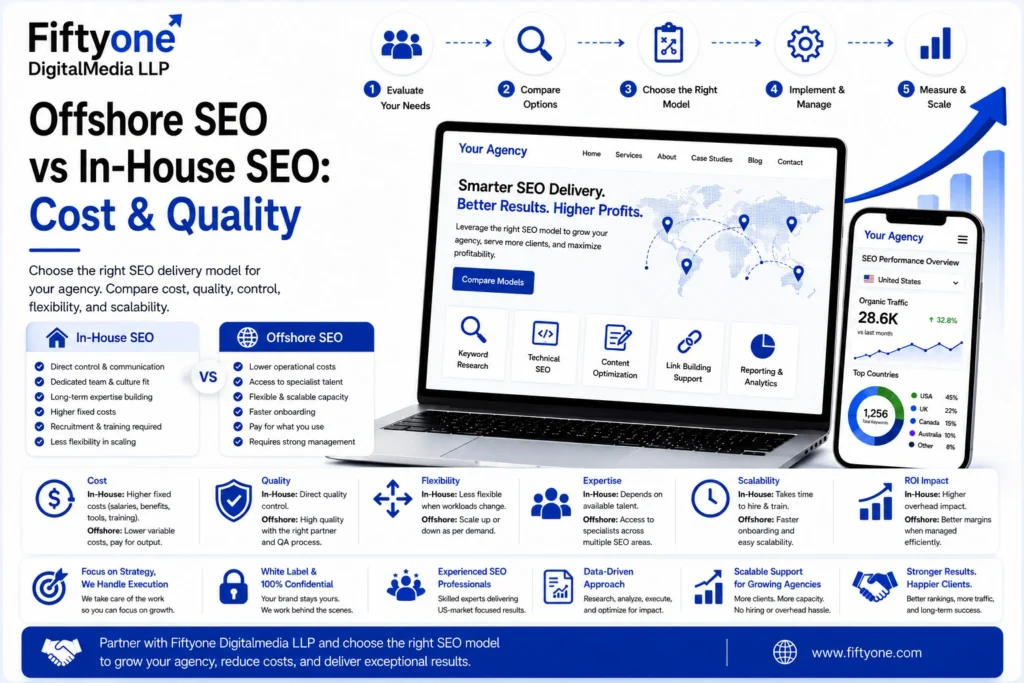
Offshore SEO vs In-House SEO: The Main Difference
An in-house model means SEO specialists are permanent members of the agency’s team. The agency controls their workload, training, processes, and day-to-day responsibilities.
Offshore SEO uses an external team to handle some or all SEO execution.
The agency can retain:
- Client relationships
- Strategy
- Pricing
- Account management
- Final approvals
The offshore team can handle:
- Keyword research
- Technical SEO
- Content optimization
- Competitor research
- Internal linking
- Reporting
- Other recurring execution
This makes offshore SEO particularly useful when an agency wants additional capacity without immediately adding permanent employees.
Which Model Costs More?
In-house SEO has several costs beyond salary.
Agencies may need to cover:
- Recruitment
- Salaries
- Benefits
- Training
- Software
- Equipment
- Management
- Employee downtime
With offshore SEO, the agency generally pays for agreed fulfillment and manages the external relationship instead of carrying the complete employment cost.
However, comparing only monthly fees can produce the wrong conclusion.
The real comparison should consider:
Total delivery cost + management time + quality control + revisions + software + recruitment
An offshore provider that requires constant corrections may not actually reduce costs.
Which Offers Better Quality?
Quality does not automatically depend on whether SEO is performed internally or offshore.
An experienced internal team can provide strong strategic control. An experienced offshore team can provide specialist expertise across multiple campaigns.
Quality depends on:
- SEO knowledge
- Research quality
- Content standards
- Technical expertise
- Quality control
- Communication
- Campaign strategy
- Understanding of the target market
For international campaigns, agencies should specifically evaluate whether the team understands the target country’s search behaviour and competition.
Offshore SEO Offers More Flexibility
One of the biggest advantages of offshore SEO is flexibility.
An agency may have ten active SEO clients today and fifteen several months later. Hiring permanent employees for every increase in workload can make the operating structure expensive.
External fulfillment allows agencies to adjust delivery capacity according to demand.
This can be useful when:
- Client numbers increase quickly
- Workloads fluctuate
- Specialist skills are temporarily required
- The agency enters new markets
- Internal employees are overloaded
For agencies considering external delivery, SEO Fulfillment for Agencies: A Complete Guide explains how fulfillment can support growing client portfolios.
In-House SEO Provides Direct Control
The strongest advantage of an internal team is direct control.
Managers can communicate with employees immediately, change priorities quickly, and develop long-term processes around the agency’s internal culture.
An in-house team may be preferable when:
- SEO is the agency’s core service
- Workload is consistently high
- The agency has strong recruitment capacity
- Long-term specialist development is important
- Direct management is a priority
The disadvantage is that internal capacity is less flexible. If workload drops, the agency still carries the staffing cost.
Offshore SEO Can Improve Agency Scalability
Scalability is where offshore SEO can become particularly valuable.
Instead of hiring a new specialist every time client volume increases, agencies can use external resources for execution-heavy work.
A hybrid structure can look like:
Internal: Strategy, sales, client communication, account management
Offshore: Research, technical execution, content optimization, internal linking, reporting support
This allows senior internal staff to focus on higher-value activities while external specialists support recurring delivery.
Agencies can also read How to Choose an Offshore SEO Partner before selecting an external team.
What About Client Trust?
Some agencies worry that outsourcing SEO will weaken client relationships.
That generally happens when the agency loses control of communication or cannot explain the work being delivered.
A better model keeps the agency as the client’s primary point of contact.
The agency presents:
- Strategy
- Recommendations
- Progress
- Performance
- Next priorities
The fulfillment team supports the work behind the scenes.
This allows the agency to maintain ownership of the client relationship while benefiting from additional SEO capacity.
Which Model Is Better for International Agencies?
There is no universal winner.
In-house SEO can be better when an agency has stable demand, sufficient budget, and a strong need for direct control.
Offshore SEO can be better when an agency needs flexible capacity, specialist support, or lower fixed delivery costs.
For many growing agencies, a hybrid model can provide the strongest balance.
The agency keeps strategic and client-facing responsibilities internal while using offshore specialists for execution.
How to Make the Decision
Consider these questions:
- Is SEO workload consistently high?
- How quickly is the client portfolio growing?
- Can the agency afford permanent specialists?
- Does the team need specific SEO expertise?
- How much internal time is spent on execution?
- Are workloads predictable?
- Does the agency serve multiple countries?
- Is flexibility more important than direct management?
If workload is unpredictable, offshore fulfillment can provide more flexibility.
If workload is consistently high and predictable, building internal expertise may become more attractive.
The Cost and Quality Balance
The right decision should not be based on cost alone.
A cheaper delivery model is not valuable if it produces poor SEO work. Similarly, an expensive internal team is not efficient if highly skilled employees spend most of their time performing repetitive tasks.
The better model is the one that provides:
Reliable quality + sustainable cost + sufficient capacity + strong client retention
Agencies looking specifically to lower operational costs can also explore How Agencies Can Reduce SEO Delivery Costs.
Frequently Asked Questions
Is offshore SEO cheaper than in-house SEO?
It can be, particularly when agencies need flexible capacity without the full cost of permanent employees. The actual savings depend on workload and provider quality.
Is in-house SEO better quality?
Not automatically. Quality depends on expertise, processes, research, strategy, and quality control.
Can agencies combine offshore and in-house SEO?
Yes. A hybrid model allows agencies to keep strategy and client management internal while outsourcing selected execution tasks.
Which model is better for growing agencies?
Offshore or hybrid SEO can be useful when client demand is growing faster than internal delivery capacity.
Conclusion
The choice between offshore SEO vs in-house SEO should be based on the agency’s workload, budget, quality requirements, expertise, and growth plans.
In-house SEO provides direct control and permanent internal expertise. Offshore SEO provides flexibility, scalable capacity, and access to external specialists without requiring the same level of permanent staffing.
For many growing agencies, combining both models can provide the best balance. Keep strategy, client relationships, and important decisions internal while using offshore specialists for execution-heavy SEO work.
The goal is not simply to spend less. It is to build an SEO delivery model that can grow without sacrificing quality or profitability.