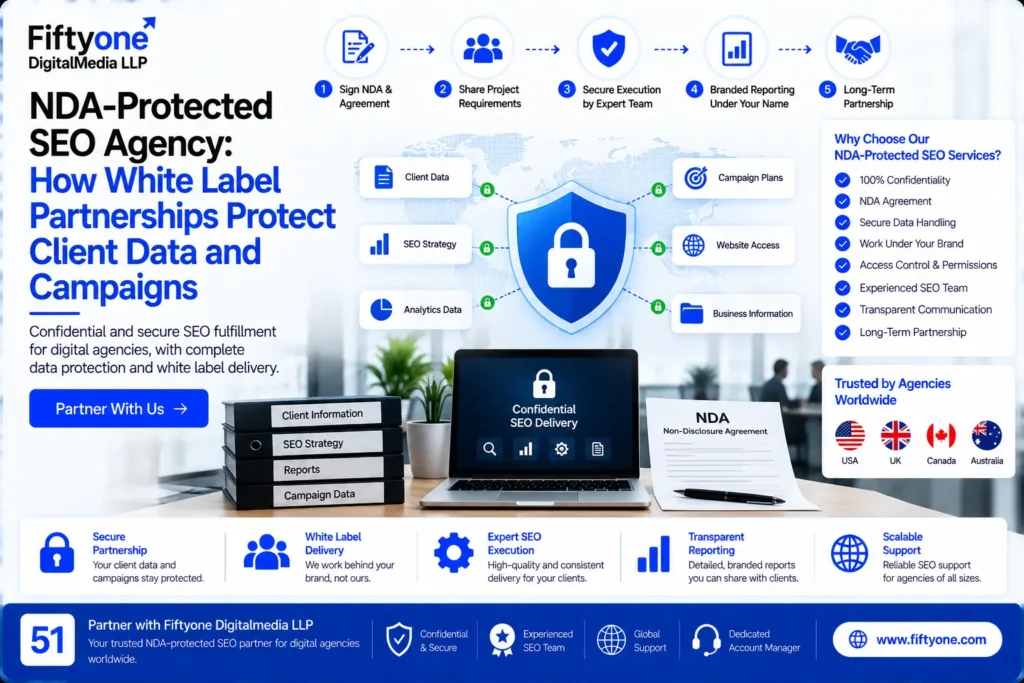
NDA-Protected SEO Agency: How White Label Partnerships Protect Client Data and Campaigns

Introduction
When a digital agency outsources SEO delivery, it shares more than a task list. The work may involve client identities, website access, analytics data, keyword strategies, campaign plans, business information, and performance reports. If these details are not handled carefully, a partnership can create risks for both the agency and its clients.
This is why confidentiality should be part of the white label partnership from the beginning—not something discussed only after a concern arises.
An NDA-protected SEO agency works with agreed confidentiality obligations that define how sensitive information can be used, accessed, and disclosed. In a white label arrangement, these safeguards also help protect the agency’s client relationships and keep delivery behind the agency’s brand.
An NDA is important, but it is not a complete security system by itself. Agencies should also review access permissions, file-sharing practices, team responsibilities, reporting workflows, and how information is handled when a project ends.
This guide explains how NDA-protected white label SEO partnerships can help agencies protect client data and campaigns, and what to check before sharing project information with a delivery partner.
Why Confidentiality Matters in White Label SEO
SEO projects often require access to information that is commercially sensitive. A delivery team may need to review a website, understand the client’s products and services, examine search performance, or work with campaign documents.
That information can reveal more than the website’s current search visibility. It may include upcoming product launches, target markets, lead-generation priorities, conversion data, business challenges, and planned campaigns.
For an agency, the concern is not limited to accidental disclosure. Unclear responsibilities can also lead to unauthorized account access, client communication outside the agreed process, or confidential material being reused in ways the agency did not approve.
A clear confidentiality arrangement helps set expectations before work begins. It should explain what information is confidential, who may access it, why it may be used, and what happens when the engagement ends.
What an NDA Should Cover in a White Label SEO Partnership
A non-disclosure agreement, or NDA, is a contract that sets out confidentiality obligations between parties. Its exact terms depend on the agreement and applicable law, so agencies should have important contracts reviewed by a qualified legal professional.
In a white label SEO engagement, the NDA should be considered alongside the service agreement and project scope. Together, these documents can clarify how the parties will handle client information throughout the engagement.
Key areas to discuss include:
- Confidential information: Client names, business details, account data, strategy documents, reports, credentials, and other information identified as confidential.
- Permitted use: The project purposes for which information may be accessed or used.
- Authorized access: Which people or roles can view client information and whether access can be shared with subcontractors.
- Disclosure restrictions: When information may or may not be shared with third parties.
- Data handling: How files, credentials, exports, and project records should be stored and transferred.
- End-of-project obligations: Whether information must be returned, deleted, or retained for a specified reason.
- Continuing confidentiality: Whether obligations continue after the project or partnership ends.
The agreement should be specific enough to guide day-to-day work. A general promise to “keep everything confidential” may not answer practical questions about access, storage, or project closure.
How NDA Protection Supports Client Data Confidentiality
1. It Defines How Client Information Can Be Used
A delivery partner may need access to client information to complete SEO work. An NDA and related service terms can establish that the information is shared for a defined business purpose rather than for unrelated use.
For example, a partner may receive website analytics to review organic traffic or search performance. The agreement should clarify that this information is to be used for the authorized project and not disclosed or repurposed without permission.
Agencies should also avoid sharing information that the partner does not need. Limiting the information provided is a practical safeguard even when an NDA is signed.
2. It Helps Establish Access Boundaries
SEO delivery may involve several people: strategists, technical specialists, content writers, analysts, and project managers. Not every person needs access to every client account or document.
Agencies should agree on who requires access and what level of access is appropriate. Where possible, use individual accounts and role-based permissions rather than sharing one login among multiple people.
For instance, a specialist reviewing Search Console data may not need administrative access to the client’s entire website. Similarly, a content writer may need a brief and brand guidelines, but not access to advertising or billing accounts.
The NDA provides a confidentiality framework; access controls help put that framework into practice.
3. It Protects Sensitive Business and Campaign Information
SEO strategy can contain information that gives a business a competitive advantage. This may include keyword priorities, planned landing pages, content calendars, market expansion plans, competitor research, and campaign timing.
An NDA can establish that such information must remain confidential and be used only for the agreed work. Agencies should define which campaign documents are covered and how they should be shared with the delivery team.
This is especially relevant when an agency works with businesses in competitive sectors or manages campaigns that have not yet been publicly announced.
4. It Clarifies Responsibilities When a Project Ends
Confidentiality does not stop being important when a campaign is completed. Project folders, exports, credentials, and reports may remain with different people unless there is a clear closure process.
The agreement and project workflow should explain what happens to client information at the end of the engagement. This may include revoking account access, returning or deleting files, and confirming whether any records must be retained for contractual or legal reasons.
Agencies should not assume that every file can always be deleted immediately. The correct process depends on the contract, the type of information, and applicable requirements.
How White Label Delivery Protects the Agency’s Client Relationship
Confidentiality is not only about files and passwords. It also concerns how the partnership is presented to the end client.
In a white label arrangement, the agency generally owns the client relationship and presents the completed work under its own brand. The delivery partner should understand whether it is permitted to contact the client, attend meetings, use the client’s name in a portfolio, or refer to the project publicly.
These rules should be agreed in writing. If direct technical communication is needed, the agency can authorize it for a specific purpose and define how that communication will take place.
For agencies reviewing their delivery options, Top White Label SEO Services for Agencies provides related context on outsourced SEO execution and the role of a white label partner.
Protecting SEO Campaigns Beyond the NDA
An NDA sets confidentiality obligations, but effective protection also depends on the way a project is managed. Agencies should build practical safeguards into their normal workflow.
Use the Minimum Access Needed
Give each team member only the access required for their assigned task. Use individual user accounts wherever supported, enable multi-factor authentication when available, and remove access when it is no longer needed.
Avoid sending passwords through ordinary email or chat messages. Use an approved password manager or secure credential-sharing method, and do not include credentials in project briefs or reports.
Keep Project Files Organized
Client documents should be stored in approved locations with appropriate permissions. Avoid mixing files from different clients in shared folders where team members may have broader access than necessary.
Use clear project naming and define who can download, edit, or share files. When a project includes sensitive exports or account data, agree how long those files should remain available.
Define Who Can Approve Campaign Changes
SEO work can involve changes to website pages, metadata, redirects, content, and technical settings. The agency should decide which changes can be implemented directly and which require client approval.
A documented approval process helps prevent accidental changes and gives the agency a record of what was authorized. It also makes responsibilities clearer if a client questions a campaign update later.
Keep Reporting Client-Ready and Controlled
White label reports should contain only information intended for the client. Internal notes, delivery-team comments, unrelated client details, and confidential partner information should not appear in client-facing documents.
Before sending a report, the agency should review the recipient list, links, attachments, and permissions. A report can be accurate and professionally designed yet still expose information if it is shared with the wrong person.
What Agencies Should Ask an NDA-Protected SEO Partner
Before sharing client access or campaign documents, agencies should ask how confidentiality works in everyday delivery—not only whether the provider signs an NDA.
Useful questions include:
- Will the NDA be signed before client information is shared?
- Which team members can access client accounts and documents?
- Are subcontractors or external tools involved in delivery?
- How are credentials and project files shared?
- Can the provider contact the end client, and under what circumstances?
- Are client names, screenshots, or campaign results used in portfolios or marketing?
- What is the process for removing access and handling files after completion?
- Who should be contacted if information is shared with the wrong person or an account is accessed unexpectedly?
The answers should be consistent with the contract and the provider’s actual operating practices. Agencies should request clarification if a response is vague or if the proposed process does not fit their clients’ requirements.
NDA Protection and White Label SEO: What It Does Not Automatically Guarantee
An NDA is a legal confidentiality tool. It does not, by itself, prevent every data incident, guarantee secure technology, or prove that a provider follows strong access practices.
For that reason, agencies should avoid treating “NDA-protected” as a substitute for due diligence. The agreement should be supported by practical controls, clear responsibilities, and a process for handling problems.
It is also important to distinguish confidentiality from other obligations. Depending on the project and the information involved, agencies may need separate terms covering data processing, information security, intellectual property, account ownership, or regulatory requirements. These should be reviewed for the relevant client and jurisdiction.
A useful way to assess a provider is to look at the whole delivery process: what information is collected, who can access it, where it is stored, how it is transferred, and what happens when the work ends.
How Fiftyone Digitalmedia LLP Approaches White Label Confidentiality
Fiftyone Digitalmedia LLP describes its white label marketing solutions as NDA-protected, with work and reporting delivered under the agency’s brand. Its published process includes agency onboarding and NDA, campaign planning, execution, optimization, and reporting.
Its published terms also state that client information, data, source code, and business logic are treated as confidential; white label work is delivered under the client’s brand; and direct client communication is avoided unless authorized.
Agencies can review the White Label Marketing Solutions page to understand the stated service and onboarding approach. For projects that include website or technical work alongside SEO, the Offshore Web Development Company in India page describes NDA-related delivery and access practices for development projects.
Before starting an engagement, agencies should discuss their own client requirements and confirm that the proposed agreement and workflow address them.
Frequently Asked Questions
Does an NDA protect client data in a white label SEO partnership?
An NDA establishes contractual confidentiality obligations, including how covered information may be used or disclosed. It should be supported by practical safeguards such as controlled access, secure file sharing, and clear project-closure procedures.
Should an agency sign an NDA before sharing client information?
Agencies should agree on confidentiality terms before sharing sensitive client information. The agreement should clarify what information is covered, who can access it, and how it may be used. Have the document reviewed by a qualified legal professional where appropriate.
Can a white label SEO partner contact my clients directly?
That depends on the written agreement. Agencies can specify that communication must go through their team unless direct contact is explicitly authorized for a particular purpose.
Does an NDA guarantee that client data cannot be exposed?
No. An NDA creates legal obligations, but it cannot guarantee that a data incident will never happen. Agencies should also assess access controls, file-handling practices, security procedures, and incident-response responsibilities.
Conclusion
An NDA-protected SEO partnership can help agencies set clear expectations for handling client information, campaign strategies, account access, and confidential business details. It can also support the agency’s white label model by defining how the delivery partner works behind the agency’s brand.
However, confidentiality needs to be part of the complete delivery process. Agencies should combine written agreements with limited access, secure file sharing, approval workflows, controlled reporting, and a clear process for closing projects.
Before choosing a partner, look beyond the NDA itself. Understand how the team handles client information in everyday work and make sure the agreement reflects your agency’s responsibilities to its clients.
Fiftyone Digitalmedia LLP provides white label marketing support for agencies looking for NDA-based delivery and branded reporting. Explore the available solutions and discuss your agency’s confidentiality and campaign requirements before beginning a partnership.