White Label SEO Services in India: How Agencies Can Build Profitable Monthly Client Packages

Introduction
For digital agencies, selling SEO is only one part of building a recurring-revenue business. The bigger challenge is delivering consistent work every month while managing client communication, campaign quality, reporting, and profitability.
Hiring an in-house SEO team can require ongoing investment in specialists, tools, training, and project management. A white label partnership offers another operating model: your agency sells SEO under its own brand, while a specialist delivery partner handles agreed campaign tasks behind the scenes.
However, outsourcing alone does not automatically create a profitable service. Agencies need clearly defined monthly packages, realistic deliverables, reliable fulfilment costs, and a process for showing clients what their investment supports.
White label SEO services in India can help agencies build that structure by accessing outsourced campaign execution while retaining control of the client relationship, pricing, and brand experience. The key is to package SEO around business needs—not simply sell a fixed number of keywords or backlinks.
This guide explains how agencies can design monthly SEO packages, calculate margins, choose deliverables, and build a repeatable client-retention process.
What Are White Label SEO Services?
White label SEO is a fulfilment arrangement in which an SEO provider performs work for an agency’s clients, while the agency presents the service under its own brand.
The agency typically manages the sales process, client relationship, proposals, and account strategy. The fulfilment partner may handle tasks such as technical audits, keyword research, on-page optimization, content support, link acquisition, and reporting, depending on the agreed scope.
The client-facing experience remains associated with the agency. Reports, communication, and deliverables can be branded accordingly, provided the arrangement and responsibilities are agreed in advance.
This model is different from simply referring a client to another SEO company. In a white label arrangement, the agency remains the primary service provider from the client’s perspective.
Agencies exploring the service mix can also review
Top White Label SEO Services for Agencies
to understand common SEO fulfilment areas.
Why Monthly SEO Packages Make Sense for Agencies
SEO usually involves ongoing work rather than a single isolated task. A website may need technical improvements, new content, content updates, authority development, and performance reviews over time.
A monthly package gives agencies a structure for planning that work and billing clients consistently. It also helps clients understand what is included in the engagement and how progress will be reviewed.
More predictable service delivery
When deliverables are planned monthly, the agency and fulfilment partner can schedule tasks in advance. This reduces last-minute requests and makes capacity planning easier.
Recurring revenue instead of one-time projects
A monthly retainer can create a more consistent revenue stream than relying only on website launches, audits, or other one-off projects. It also gives agencies a reason to maintain an ongoing relationship with clients.
Easier scope management
A defined package sets expectations about what the client receives. Without a clear scope, requests can gradually expand beyond the original agreement, affecting delivery time and margins.
Flexible fulfilment as the client base grows
An agency can begin with a small number of SEO accounts and increase delivery capacity as demand grows. The arrangement should still include quality checks, communication standards, and realistic workload limits.
How to Build Monthly White Label SEO Packages
A profitable package is not simply a list of tasks. It connects a client’s needs with a manageable level of work and a price that covers fulfilment, account management, and business overhead.
Start by defining the type of client each package is designed to serve. A local service business, a national ecommerce store, and a B2B company targeting several countries will not need identical campaign plans.
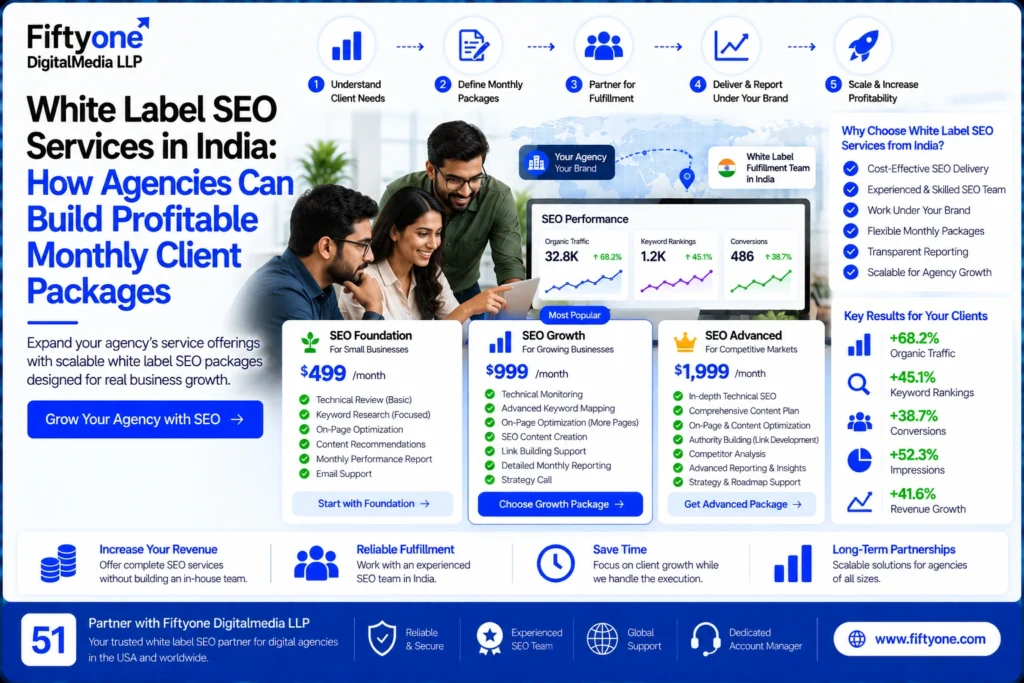
The following three-tier structure can be adapted to your agency’s market and delivery costs.
1. SEO Foundation Package
Designed for: Small businesses with a relatively focused website and clear local or niche search goals.
This package should establish the technical and on-page foundations needed for ongoing SEO. It is not intended to cover every possible optimization task.
Possible monthly inclusions:
- Initial or periodic technical review, based on the agreed schedule
- Keyword research for a limited set of priority topics
- On-page optimization for selected pages
- Basic content recommendations
- Google Business Profile support where local SEO is relevant
- Monthly performance report
- A defined number of account updates or review calls
The agency should specify how many pages, keywords, or content items are covered. Avoid describing the package as “complete SEO” if it only includes a limited set of activities.
2. SEO Growth Package
Designed for: Businesses competing across a city, region, or defined product category.
This package can include a broader content and optimization plan, with regular reviews of what is working and where the campaign needs adjustment.
Possible monthly inclusions:
- Technical monitoring and prioritized recommendations
- Keyword mapping across additional pages
- On-page optimization for agreed pages
- SEO content creation or content refreshes
- Internal linking improvements
- Link acquisition activities with transparent quality standards
- Competitor and search visibility review
- White-label monthly reporting
The main difference from a foundation package should be the campaign’s scope and depth—not just a larger number of keywords in a report.
3. SEO Expansion Package
Designed for: Established businesses, ecommerce brands, or companies targeting multiple locations or markets.
Expansion campaigns often involve more pages, more complex technical requirements, and a wider content strategy. They may also require coordination with developers, content teams, or the client’s internal marketing department.
Possible monthly inclusions:
- Broader technical SEO analysis and implementation support
- SEO planning across multiple categories, services, or locations
- Content briefs, production, and optimization
- Ecommerce or multi-location SEO support, where relevant
- Digital PR or link acquisition planning, depending on scope
- Conversion and landing-page recommendations
- Competitor analysis
- Detailed reporting and scheduled strategy reviews
Do not promise a particular ranking position or traffic increase as a guaranteed outcome. Search performance depends on competition, website condition, market demand, implementation, and other factors outside the provider’s complete control.
What Should Every Monthly Package Include?
The exact deliverables will vary by client, but a well-managed monthly SEO service should include more than a ranking screenshot.
A defined strategy
Each client should have a documented campaign direction. This may include target audiences, priority services or products, locations, keyword themes, and the website sections being optimized.
A deliverables schedule
Specify what the client receives each month and what is delivered less frequently. For example, a technical audit may be part of onboarding and repeated periodically, while reporting and optimization reviews happen monthly.
Quality assurance
The agency should review work before it reaches the client. Check that page recommendations match the brief, content is accurate, links meet the agreed standards, and technical changes are tested appropriately.
Branded reporting
Reports should explain activity and performance in a way clients can understand. Include relevant metrics such as organic clicks, impressions, conversions where tracking is available, priority keyword visibility, and completed work.
Communication and escalation
Set expectations for response times, approvals, access requests, and urgent issues. A monthly package should clarify who communicates with the client and how the fulfilment partner supports that process.
How Agencies Can Price Packages and Protect Profit Margins
White label SEO generally follows a wholesale-to-retail model. The agency pays the fulfilment partner for the agreed work and charges the client a retail fee that also accounts for the agency’s own responsibilities.
There is no single price that suits every client. Costs can change based on competition, website size, technical complexity, content requirements, target market, and the amount of ongoing work.
A practical pricing calculation is:
Client fee − fulfilment cost − direct account-management cost − other delivery expenses = gross contribution
For example, use a hypothetical monthly client fee of $1,000. If fulfilment costs $450 and direct account-management and delivery expenses total $150, the remaining $400 is the gross contribution before general business overhead and taxes.
This is an illustrative calculation, not a market price or a guaranteed margin.
Price the scope, not just the keyword count
A package that tracks 50 keywords is not necessarily more valuable than one tracking 20. The work behind those keywords matters: technical fixes, content quality, search intent, competition, and conversion opportunities.
Include your agency’s work in the calculation
Your price should account for sales, onboarding, client meetings, strategy, quality assurance, reporting review, and payment administration. These responsibilities remain even when execution is outsourced.
Set a minimum viable fee
If the retail price does not cover fulfilment and account management, the package may become difficult to sustain. Review the economics before offering discounts or adding extra deliverables.
Use scope-based upgrades
When clients need additional locations, content volume, technical implementation, or ecommerce support, quote an appropriate package adjustment rather than quietly absorbing the extra work.
How to Choose the Right White Label SEO Partner in India
Your fulfilment partner affects the quality of the service your agency sells. Before committing to a monthly arrangement, review the delivery process and commercial terms—not just the advertised service list.
Consider these areas:
- Defined deliverables: Are monthly tasks, exclusions, and responsibilities documented?
- SEO methods: Can the provider explain its approach to technical SEO, content, and link acquisition?
- Reporting: Can reports be branded and explained in client-friendly language?
- Communication: Is there a clear contact person and escalation process?
- Confidentiality: Are client data, access credentials, and non-solicitation expectations addressed in writing?
- Quality control: Who reviews work before it is submitted?
- Scalability: Can the provider handle additional accounts without weakening delivery standards?
- Commercial clarity: Are revisions, additional work, timelines, and payment terms documented?
A partner should be able to explain what it will do, what it will not do, and what information it needs from your agency.
For a closer look at the operating differences, read
White Label SEO Agency vs Freelancers: Which Delivers Better Results?
.
Build a Repeatable Client Onboarding Process
A monthly package becomes easier to manage when every new client follows the same onboarding steps. This also reduces the risk of beginning work without the access or information needed to deliver it.
A practical process can look like this:
- Collect business information: Understand the client’s services, locations, audience, competitors, and business goals.
- Confirm access: Arrange the required website, analytics, search console, and other platform access securely.
- Review the website: Identify technical issues, existing content, search visibility, and immediate priorities.
- Agree on the roadmap: Confirm target pages, deliverables, approval responsibilities, and reporting metrics.
- Start fulfilment: Share a complete brief with the white label partner and agree on deadlines.
- Review before reporting: Check completed work and explain progress, blockers, and next steps to the client.
This process helps prevent a common problem: selling a package before confirming whether the client’s website and goals fit the proposed scope.
How to Retain Clients With Better Monthly Reporting
Clients do not always understand technical SEO tasks. A report that lists completed activities without explaining their purpose may make the service feel like a checklist rather than an ongoing investment.
A useful monthly report should answer four questions:
What did we work on? Summarize completed technical, content, on-page, and off-page activities.
What changed? Show relevant movement in organic clicks, impressions, conversions, and priority search visibility. Explain the reporting period and any tracking limitations.
What affected performance? Mention implementation delays, website changes, seasonal demand, tracking issues, or other relevant context.
What happens next? Set out the next month’s priorities and identify any decisions or approvals needed from the client.
Avoid presenting rankings as the only measure of success. A keyword may move up without generating qualified leads, while a page that attracts fewer visits may contribute meaningfully to conversions. Reports should connect search performance with the client’s actual business objectives wherever tracking allows.
Common Mistakes That Reduce Package Profitability
Even agencies with a capable fulfilment partner can lose margin if their packages are poorly designed.
Selling unlimited work for a fixed fee
“Unlimited SEO” makes scope difficult to control. Define the work included, the number of pages or content items where relevant, and how additional requests will be quoted.
Using the same package for every industry
A local plumber and an international SaaS company have different search needs. Build a core service structure, then adjust scope for the client’s market, competition, and website complexity.
Competing only on low prices
A low retail fee leaves less room for strategy, account management, and quality assurance. Explain the value and scope of the service instead of making price the only selling point.
Promising guaranteed rankings
Search outcomes cannot be fully controlled by an agency or its fulfilment partner. Set expectations around the work, measurement, and review process rather than guaranteeing a specific position.
Ignoring client communication
Outsourcing execution does not outsource the client relationship. Agencies still need to explain decisions, collect approvals, and raise problems early.
Failing to review fulfilment quality
Do not forward every deliverable automatically. A defined review process helps protect your agency’s reputation and gives the partner useful feedback.
How Fiftyone Digitalmedia LLP Supports Agency Delivery
Agencies looking to expand SEO services can use a white label delivery model to offer campaign support without building every specialist function internally. Fiftyone Digitalmedia LLP provides white-label marketing solutions for agencies and service providers, including SEO support across on-page optimization, technical SEO, content optimization, and link building.
Its published white-label model describes NDA-protected engagement, branded reporting and communication, and monthly or custom engagement options. Agencies should confirm the specific deliverables, timelines, and responsibilities for each client before finalizing a package.
The agency’s role remains important: understand the client’s goals, define the scope, review the work, and communicate performance clearly. A fulfilment partner can support execution, but the agency should retain ownership of the service experience it sells.
Frequently Asked Questions
What are white label SEO services in India?
They are SEO services delivered by a specialist provider in India and resold by another agency under its own brand. The agency generally manages the client relationship while the provider fulfils the agreed SEO work.
What should a monthly white label SEO package include?
It may include keyword research, technical SEO, on-page optimization, content support, link acquisition, and branded reporting. The exact scope should depend on the client’s goals, website, market, and budget.
How do agencies make money from white label SEO?
Agencies charge clients a retail fee and pay the fulfilment partner a wholesale fee. Profitability depends on the difference between those costs after accounting for account management, quality checks, sales, and other delivery expenses.
Can a small agency start with one white label SEO client?
Yes. An agency can begin with a single client if the partner’s minimum terms and the campaign scope make sense. Starting small can help the agency test onboarding, communication, reporting, and quality control before adding more accounts.
Conclusion
White label SEO services in India can help agencies create monthly service packages without building every SEO capability in-house. But recurring revenue becomes sustainable only when the agency defines clear deliverables, prices for the full cost of service, reviews fulfilment quality, and communicates progress honestly.
Start with a focused package for a specific client type. Document what is included, agree on how results will be measured, and establish a consistent monthly workflow. As your client base grows, use campaign data and delivery experience to refine the packages rather than adding work without reviewing the economics.
Fiftyone Digitalmedia LLP supports agencies with white-label marketing services designed for ongoing and custom engagements. If your agency is planning to add or expand SEO retainers, discuss your client requirements and delivery scope before selecting a package.