White Label SEO: Complete Guide for Agencies
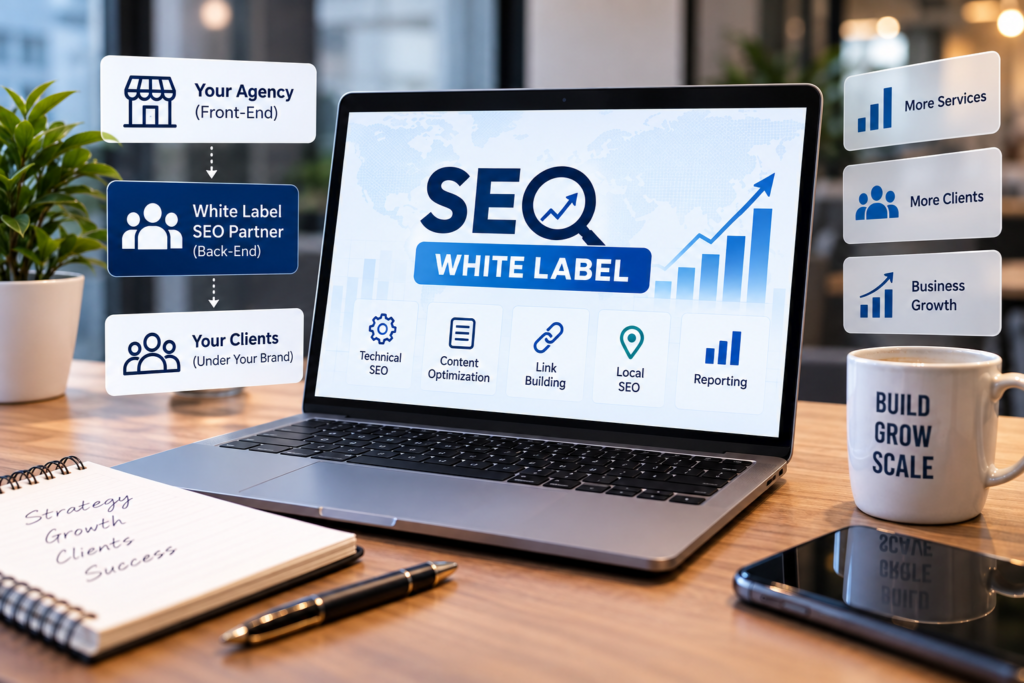
Digital marketing agencies often want to offer SEO without building a large in-house SEO team. Hiring specialists, managing campaigns, creating content, handling technical SEO, and preparing reports can require significant time and resources.
This is where white label SEO becomes useful.
White label SEO allows an agency to partner with an SEO provider that handles the delivery work while the agency presents the services under its own brand.
In simple terms, the SEO work is outsourced, but the client relationship remains with the agency.
What Is White Label SEO?
White label SEO is an arrangement where an SEO provider delivers services on behalf of another company, usually a digital marketing, web development, advertising, or branding agency.
The provider may handle tasks such as:
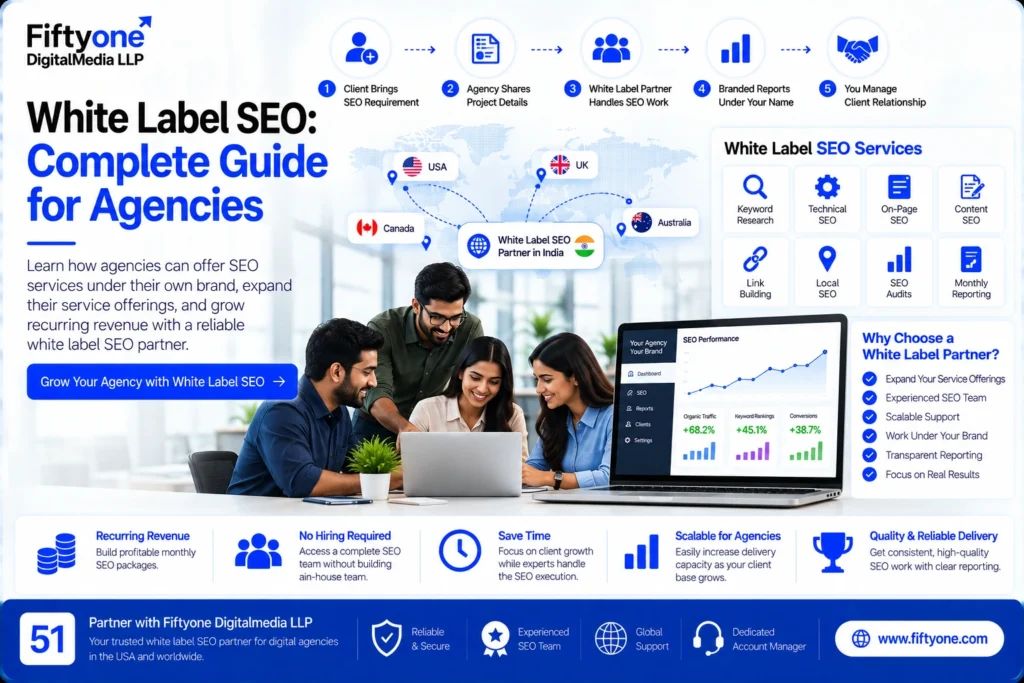
- Keyword research
- Technical SEO
- On-page optimization
- Content optimization
- Link building
- Local SEO
- SEO audits
- Monthly reporting
The agency then reviews and delivers the work to its own clients under its branding.
This model is also commonly called SEO reseller services or SEO fulfillment.
How Does White Label SEO Work?
The process is generally straightforward.
A marketing agency brings in a client that needs SEO. Instead of completing all the SEO work internally, the agency sends the project requirements to its white label SEO partner.
The SEO provider works in the background and prepares the required deliverables.
The agency remains responsible for the client relationship, communication, strategy alignment, and final presentation.
A typical workflow looks like this:
Client → Marketing Agency → White Label SEO Partner → SEO Delivery → Agency → Client
The exact workflow can vary depending on the partnership and the level of involvement required from the agency.
What Services Can Be White-Labeled?
A white label SEO partner can support different parts of an SEO campaign.
Technical SEO
This may include technical audits, crawlability checks, indexing issues, site structure, metadata, performance recommendations, and other technical improvements.
Keyword Research
The SEO team can identify relevant search terms based on the client’s industry, audience, competitors, and business goals.
On-Page SEO
This involves improving page titles, headings, content structure, internal linking, metadata, and other page-level elements.
Content SEO
Agencies can outsource SEO-focused content planning, briefs, optimization, and content production depending on the provider’s capabilities.
Link Building
Some providers offer link-building services as part of their white label SEO solutions. Agencies should evaluate the quality and relevance of the approach before offering it to clients.
Local SEO
For businesses serving specific locations, white label SEO can include local optimization, Google Business Profile support, citation management, and location-focused content.
Reporting
White label providers can also prepare campaign reports that agencies customize and present under their own branding.
Why Do Agencies Use White Label SEO?
The biggest attraction is flexibility.
An agency does not necessarily need to hire a separate SEO specialist for every capability it wants to offer.
Instead, it can use an experienced fulfillment partner while keeping its own team focused on sales, account management, strategy, design, development, or other services.
For agencies that already provide several digital marketing services, white label SEO can also make it easier to build a broader service offering.
If you are exploring how agencies can use this model for growth, see How Agencies Can Grow With White Label SEO.
White Label SEO vs In-House SEO
Both models have different operational requirements.
| Area | White Label SEO | In-House SEO |
|---|---|---|
| Hiring | Partner-based | Internal recruitment |
| SEO specialists | Provided by partner | Hired by agency |
| Management | Shared/outsourced | Internal |
| Scalability | Generally flexible | Depends on team capacity |
| Client relationship | Agency-owned | Agency-owned |
| SEO delivery | External partner | Internal team |
| Tools | Often provided by partner | Agency manages tools |
Neither model works identically for every agency.
The right approach depends on client volume, internal expertise, service requirements, management capacity, and long-term business plans.
What Should Agencies Look for in a White Label SEO Partner?
Choosing a provider is about more than finding someone who can complete SEO tasks.
Look at how the provider actually works.
1. Transparent Workflow
You should understand how campaigns are planned, executed, reviewed, and reported.
2. Quality Control
SEO deliverables should be reviewed before they reach your clients. This is particularly important for content, technical recommendations, and link-building activities.
3. Communication
A reliable communication process helps agencies handle client questions and project changes more efficiently.
4. Customization
Your clients may have different industries, locations, websites, and objectives. Avoid a fulfillment model that treats every campaign exactly the same.
5. Reporting
Reports should be understandable, useful, and suitable for your agency’s branding and client communication process.
6. Scalability
If your agency acquires additional SEO clients, your provider should have the capacity and workflow to support increasing workloads.
White Label SEO for International Agencies
White label SEO can be particularly useful for agencies serving clients across international markets.
An agency working with businesses in the USA, UK, Canada, Australia, Europe, UAE, Singapore, or New Zealand may need SEO campaigns adapted to different markets, search behavior, locations, and industries.
The important factor is not simply where the fulfillment team is located. What matters is whether the SEO process can be adapted to the target market and the client’s actual business objectives.
For agencies combining SEO with website services, White Label Web Development Solutions for Marketing Agencies can also complement an outsourced delivery model.
How to Manage a White Label SEO Partnership
A successful partnership needs clear responsibilities.
Before starting a campaign, establish:
- Who communicates directly with the client
- Who approves SEO strategies
- What deliverables are included
- How revisions are handled
- How often reports are provided
- How urgent requests are managed
- Who owns client communication
- What happens when campaign requirements change
Clear expectations reduce confusion and make the relationship easier to manage as the number of clients increases.
Common White Label SEO Mistakes
Agencies can run into problems when they choose a provider only because of low cost or a large list of promised services.
Other common issues include:
Using identical strategies for every client: SEO should consider the business, competition, website, market, and search intent.
Poor communication: Delayed updates can make client management difficult.
No quality review: Deliverables should be checked before reaching the client.
Unclear reporting: Clients need reports that explain meaningful progress rather than simply displaying large amounts of data.
Overpromising results: SEO is influenced by competition, search engine changes, website quality, content, and many other factors. Agencies should set realistic expectations.
Is White Label SEO Right for Your Agency?
White label SEO can make sense when an agency wants to offer SEO services without developing every SEO capability internally.
It may be particularly relevant for:
- Web development agencies
- Branding agencies
- PPC agencies
- Social media agencies
- Full-service digital agencies
- Marketing consultants
- Lead-generation companies
The key is finding a fulfillment partner whose processes, quality standards, communication, and delivery model fit your agency.
For a deeper look at the operational side of SEO fulfillment, see SEO Fulfillment for Agencies: A Complete Guide..
Conclusion
White label SEO gives agencies a practical way to expand their SEO services without building every SEO capability in-house. From keyword research and technical SEO to content, link building, local SEO, and reporting, agencies can outsource delivery while maintaining their own client relationships and brand.
The right white label SEO partner should offer reliable processes, quality control, clear communication, flexible services, and scalable support. With the right partnership, agencies can focus more on client growth and business development while an experienced SEO team handles the execution behind the scenes.
For agencies serving clients across international markets, white label SEO can also provide the flexibility needed to manage different industries, locations, and campaign requirements under one service model.