
White Label SEO vs Hiring an In-House SEO Team: Which Costs More?

Introduction
For a growing digital agency, adding SEO services can create an important business decision: should you build an in-house SEO team or use a white label SEO partner?
At first, the comparison can appear simple. One option involves hiring employees, while the other involves paying an external SEO provider. In reality, both models have several costs that are easy to overlook.
An in-house team requires salaries, recruitment, training, software, management, equipment, and ongoing employee development. White label SEO typically works differently because the agency pays for outsourced delivery based on its requirements.
Recent 2026 industry comparisons also highlight that the meaningful comparison is not simply salary versus SEO retainer. Agencies need to consider the total cost of building SEO capability, including tools, specialist coverage, management, recruitment, and unused capacity.
So, which costs more?
There is no universal answer. It depends on the agency’s client volume, SEO workload, internal resources, desired control, and how consistently SEO work needs to be delivered.
What Is White Label SEO?
White label SEO allows an agency to sell SEO services under its own brand while an external SEO team handles some or all of the fulfillment.
The agency maintains the client relationship, pricing, branding, and overall business relationship. The fulfillment partner works behind the scenes.
Depending on the arrangement, the external team may handle:
- Keyword research
- Technical SEO
- On-page SEO
- Content optimization
- SEO content
- Link building
- Local SEO
- International SEO
- Reporting
- Ongoing campaign execution
This model allows an agency to add SEO capacity without necessarily hiring specialists for every part of the SEO process.
What Does an In-House SEO Team Involve?
An in-house SEO team means hiring employees who work directly for the agency.
A small agency may start with one SEO specialist. As the client base grows, it may need additional expertise in technical SEO, content, outreach, analytics, strategy, and account management.
This creates an important consideration: one SEO employee does not necessarily provide the same range of capabilities as a complete SEO delivery team.
Modern SEO can involve technical optimization, content strategy, digital PR, link acquisition, analytics, local SEO, international SEO, and emerging search experiences. Current industry discussions similarly point out that agencies need to consider specialist coverage rather than treating SEO as one job role.
The Real Cost of an In-House SEO Team
The visible cost of an employee is usually their salary. But salary is only one part of the overall investment.
An agency may also need to account for:
- Recruitment and hiring
- Employee benefits
- Training
- SEO software
- Computers and equipment
- Management time
- HR administration
- Paid leave and absence
- Recruitment replacement
- Professional development
- Additional specialists as workload grows
This means comparing one employee’s salary against a white label provider’s fee can produce a misleading picture.
An agency should instead calculate the total cost of maintaining SEO capability internally.
The Cost Structure of White Label SEO
White label SEO generally has a different cost structure.
Instead of maintaining a permanent SEO department, the agency purchases external fulfillment according to its requirements.
Depending on the provider, this may involve a monthly package, individual services, client-based fulfillment, project-based work, or dedicated resources.
This can make costs more closely connected to actual client demand.
For example, if an agency has several SEO clients requiring ongoing fulfillment, it can outsource the work associated with those accounts instead of hiring multiple specialists before the workload justifies them.
Recent 2026 agency comparisons describe this distinction as fixed internal capability versus externally scoped delivery capacity.
White Label SEO vs In-House SEO: What Are You Actually Paying For?
The biggest difference is not simply where the SEO work happens.
You are paying for different operating models.
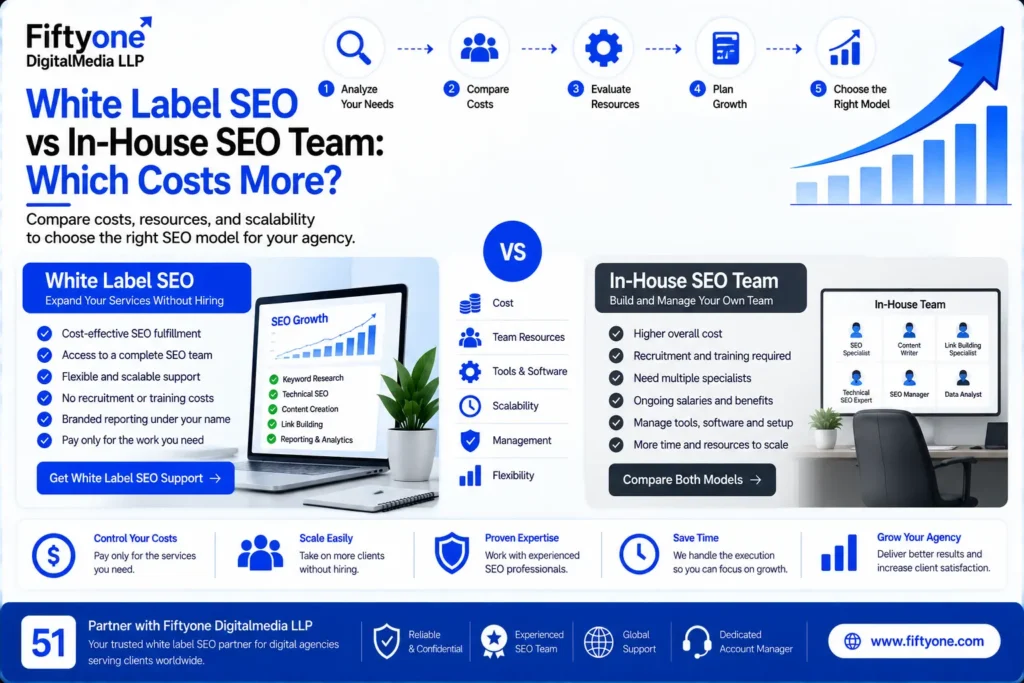
| Factor | White Label SEO | In-House SEO |
|---|---|---|
| Hiring | External provider handles delivery resources | Agency handles recruitment |
| SEO tools | Often included in provider’s workflow | Agency purchases and manages tools |
| Specialist coverage | Can access multiple specialists | Depends on employees hired |
| Capacity | Can generally be adjusted to workload | Limited by existing employees |
| Management | Shared through provider’s process | Managed directly by agency |
| Training | Provider manages its team | Agency manages employee development |
| Client ownership | Remains with agency | Remains with agency |
| Scalability | Scope can be adjusted as demand changes | Growth usually requires additional hiring |
| Internal control | Less direct control over execution | Greater direct control |
| Knowledge retention | Knowledge remains partly external | Knowledge develops inside the agency |
Neither structure is automatically suitable for every agency.
The right comparison depends on how much SEO work you have and how predictable that workload is.
Recruitment Can Become a Major Cost
Hiring an SEO specialist takes more than publishing a job advertisement.
An agency needs to define the role, find candidates, conduct interviews, evaluate experience, negotiate compensation, onboard the employee, and provide the necessary tools and processes.
The process can become more complicated when an agency needs multiple specialists.
For example, hiring one general SEO professional may not provide the same coverage as having dedicated expertise across technical SEO, content, and outreach.
Current 2026 industry sources also identify recruitment time and specialist coverage as important differences between internal and outsourced SEO models.
SEO Tools and Software
SEO requires access to research, analytics, reporting, crawling, keyword, content, and monitoring tools.
An in-house team needs the agency to purchase and manage the appropriate software.
With white label SEO, some of these tools may already be part of the provider’s operating infrastructure.
This does not mean tools are free in an outsourced model. Their cost is simply incorporated differently into the fulfillment arrangement.
Agencies should therefore ask prospective white label partners which tools, reporting systems, and platforms are included in the service.
Specialist Skills and Team Coverage
One of the biggest differences between the two models is access to specialist skills.
An in-house team may start with one generalist. If the agency later needs technical SEO, content strategy, outreach, local SEO, or international SEO expertise, it may need to hire additional people or use freelancers.
A white label provider can potentially offer access to several specialists within one delivery structure.
This can be useful for agencies whose SEO demand changes from month to month.
For example, one client may need technical SEO while another requires extensive content production. A flexible external team can allocate resources according to those requirements.
Capacity and Scalability
Agency workload is rarely perfectly predictable.
You may gain several SEO clients in one month and then experience a quieter period afterward.
With an in-house team, employee costs continue even when client demand temporarily decreases.
With white label fulfillment, the agency can often adjust the amount of outsourced work according to its client requirements.
This flexibility is one reason recent 2026 industry comparisons identify workload predictability and volume as important considerations when comparing internal and external SEO delivery.
Quality Control and Client Experience
Cost should never be considered separately from quality.
If an agency uses white label SEO, it needs a reliable quality-control process before work reaches the client.
The agency should review:
- Content quality
- Technical recommendations
- Keyword targeting
- Link-building practices
- Reports
- Brand consistency
- Client-specific requirements
An in-house team provides more direct control over daily execution, while a white label arrangement requires clear communication and quality standards between the agency and provider.
This is why the cheapest fulfillment arrangement is not necessarily the most useful one.
When In-House SEO Can Make Sense
An in-house SEO team can make sense when SEO is a major and consistent part of an agency’s business and there is enough ongoing work to keep specialists productive.
It can also be valuable when the agency wants SEO knowledge deeply integrated into its internal processes.
An internal team may provide closer day-to-day collaboration with designers, developers, content teams, sales teams, and account managers.
For agencies with stable, high-volume SEO demand, building internal expertise can become an important long-term capability. Industry comparisons likewise note that predictable, sustained workload is a key factor when considering internal hiring.
When White Label SEO Can Make Sense
White label SEO can be useful when an agency wants to add SEO services without immediately building a complete internal team.
It can also work well when SEO demand is growing but not yet predictable enough to justify several permanent hires.
For agencies with changing client requirements, external fulfillment can provide additional capacity without requiring a new recruitment process every time workload increases.
Our guide How Agencies Can Grow With White Label SEO, explains how agencies can use outsourced SEO delivery as part of their broader growth strategy.
The Hybrid SEO Model
Agencies do not necessarily have to choose only one model.
A hybrid approach can combine internal strategy with external fulfillment.
For example, an agency may keep an SEO strategist or account manager internally while using a white label team for technical work, content, link building, reporting, or campaign execution.
This can provide internal client knowledge while allowing the agency to access additional specialist capacity.
The hybrid approach can be particularly useful when an agency wants more control over strategy but does not want to hire every specialist required for delivery.
How to Compare the Two Models
Instead of asking only “Which is cheaper?”, agencies should compare the total operating requirements.
Consider:
- How many SEO clients do you currently have?
- How predictable is your SEO workload?
- Which SEO skills do you already have internally?
- Which specialists are missing?
- What SEO tools are required?
- How much management time is available?
- How quickly do you need additional capacity?
- How much control do you require over execution?
- How much client work can your current team realistically handle?
- Will your SEO workload change significantly over the next year?
This approach provides a much more useful financial comparison than looking at a salary or monthly fulfillment fee alone.
White Label SEO vs In-House SEO for International Agencies
For agencies serving clients across the UK, USA, Canada, Australia, Europe, New Zealand, UAE, Singapore, and other international markets, SEO requirements can vary significantly between clients.
Different markets may require different keyword research, content strategies, local optimization, technical SEO, and international targeting.
An agency may therefore need a broader range of SEO capabilities than a single employee can provide.
White label fulfillment can offer access to additional delivery capacity, while an internal team can provide deeper organizational knowledge and direct control.
The appropriate model depends on how the agency wants to structure its operations.
Why Choose Fiftyone Digitalmedia LLP?
Fiftyone Digitalmedia LLP provides white label SEO fulfillment support for digital agencies serving international clients.
Depending on the agency’s requirements, the support can include keyword research, technical SEO, on-page optimization, content, link-building support, reporting, and ongoing campaign fulfillment.
The objective is to provide agencies with additional SEO delivery capacity while allowing them to retain their own branding and client relationships.
For agencies that are not ready to build a complete internal SEO department, an external fulfillment model can provide another way to manage growing client demand.
Frequently Asked Questions
Is white label SEO cheaper than hiring an in-house team?
It depends on the agency’s workload, team requirements, tools, management costs, and client volume. White label SEO can reduce the fixed costs associated with building an internal team, while in-house SEO provides direct control over employees and processes.
What costs should be included when comparing in-house SEO?
Consider salaries, benefits, recruitment, software, equipment, training, management time, employee replacement, and the cost of hiring additional specialists as the workload grows.
Can a small agency use white label SEO?
Yes. White label SEO can be useful for agencies that want to offer SEO services without immediately hiring a full internal SEO department.
Can agencies combine white label and in-house SEO?
Yes. A hybrid model can keep strategy and client management internally while outsourcing selected SEO execution tasks.
Conclusion
Comparing white label SEO with an in-house SEO team is not simply a matter of comparing an employee’s salary with an outsourcing fee.
An in-house model involves recruitment, salaries, tools, training, management, employee capacity, and specialist coverage. White label SEO generally shifts more of the delivery responsibility to an external provider and allows the agency to adjust fulfillment around its client workload.
For agencies with stable and substantial SEO demand, building internal expertise may be worth considering. For agencies with fluctuating workloads, growing client demand, or gaps in specialist skills, external fulfillment can provide another operating model.
The most useful decision comes from calculating the total cost of SEO capability, not just the visible monthly or annual expense.
CTA
Looking to expand your SEO services without immediately building a larger internal team? Contact Fiftyone Digitalmedia LLPto discuss white label SEO fulfillment for your international agency clients.
