How Agencies Scale SEO Through Outsourcing
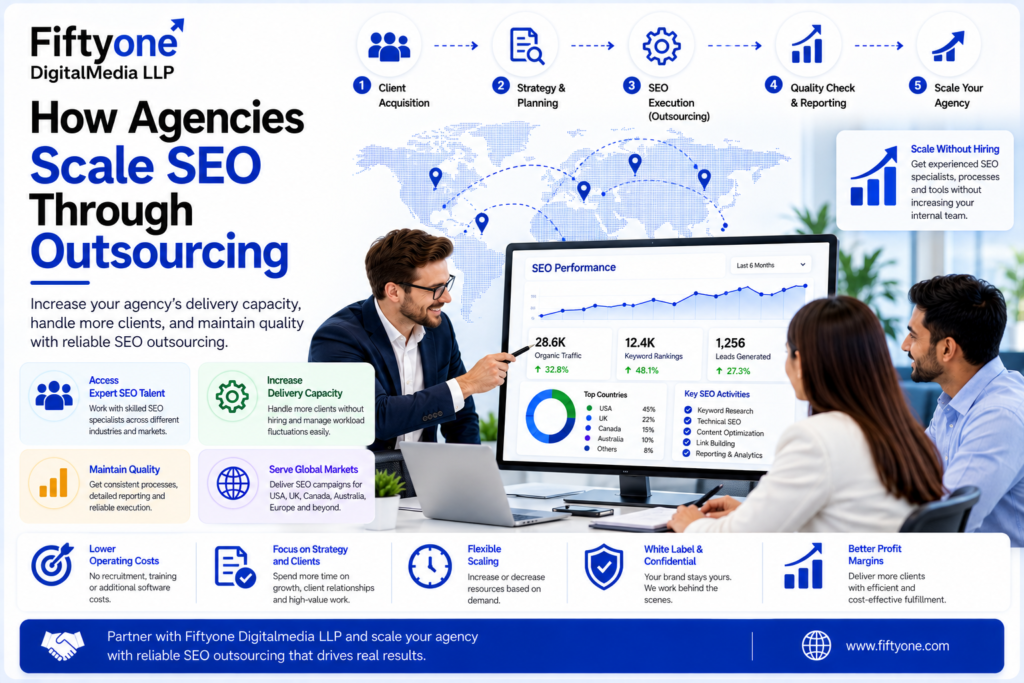

SEO is one of the most valuable services a digital agency can offer, but delivering SEO at scale can become difficult as the number of clients increases. More campaigns mean more keyword research, technical optimization, content production, reporting, competitor analysis, and ongoing communication.
For agencies, the challenge is not always finding SEO clients. The bigger challenge is maintaining consistent quality while handling a growing workload. Hiring new specialists every time the client list expands can increase costs and create management pressure.
This is why many agencies use SEO outsourcing as part of their growth strategy. By working with an experienced external team, agencies can increase their delivery capacity while keeping their focus on sales, client relationships, strategy, and business development.
Why Agencies Struggle to Scale SEO Internally
Managing a few SEO campaigns with a small internal team may be relatively simple. As the agency grows, however, every new client adds additional responsibilities.
An SEO team may need to manage technical audits, keyword research, content optimization, link-building campaigns, ranking analysis, reporting, and client-specific requirements at the same time. If the team grows more slowly than the client base, quality and turnaround times can suffer.
Hiring is another challenge. A growing agency may need SEO strategists, technical SEO specialists, content writers, link-building specialists, analysts, and account managers. Recruiting and training these specialists takes time and increases fixed operating costs.
Outsourcing can provide an alternative by allowing agencies to access additional SEO capacity without immediately expanding their permanent internal workforce.
What Does SEO Outsourcing Mean for Agencies?
SEO outsourcing means hiring an external SEO team or provider to handle some or all of the SEO execution for an agency’s clients.
The agency normally remains responsible for the client relationship and overall business strategy, while the outsourced team handles agreed campaign activities.
Depending on the arrangement, the external team may work on keyword research, technical SEO, content optimization, link building, competitor research, local SEO, reporting, or ongoing campaign management.
This creates a flexible structure where the agency can increase or decrease SEO resources according to client demand.
How Outsourcing Helps Agencies Increase SEO Capacity
The biggest advantage of outsourcing is that it allows an agency to increase its delivery capacity without increasing its internal workload at the same rate.
Imagine an agency has ten SEO clients and its internal team is already operating near capacity. If the agency wins another five clients, it has two choices: hire more employees or outsource part of the fulfillment.
With outsourcing, the agency can access additional specialists and processes without waiting for a long recruitment cycle. This makes it easier to accept new business while maintaining existing campaigns.
The model can be especially useful for agencies that have strong sales teams but limited SEO delivery capacity.
Which SEO Tasks Can Agencies Outsource?
Not every agency needs to outsource its entire SEO operation. Many choose a hybrid model where strategy and client communication remain internal while execution is handled by an external team.
Commonly outsourced activities include:
- Keyword research
- Technical SEO audits
- On-page optimization
- Content research and optimization
- SEO content production
- Link-building campaigns
- Local SEO
- Competitor research
- SEO reporting
- Performance monitoring
The right combination depends on the agency’s internal skills and the amount of control it wants to maintain.
Outsourcing vs. Building a Larger Internal SEO Team
Before outsourcing, agencies often compare the model with expanding their in-house team. Both approaches have advantages, but the financial and operational requirements are different.
An internal team provides direct control over hiring, processes, and day-to-day execution. However, it also creates ongoing costs related to salaries, recruitment, training, software, management, and employee retention.
Outsourcing provides more flexibility because resources can be adjusted according to demand.
| Factor | SEO Outsourcing | In-House SEO Team |
|---|---|---|
| Hiring | Lower requirement | Ongoing recruitment |
| Scalability | Flexible | Requires additional hiring |
| Training | Provider-managed expertise | Agency-managed |
| SEO Tools | Often provider-managed | Agency investment |
| Fixed Costs | Generally lower | Generally higher |
| Delivery Capacity | Can scale with demand | Limited by team size |
| Management | Shared | Fully internal |
For agencies in a growth phase, outsourcing can therefore provide a useful bridge between a small internal team and a large fully staffed SEO department.
How Agencies Can Maintain Quality While Outsourcing
Outsourcing only works effectively when there is a clear quality-control system. Sending work to an external provider without defined standards can create inconsistent results.
Agencies should establish clear expectations for content quality, technical SEO recommendations, reporting, turnaround times, communication, and approval processes.
A good workflow might look like:
Client Brief → SEO Strategy → Task Assignment → Execution → Quality Review → Agency Approval → Client Reporting
The agency should also maintain control over important strategic decisions. Outsourcing execution does not mean giving up ownership of the client’s SEO strategy.
Regular reviews can help identify problems early and keep campaigns aligned with client objectives.
How Outsourcing Can Improve Agency Profitability
Scaling SEO is not only about handling more clients. Agencies also need to make sure that additional clients contribute positively to profitability.
Suppose an agency sells an SEO package for $2,000 per month. If the agency can outsource fulfillment for $900, it has $1,100 remaining before accounting for account management, sales, software, communication, and other operational expenses.
The important point is that outsourcing should create a healthy margin while maintaining service quality.
Agencies should calculate their complete delivery cost before setting client pricing. This helps them avoid underpricing SEO services and ensures that growth does not simply increase workload without increasing profit.
For agencies already using white label services, the White Label SEO Pricing & Packages guide can provide additional context when structuring SEO offerings.
How to Build a Scalable SEO Outsourcing Workflow
A scalable outsourcing model needs standardized processes. If every client requires a completely different workflow, managing dozens of campaigns can quickly become complicated.
Agencies should create a repeatable onboarding process that collects website information, target locations, business goals, competitors, existing SEO data, important services, and keyword priorities.
Once the campaign begins, tasks should be assigned according to clear deadlines and responsibilities. Reporting should follow a consistent format while still highlighting client-specific results.
Technology can also help. Project-management platforms, SEO tools, communication systems, shared documents, and reporting dashboards can reduce unnecessary manual work and improve transparency.
The goal is to make the process predictable enough that adding another client does not require rebuilding the entire workflow.
Choosing the Right SEO Outsourcing Partner
The success of an outsourcing strategy depends heavily on the quality of the external partner. Agencies should evaluate more than pricing before making a decision.
Look for a provider with a clear SEO process, experienced specialists, consistent communication, professional reporting, and the ability to handle increasing workloads.
It is also useful to review sample deliverables before committing to a large number of campaigns. Agencies should understand how the provider approaches technical SEO, content, keyword research, link building, and reporting.
Another important consideration is confidentiality. In a white-label relationship, the provider should understand that the agency owns the client relationship and that the work may need to be delivered entirely under the agency’s branding.
Why Fiftyone Digitalmedia LLP Can Support SEO Outsourcing
Fiftyone Digitalmedia LLP provides digital marketing and white-label services alongside website and application development. The company’s website describes SEO, Google Ads, Meta Ads, social media marketing, and white-label development as part of its service offering.
For agencies, this broader capability can be useful when clients need SEO together with website development, landing-page improvements, design, or other digital services. The company’s website also states that its white-label development services are designed to help agencies increase delivery capacity without increasing overhead.
Agencies should still evaluate a potential outsourcing partner based on their own requirements, expected deliverables, communication standards, pricing, and quality expectations before starting a long-term engagement.
Frequently Asked Questions
How does SEO outsourcing help agencies scale?
SEO outsourcing gives agencies access to additional specialists and delivery capacity without requiring them to hire a new internal employee for every increase in client demand.
What SEO tasks can be outsourced?
Agencies can outsource keyword research, technical SEO, content optimization, content creation, link building, local SEO, competitor research, reporting, and campaign monitoring.
Is SEO outsourcing cheaper than hiring an internal team?
It can reduce fixed staffing and infrastructure costs, although the total value depends on the scope of work, provider pricing, internal management requirements, and client volume.
Can an agency outsource SEO and keep the client relationship?
Yes. Many agencies keep strategy, communication, and account management internally while an external team handles campaign execution.
How can agencies maintain SEO quality when outsourcing?
Clear briefs, defined deliverables, quality checks, regular communication, standardized processes, and consistent reporting can help maintain quality.
Is SEO outsourcing suitable for growing agencies?
Yes. It can be particularly useful when client demand is increasing faster than the agency’s internal SEO capacity.
Should agencies outsource all SEO work?
Not necessarily. A hybrid approach can work well, where the agency retains strategy and client management while outsourcing specialized or repetitive execution tasks.
What should agencies look for in an SEO outsourcing partner?
Consider SEO expertise, communication, reporting, quality standards, scalability, confidentiality, turnaround times, pricing, and the provider’s overall workflow.
Conclusion
SEO outsourcing can give agencies a practical way to increase delivery capacity without continuously expanding their internal workforce. Instead of allowing growing client demand to create hiring and operational pressure, agencies can use external specialists to support campaign execution.
The most effective approach is not simply to outsource as much work as possible. Agencies should build a structured model where strategy, communication, quality control, and client relationships remain clearly managed while specialized SEO execution is handled by a reliable partner.
With standardized workflows, transparent reporting, appropriate pricing, and the right outsourcing partner, agencies can handle more SEO campaigns while protecting service quality and profitability.
For agencies looking to grow beyond their current delivery capacity, Fiftyone Digitalmedia LLP can be considered as a potential digital fulfillment partner for SEO and complementary digital services.