
Outsource Web Development Without Losing Client Control

Introduction
For digital agencies, outsourcing web development can create additional technical capacity without requiring a large internal development team. However, many agency owners have one major concern: Will outsourcing cause them to lose control over their clients?
The concern is understandable. Agencies spend years building client relationships, developing trust, and establishing their brand. Handing technical work to an external development team should not mean handing over ownership of the client relationship.
With the right process, an agency can outsource website development while continuing to control communication, pricing, strategy, approvals, timelines, and final delivery.
The key is to create a clear separation between client management and technical execution.
What Does Outsourcing Web Development Actually Mean?
Outsourcing web development means using an external development team to handle some or all of the technical work required to build and maintain a website.
The agency remains responsible for the business relationship, while the development partner works according to the agency’s project requirements.
Depending on the project, outsourced development can include WordPress websites, Shopify stores, ecommerce development, landing pages, custom functionality, integrations, redesigns, and ongoing maintenance.
A simple structure looks like this:
Client → Digital Agency → Development Partner
The client works with the agency. The agency coordinates requirements and approvals, while the development partner focuses on implementation.
This model allows agencies to increase technical capacity without making every project dependent on their internal development resources.
Why Agencies Fear Losing Client Control
The biggest outsourcing concerns are usually not technical. They are related to the client relationship.
An agency may worry that an external developer could communicate directly with the client, create confusion about responsibilities, or become more visible than the agency itself.
Other concerns include:
- Losing control of project communication
- Client information being shared unnecessarily
- Unclear project responsibilities
- Development delays affecting the agency’s reputation
- Poor quality work reaching the client
- Clients discovering the external development partner
- Difficulty managing revisions
These problems are not unavoidable. They usually occur when an agency does not establish clear processes before outsourcing begins.
Keep Client Communication Under Your Agency
The simplest way to maintain client control is to keep client communication centralized.
The agency should remain responsible for discussing requirements, collecting feedback, explaining timelines, presenting completed work, and managing expectations.
The development team should receive requirements through the agency’s internal workflow.
For example:
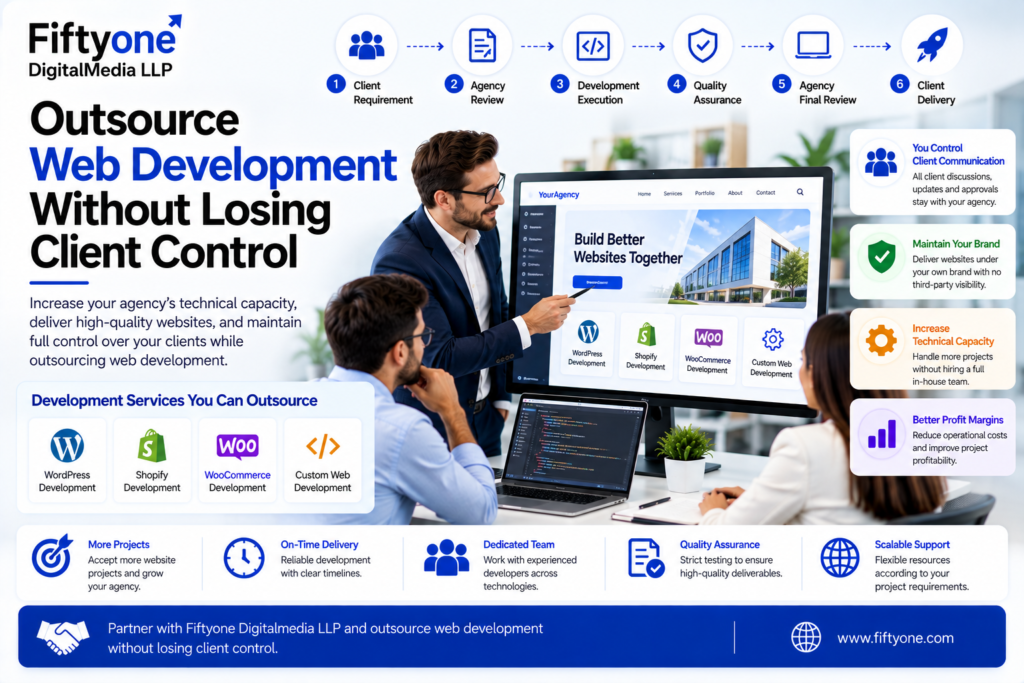
Client Requirement → Agency Review → Development Brief → Developer → Agency QA → Client Presentation
This creates a communication layer between the client and development team.
It also allows the agency to translate technical information into language that the client can easily understand.
Instead of the developer explaining a technical issue directly to the client, the agency can review the issue first and then communicate the appropriate solution.
This keeps the agency positioned as the client’s primary digital partner.
Define Roles Before Starting the Project
Client control becomes much easier when responsibilities are clearly documented.
Before beginning an outsourced project, establish who handles each part of the workflow.
| Responsibility | Agency | Development Partner |
|---|---|---|
| Client Communication | Yes | No, unless authorized |
| Project Strategy | Yes | Support |
| Client Pricing | Yes | No |
| Requirement Collection | Yes | Technical clarification |
| Development | Oversight | Yes |
| Testing | Final Review | Technical QA |
| Client Approval | Yes | No |
| Final Delivery | Yes | Technical Support |
| Maintenance | Manage Client | Execute Tasks |
This structure removes confusion and ensures the client knows who owns the relationship.
The exact responsibilities can vary depending on the project, but they should always be agreed upon before development starts.
Protect Client Information and Project Confidentiality
Confidentiality is another important part of outsourcing.
An agency may provide its development partner with access to website credentials, design files, databases, APIs, analytics systems, hosting accounts, or other sensitive project information.
Access should be limited to what is actually required.
Agencies should also consider appropriate confidentiality agreements and internal access procedures.
A professional outsourcing workflow should define:
Who can access the project?
Only people involved in the project should receive relevant credentials or files.
What information can be shared?
The development team should receive the information necessary to complete its responsibilities.
How are credentials handled?
Credentials should be shared securely and changed or revoked when access is no longer required.
Who owns the final project?
The agency should clearly establish ownership and usage rights in its agreements.
These steps help protect both the agency and its clients.
Use Your Own Project Management Process
Outsourcing does not mean the agency needs to abandon its existing project-management system.
In fact, the opposite is usually better.
If the agency already uses a project-management platform, task system, documentation process, or approval workflow, the development partner should work within that structure whenever practical.
A strong workflow can include:
- Client discovery
- Requirement documentation
- Project scope approval
- Design approval
- Development
- Internal testing
- Agency review
- Client review
- Revisions
- Final launch
This gives the agency visibility into project progress without requiring the client to manage the development team directly.
Maintain Control Over Pricing and Profit Margins
Another important aspect of client control is commercial control.
The development partner should not determine what the client pays unless the agency has specifically agreed to that arrangement.
The agency should control:
- Client pricing
- Service packages
- Project scope
- Payment terms
- Additional service charges
- Revision policies
- Maintenance packages
For example, an agency may purchase development fulfillment at an agreed cost and then create its own client package based on strategy, design, project management, development, and ongoing support.
This allows the agency to maintain its own pricing model and protect its margins.
Outsourcing should increase delivery flexibility without transferring commercial ownership to the development partner.
Create a Strong Approval Process
One of the easiest ways to lose control over an outsourced project is to allow development to move forward without structured approvals.
Agencies should create approval points throughout the project.
For example:
Requirement Approval → Design Approval → Development Review → Testing Approval → Final Client Approval
This gives the agency opportunities to identify problems before they reach the client.
It also reduces expensive revisions because major decisions are confirmed earlier in the process.
For larger websites, milestone-based approvals can be particularly useful.
Instead of waiting until the entire website is complete, the agency can review individual stages and provide feedback before the project moves forward.
How to Handle Client Feedback
Client feedback should ideally pass through the agency rather than directly to the external developer.
The agency can collect feedback, organize it, remove unnecessary requests, and convert it into clear development tasks.
For example, instead of forwarding a message saying:
“The client doesn’t like this page and wants it changed.”
The agency can provide a structured task:
Homepage Hero Section
- Replace current headline
- Increase CTA visibility
- Update button destination
- Maintain approved typography
- Complete revision by agreed milestone
This reduces misunderstandings and gives the development team clearer instructions.
More importantly, the agency remains the person interpreting the client’s business requirements.
What If the Client Wants to Speak Directly With the Developer?
Sometimes a client may request a technical discussion with the developer.
That does not automatically mean the agency has lost control.
The agency can remain involved by arranging a controlled technical meeting.
For example, the agency can join the meeting, introduce the developer, explain the purpose of the discussion, and remain responsible for follow-up actions.
The developer can answer technical questions while the agency continues managing the broader relationship.
The important principle is:
Technical access does not have to mean relationship ownership.
The agency can give the client access to technical expertise while remaining the primary strategic and commercial partner.
How to Choose an Outsourcing Partner Without Losing Control
The right development partner should fit into your agency’s workflow rather than forcing your agency to change its entire client-management model.
Before choosing a provider, evaluate:
Communication
Can the partner provide regular project updates and respond within agreed timelines?
Technical Expertise
Does the team have experience with the platforms and technologies your clients need?
Confidentiality
Are confidentiality expectations and access procedures clearly defined?
Quality Assurance
Does the development team test projects before handing them back to the agency?
Scalability
Can the partner handle additional projects when your agency grows?
Flexibility
Can the partner work according to your project-management process instead of requiring every project to follow its own system?
Reliability
Can the partner consistently meet agreed milestones?
Price is important, but it should not be the only deciding factor. A low-cost provider that creates repeated revisions or missed deadlines can ultimately cost the agency much more.
How Fiftyone Digitalmedia LLP Can Support Agencies
Fiftyone Digitalmedia LLP provides white-label development support designed for agencies that want to increase technical capacity while maintaining their own client relationships and brand positioning. The company’s website describes confidential white-label website, app, and design development support for agencies.
For an agency, the objective is not simply to find someone who can write code. The development partner needs to fit into the agency’s delivery process.
Fiftyone Digitalmedia LLP can support agencies that want external technical execution while keeping client communication, pricing, project strategy, and final approvals within their own business.
A structured outsourcing model can therefore give agencies additional development capacity without requiring them to surrender control over the client experience.
A Simple Framework for Controlled Web Development Outsourcing
Agencies can use a simple five-part framework when outsourcing development:
| Stage | Agency Control |
|---|---|
| 1. Discover | Understand client goals |
| 2. Define | Create detailed requirements |
| 3. Develop | Coordinate external technical work |
| 4. Review | Test and approve deliverables |
| 5. Deliver | Present the completed project to the client |
This framework keeps the agency involved throughout the project without requiring its internal team to perform every technical task.
The development partner becomes an extension of the delivery team rather than a replacement for the agency.
Frequently Asked Questions
1. Can I outsource web development and still own the client relationship?
Yes. The agency can remain responsible for client communication, strategy, pricing, approvals, and final delivery while an external team handles development.
2. Will my client know that I outsourced development?
That depends on the agreement and how your agency structures the relationship. In a white-label model, development can be delivered behind the agency’s brand, subject to appropriate confidentiality arrangements.
3. How can I prevent developers from contacting my clients directly?
Establish clear communication rules before the project starts. Client communication should normally pass through the agency unless a direct technical discussion has been specifically authorized.
4. Can I control project pricing when outsourcing?
Yes. The agency can establish its own client pricing, packages, scope, and commercial terms while paying the development partner an agreed fulfillment cost.
5. How do I maintain quality when outsourcing development?
Use clear requirements, milestone approvals, internal testing, structured feedback, and final agency review before delivering the project to the client.
6. Is outsourcing web development suitable for small agencies?
Yes. Outsourcing can give smaller agencies access to technical capacity without requiring them to immediately build a full-time development department.
7. Can an agency outsource ongoing website maintenance?
Yes. Website updates, bug fixes, performance improvements, feature additions, and other technical maintenance tasks can be included in an outsourcing arrangement.
8. What is the biggest mistake agencies make when outsourcing?
A common mistake is outsourcing the work without establishing ownership, communication, approval, confidentiality, and responsibility rules. A clear process should be created before development begins.
Conclusion
Outsourcing web development does not mean giving up control.
The agency can continue to own the client relationship, manage communication, determine pricing, control project strategy, approve deliverables, and present the final website while an external development team handles technical execution.
The key is to build a structured workflow where responsibilities are clearly separated.
When communication, confidentiality, project management, approvals, and quality control are handled properly, outsourcing can become an extension of the agency’s internal capabilities rather than a threat to client ownership.
For growing digital agencies, the goal should not be to control every line of code. The goal should be to control the client experience while using reliable technical resources to deliver the work efficiently.