
How Agencies Can Scale With White Label Services

Introduction
Growing a digital agency is not only about getting more clients. The real challenge is delivering more work without allowing costs, workload, and operational complexity to grow at the same speed.
An agency may have a strong sales pipeline but limited internal resources. As new clients arrive, existing teams can become overloaded with SEO campaigns, website development, content, design, advertising, and ongoing support.
This is wherewhite label services can provide a scalable delivery model.
Instead of building a large internal team for every service, agencies can partner with specialized providers that handle execution behind the scenes. The agency continues to manage the client relationship, strategy, pricing, and brand while the white label partner supports fulfillment.
The result can be a more flexible business model that allows agencies to increase capacity without immediately increasing permanent overhead.
What Are White Label Services?
White label services are services delivered by one company but sold by another company under its own brand.
For a digital agency, this means the agency can offer additional services to clients without necessarily performing every task internally.
For example, an agency may sell:
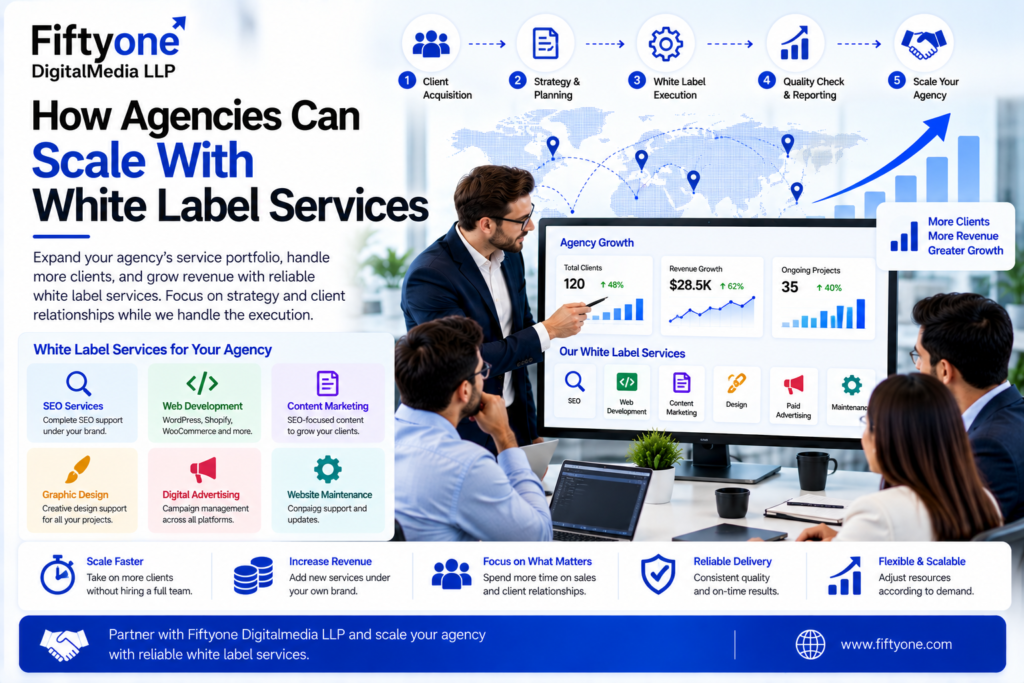
- SEO services
- Website development
- Ecommerce development
- Content marketing
- Graphic design
- Social media services
- Technical SEO
- Website maintenance
The fulfillment partner handles the agreed work while the agency remains responsible for the client-facing experience.
The model is particularly useful when an agency wants to expand its service portfolio but does not want to build a separate department for every new service.
Why Agencies Struggle to Scale Traditionally
Traditional agency growth often depends heavily on hiring.
When an agency wins more clients, it hires more employees. When service demand increases, it recruits additional specialists. As the team becomes larger, management requirements also increase.
This creates several challenges.
Recruitment can take weeks or months. New employees require onboarding and training. Additional team members also create recurring salary, software, equipment, and management costs.
There is also the problem of uneven demand.
An agency may need five additional developers during a busy period but have significantly less development work later. Maintaining the same team size throughout these fluctuations can reduce operational efficiency.
White label services provide another way to handle changing demand.
How White Label Services Help Agencies Increase Capacity
The biggest advantage of white label fulfillment is additional delivery capacity.
Suppose an agency has enough sales capability to acquire 20 new clients but its internal team can only handle 10 additional campaigns. The agency has a capacity problem rather than a sales problem.
A white label partner can provide additional fulfillment capacity.
This allows the agency to accept more work while keeping its internal team focused on the areas where it creates the most value.
The agency can concentrate on:
Sales: Finding and converting new clients.
Strategy: Developing campaigns and business recommendations.
Account Management: Maintaining strong client relationships.
Branding: Building the agency’s market position.
Quality Control: Reviewing completed work before it reaches clients.
The white label partner handles the agreed execution tasks behind the scenes.
Which Services Can Agencies Scale With White Label Support?
White label services are not limited to SEO. Agencies can use external fulfillment across multiple areas depending on their business model.
SEO
SEO is one of the most common areas agencies outsource because campaigns require ongoing research, optimization, content, technical work, and reporting.
Web Development
Agencies can offer website development, ecommerce stores, landing pages, redesigns, integrations, and maintenance without maintaining a large development department.
Content Marketing
Content fulfillment can include blog articles, landing-page content, website copy, and other SEO-focused content requirements.
Design
Agencies can expand their creative capacity through graphic design, UI/UX design, social media creatives, branding assets, and marketing materials.
Digital Advertising
Paid advertising fulfillment can support agencies that want to offer campaign management without hiring specialists for every advertising platform.
The best service mix depends on the agency’s existing strengths and its target clients.
White Label Services vs. Building Everything In-House
Both approaches can work, but they have different operational characteristics.
| Factor | White Label Model | In-House Model |
|---|---|---|
| Initial Investment | Lower | Higher |
| Hiring Requirement | Flexible | Continuous as demand grows |
| Scalability | High | Depends on team capacity |
| Fixed Costs | Lower | Higher |
| Specialist Access | Through partner | Through employees |
| Capacity Expansion | Faster | Requires recruitment |
| Management | Shared | Fully internal |
| Service Expansion | Easier | More resource intensive |
| Client Ownership | Agency controlled | Agency controlled |
For agencies with predictable, high-volume demand, building an internal team can eventually make sense.
For agencies dealing with changing demand or trying to expand services quickly, white label fulfillment can provide greater flexibility.
How White Label Services Can Improve Agency Margins
Scaling revenue does not automatically mean scaling profit.
If an agency wins more clients but has to increase its internal payroll, management costs, software expenses, and infrastructure at the same rate, the additional revenue may not create the expected profit.
White label fulfillment can change this equation.
The agency can establish service packages, determine client pricing, and manage its fulfillment cost.
For example:
| Service Package | Client Need | Fulfillment Model |
|---|---|---|
| SEO Starter | Basic organic growth | SEO fulfillment |
| SEO Growth | Competitive search visibility | SEO + content |
| Website Package | New business website | Web development |
| Ecommerce Package | Online store | Shopify/WooCommerce development |
| Growth Package | Multiple digital services | Combined fulfillment |
| Maintenance | Ongoing support | Monthly technical fulfillment |
The agency’s actual margin will depend on pricing, fulfillment cost, client retention, sales expenses, and the amount of internal work required.
The goal should be to create packages that are profitable and repeatable rather than simply selling more services.
Build Standardized White Label Packages
One of the best ways to scale is to stop treating every project as completely unique.
Agencies can create standardized packages with clearly defined deliverables, timelines, revision limits, reporting formats, and support terms.
For example, an agency could create three SEO packages instead of creating a completely custom SEO proposal for every client.
The same principle can be applied to web development.
A website package might include a fixed number of pages, responsive development, contact forms, basic technical setup, testing, and launch support.
Standardization makes the sales process easier and gives the fulfillment partner clearer instructions.
It also makes profitability easier to measure.
Create a Clear White Label Workflow
A white label partnership works best when responsibilities are defined before projects begin.
A scalable workflow can look like:
Lead Generation → Sales → Client Discovery → Strategy → Project Brief → White Label Fulfillment → Agency QA → Client Delivery → Reporting → Retention
The agency should remain involved at the strategic and quality-control stages.
The fulfillment partner should receive clear instructions and deadlines rather than incomplete client messages.
A detailed project brief should normally include:
- Client goals
- Target audience
- Required services
- Project scope
- Deliverables
- Design references
- Target locations
- Keywords where applicable
- Deadlines
- Approval requirements
- Reporting expectations
Better project documentation generally creates fewer misunderstandings and revisions.
Keep the Client Relationship With Your Agency
Scaling through white label services should not mean giving away the client relationship.
The agency should continue controlling the client-facing experience.
Client communication, pricing, strategic recommendations, approvals, and final delivery can remain within the agency.
The fulfillment team works as an extension of the agency’s delivery operation.
This creates an important distinction:
The agency owns the relationship.The white label partner supports execution.
That separation allows agencies to use external expertise while continuing to build their own brand and reputation.
For agencies concerned about client control, this model can be particularly valuable when communication and confidentiality procedures are clearly established.
How White Label Services Help Agencies Enter New Markets
A growing agency may have strong demand in one market but limited resources to expand into another.
White label fulfillment can make expansion easier because the agency does not need to build a completely new delivery department before entering the market.
For example, an agency focused on SEO could add web development to its service portfolio. A web design agency could add SEO and content. A branding agency could add website development and digital marketing.
This creates opportunities to sell more comprehensive solutions to existing clients.
Instead of being known for one service, the agency can gradually become a broader digital partner.
How to Maintain Quality While Scaling
More capacity is useful only when quality remains consistent.
Agencies should establish a quality-control system before increasing project volume.
A practical process can include:
Brief Review: Confirm that requirements are complete.
Milestone Review: Check progress before the project reaches the final stage.
Quality Assurance: Test the completed work.
Agency Approval: Review the deliverables internally.
Client Delivery: Present the approved work to the client.
Feedback Management: Collect and organize revisions.
This process creates a buffer between fulfillment and the client.
It also allows the agency to identify problems before they affect the customer experience.
How to Choose the Right White Label Partner
The wrong partner can create more problems than it solves.
Agencies should evaluate potential providers based on more than price.
Look at their technical or marketing expertise, communication process, turnaround times, quality-control procedures, scalability, confidentiality, and ability to follow agency workflows.
A good partner should be able to handle increased project volume without sacrificing communication or quality.
It is also useful to start with a smaller number of projects before moving into a larger long-term arrangement.
This gives the agency an opportunity to evaluate the partner’s actual delivery process.
Why Fiftyone Digitalmedia LLP Can Support Agency Scaling
Fiftyone Digitalmedia LLP offers white-label development and digital marketing support designed for agencies that want to expand delivery capacity while maintaining their own client relationships and brand positioning. The company’s website specifically describes its white-label development partnership as a way for agencies to scale without increasing overhead.
For agencies, the objective is not simply to outsource individual tasks. The larger opportunity is to build a repeatable delivery system that can support additional clients and services.
Fiftyone Digitalmedia LLP can support agencies looking for flexible fulfillment across areas such as website development, app development, design, and digital marketing.
When the workflow, communication, quality control, and responsibilities are clearly defined, a white label partnership can become an extension of the agency’s internal delivery team.
Frequently Asked Questions
1. How do white label services help agencies scale?
White label services give agencies additional fulfillment capacity, allowing them to accept more clients and expand their service offerings without immediately building large internal teams.
2. Can small agencies use white label services?
Yes. Small agencies can use white label fulfillment to offer services that they do not currently have the resources to deliver internally.
3. What services can be offered through white label partnerships?
Common services include SEO, web development, ecommerce development, content marketing, design, paid advertising, social media, and website maintenance.
4. Will the agency still own the client relationship?
Yes. In a typical white label arrangement, the agency controls client communication, pricing, strategy, and final delivery while the partner handles agreed fulfillment work.
5. Can white label services increase agency profitability?
They can. White label fulfillment can help agencies increase service capacity while avoiding some of the fixed costs associated with building large internal teams. Profitability still depends on pricing, fulfillment costs, client retention, and overall operations.
6. How can agencies maintain quality while outsourcing?
Agencies should use detailed briefs, defined deliverables, milestone reviews, quality assurance, internal approval, and structured client feedback processes.
7. Is white label better than hiring employees?
It depends on the agency. White label services offer flexibility, while an internal team provides direct control. Many agencies use a combination of internal employees and external fulfillment as they grow.
8. What should agencies look for in a white label partner?
Look for expertise, reliable communication, consistent quality, scalability, confidentiality, transparent processes, and the ability to work according to your agency’s workflow.
Conclusion
Scaling an agency is not simply about acquiring more clients. It is about creating a delivery system capable of handling growth without allowing operational complexity to grow uncontrollably.
White label services can give agencies the additional capacity needed to expand SEO, web development, content, design, and other digital services without building every department internally.
The strongest model is one where the agency retains control over its brand, client relationships, pricing, strategy, and quality while a reliable partner supports execution.
With standardized packages, clear workflows, strong quality control, and the right fulfillment partner, agencies can build a more flexible model for sustainable growth.
The goal is not to build the biggest internal team. The goal is to build the most scalable delivery system.