
Web Development Outsourcing: How Agencies Can Scale Faster

Introduction
Digital agencies often reach a point where winning new clients is easier than delivering all the work with their existing team.
A growing client base can quickly increase website projects, ecommerce builds, landing pages, redesigns, integrations, maintenance requests, and custom development requirements. When internal developers are already working at full capacity, taking on additional projects can create delays and operational pressure.
Hiring more developers may seem like the obvious solution, but recruitment can take time and create additional fixed costs. Agencies also need to manage salaries, training, software, infrastructure, employee retention, and technical management.
Web development outsourcing provides another way to increase delivery capacity.
Instead of building a larger development department for every stage of growth, an agency can work with an external development team to handle technical execution. Fiftyone Digitalmedia LLP can provide additional development capacity while the agency maintains control over client relationships, communication, and project management.
For agencies that want to grow faster without allowing development bottlenecks to slow them down, outsourcing can become an important part of their operating model.
What Is Web Development Outsourcing?
Web development outsourcing means assigning some or all development tasks to an external team instead of completing every technical activity internally.
The agency remains responsible for the client relationship and overall project direction, while the outsourcing partner handles agreed development responsibilities.
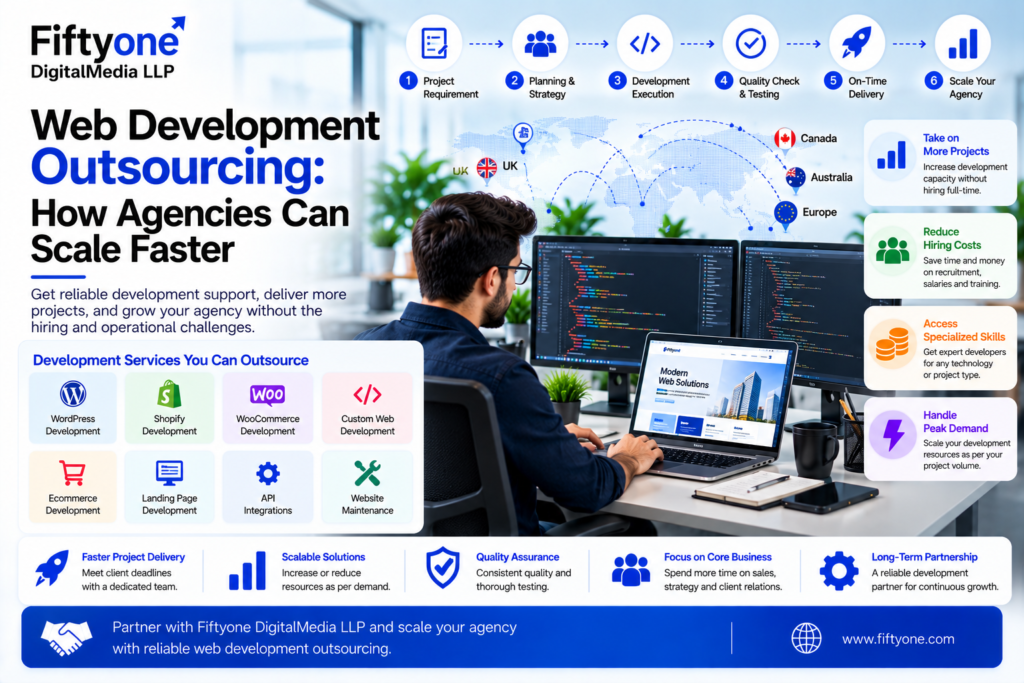
Depending on the agency’s requirements, outsourced development can include:
- Business website development
- WordPress development
- Shopify development
- WooCommerce development
- Ecommerce development
- Landing page development
- Custom web applications
- API integrations
- Website redesigns
- Website maintenance
- Performance optimization
The agency can choose whether to outsource individual projects, specific technical tasks, or ongoing development work.
This flexibility makes outsourcing useful for both smaller agencies and established agencies managing fluctuating project volumes.
Why Growing Agencies Struggle With Development Capacity
Agency growth creates a unique operational problem.
When sales increase, the number of projects increases. But technical capacity does not automatically increase at the same speed.
An agency may have enough designers and account managers but only a limited number of developers. As a result, projects can start accumulating in the development pipeline.
Common problems include:
Development Backlogs
Projects remain waiting for developer availability, making it difficult to meet promised deadlines.
Too Many Simultaneous Projects
Developers may have to switch between several projects, reducing focus and increasing the possibility of mistakes.
Recruitment Delays
Hiring additional developers takes time, especially when agencies need people with specific technical skills.
Rising Fixed Costs
Adding permanent employees increases monthly operating expenses regardless of how much development work is available.
Missed Growth Opportunities
Some agencies may hesitate to accept larger projects because they are uncertain whether their internal team can handle the workload.
Outsourcing can help address these capacity limitations without requiring every new project to result in another permanent hire.
How Web Development Outsourcing Helps Agencies Scale Faster
The primary advantage of outsourcing is additional capacity.
When an agency has access to external developers, it can distribute work more effectively and accept projects that might otherwise exceed its internal capacity.
Take on More Projects
An agency does not necessarily have to reject a new project simply because its internal development team is busy.
Additional technical resources can help increase project capacity.
Reduce Development Bottlenecks
When internal developers are overloaded, outsourced resources can handle selected projects or technical tasks.
This keeps the development pipeline moving.
Access Specialized Skills
Some projects require technologies or expertise that the agency does not use regularly.
Instead of hiring a permanent specialist for occasional requirements, the agency can access external expertise when needed.
Handle Peak Demand
Project demand is not always consistent.
An agency may have a particularly busy quarter because of multiple website launches, ecommerce projects, or seasonal campaigns.
Outsourcing allows development capacity to increase when demand increases.
What Development Tasks Can Agencies Outsource?
Agencies do not need to outsource their entire development operation.
A more practical approach is often to identify activities that can be delegated without affecting the agency’s core client-management capabilities.
| Development Requirement | Outsourcing Potential | Agency Responsibility |
|---|---|---|
| WordPress Development | High | Requirements & approval |
| Shopify Development | High | Client strategy |
| Ecommerce Development | High | Scope & project management |
| Landing Pages | High | Design direction |
| Website Redesigns | High | Client communication |
| API Integration | High | Technical requirements |
| Custom Features | High | Business logic approval |
| Maintenance | High | Client coordination |
| Bug Fixes | High | Prioritization |
| Performance Optimization | High | Final review |
The agency can retain strategic and client-facing responsibilities while using external resources for technical implementation.
Outsourcing vs. Hiring an In-House Development Team
Both approaches have advantages, but they support different growth models.
| Factor | Outsourcing | In-House Hiring |
|---|---|---|
| Recruitment | Minimal | Required |
| Fixed Costs | More flexible | Higher |
| Resource Scaling | Faster | Slower |
| Specialist Access | Flexible | Requires hiring |
| Training | Reduced | Agency responsibility |
| Peak Workload Support | Strong | Limited by team size |
| Employee Management | Lower | Higher |
| Project Flexibility | High | Depends on availability |
| Long-Term Internal Control | Lower | Higher |
| Suitable For | Growing/fluctuating demand | Consistent high workload |
For agencies with a predictable and consistently high development workload, building an internal team may make sense.
For agencies experiencing changing demand or rapid growth, outsourcing can provide additional flexibility.
Many agencies can also use a hybrid model where project management and core development remain internal while external developers provide additional capacity.
How Outsourcing Can Improve Project Delivery
Speed is one of the most important factors in agency-client relationships.
A client may not care whether a website was built by an internal employee or an external development partner. They care about whether the project meets expectations and launches on time.
A structured outsourcing model can help agencies improve delivery by distributing technical work according to availability and expertise.
For example:
Client Requirement → Agency Planning → Development Brief → External Development → Quality Testing → Agency Review → Client Approval → Launch
This allows the agency to remain involved throughout the project without requiring its internal team to perform every technical task.
The development partner becomes an extension of the agency’s delivery resources.
How Web Development Outsourcing Can Support Agency Profitability
Outsourcing should not be viewed only as a way to reduce development costs.
It can also improve the relationship between project capacity and revenue.
Suppose an agency has enough sales capacity to generate ten website projects but its internal team can only deliver six.
The agency may have to delay or reject four opportunities.
By adding external development capacity, the agency can potentially accept more projects without immediately increasing permanent headcount.
However, profitability depends on more than revenue.
Agencies should consider:
- Client acquisition cost
- Development fulfillment cost
- Internal project-management time
- Revision costs
- Quality assurance
- Software and infrastructure
- Client retention
- Project margins
The goal should be to create a predictable delivery model where outsourcing costs are included in the agency’s pricing strategy.
How to Maintain Quality When Outsourcing
Scaling faster only helps when quality remains consistent.
Agencies should establish clear standards before assigning projects to an external development team.
Detailed Requirements
Every project should have clear functionality, design references, technical requirements, and deadlines.
Development Standards
Coding practices, platform requirements, browser compatibility, responsiveness, and performance expectations should be defined.
Milestone Reviews
Large projects should be reviewed at multiple stages rather than only at final delivery.
Quality Assurance
Websites should be tested across relevant devices and browsers before reaching the client.
Agency Approval
The agency should complete a final review before presenting the project as finished.
A structured quality process reduces revisions and protects the agency’s reputation as project volume increases.
How Agencies Can Build a Scalable Outsourcing Workflow
A scalable process is more important than simply finding developers.
The agency should create a repeatable workflow that can be used for every project.
1. Project Discovery
Understand the client’s business objectives, target audience, functionality, and technical requirements.
2. Scope Definition
Document exactly what will be delivered and what is outside the project scope.
3. Development Brief
Convert client requirements into clear technical tasks.
4. Resource Allocation
Assign the project to the appropriate development resources.
5. Development
The external team completes the agreed technical work.
6. Internal QA
The agency reviews functionality, design implementation, responsiveness, and performance.
7. Client Review
The agency presents the completed work to the client and collects structured feedback.
8. Launch and Support
After approval, the project is launched and ongoing maintenance can be managed through the same workflow.
This process allows agencies to increase project volume without creating completely new systems for every client.
How to Protect Your Agency’s Client Relationship
Outsourcing development does not mean outsourcing the client relationship.
The agency should continue controlling:
- Client communication
- Project pricing
- Scope
- Strategy
- Approvals
- Timelines
- Final delivery
- Client feedback
The development partner should primarily focus on technical execution.
This separation allows the agency to use external expertise while maintaining ownership of the customer experience.
It also prevents communication problems that can occur when multiple teams contact the client without a clear structure.
How to Choose the Right Development Partner
The right outsourcing partner should be able to work as an extension of the agency rather than operating as a disconnected vendor.
Before choosing a partner, agencies should evaluate:
Technical Expertise: Does the team have experience with the platforms and technologies your clients require?
Communication: Can the team provide timely updates and respond to project questions?
Quality Assurance: Is there a structured testing process?
Scalability: Can the partner handle additional projects when demand increases?
Project Management: Can the partner work with your existing workflow?
Confidentiality: Are client information and project assets protected?
Turnaround Time: Can the partner consistently meet agreed milestones?
Flexibility: Can the team adapt to different project sizes and requirements?
Price should be considered, but selecting a development partner solely because it is cheap can create larger costs through delays, revisions, and poor client experiences.
Why Fiftyone Digitalmedia LLP Can Support Agency Growth
Fiftyone Digitalmedia LLP supports agencies that need additional web development capacity without continuously expanding their permanent internal teams.
The company provides development support across areas such as websites, ecommerce, custom development, and other digital solutions, allowing agencies to use external technical resources according to project requirements.
For an agency, the objective is not simply to outsource coding. The more valuable goal is to create a scalable delivery system where external developers can work according to the agency’s requirements while the agency continues managing its clients.
A reliable development partner can therefore help agencies accept more projects, reduce technical bottlenecks, and focus internal resources on business development and client relationships.
Common Web Development Outsourcing Mistakes
Choosing Only on Price
The cheapest development partner may not provide the quality or reliability required for professional agency projects.
Providing Poor Project Documentation
Unclear requirements often create unnecessary revisions and delays.
Outsourcing Without Quality Control
Agencies should always review completed work before delivering it to clients.
Promising Unrealistic Deadlines
External developers can increase capacity, but every project still requires realistic planning.
Ignoring Communication Processes
Without clear communication rules, project updates and client feedback can become confusing.
Outsourcing Everything Immediately
Agencies should identify which tasks make sense to outsource instead of transferring their entire development operation without a clear strategy.
Frequently Asked Questions
1. What is web development outsourcing for agencies?
Web development outsourcing allows an agency to use an external development team to handle website and technical projects while the agency manages the client relationship, strategy, and project direction.
2. Can small agencies outsource web development?
Yes. Outsourcing can be particularly useful for small agencies that want to offer development services without maintaining a large permanent technical team.
3. What web development services can agencies outsource?
Agencies can outsource WordPress, Shopify, ecommerce, custom development, landing pages, API integrations, website maintenance, redesigns, bug fixes, and performance optimization.
4. Does outsourcing help agencies accept more clients?
It can. Additional development resources can increase technical capacity and help agencies handle projects when internal teams are already busy.
5. Is outsourcing cheaper than hiring developers?
The cost depends on project volume, engagement model, skill requirements, and internal management costs. Outsourcing can provide more flexibility because agencies do not necessarily have to add permanent employees for temporary demand.
6. How can agencies maintain quality while outsourcing?
Agencies should use detailed requirements, development standards, milestone reviews, quality assurance, structured feedback, and final internal approval.
7. Can outsourced developers communicate directly with clients?
They can if the agency specifically allows it, but many agencies prefer to keep client communication centralized to maintain control over the relationship.
8. Is outsourcing suitable for long-term development work?
Yes. Agencies can use external teams for individual projects, ongoing maintenance, dedicated resources, or long-term development support depending on their requirements.
Conclusion
Web development outsourcing can give agencies the additional technical capacity they need to scale faster without making every increase in project volume dependent on internal hiring.
By using external development resources, agencies can handle more projects, access specialized expertise, reduce development bottlenecks, and respond more effectively to changing client demand.
The most successful outsourcing model is built around clear requirements, reliable communication, quality assurance, defined responsibilities, and a repeatable project workflow.
Agencies should view outsourcing as an extension of their delivery capabilities rather than simply a way to reduce costs.
When the right development partner is integrated into the agency’s workflow, the agency can spend more time winning clients, building relationships, developing strategy, and growing the business while technical execution is handled efficiently behind the scenes.
For agencies planning long-term growth, web development outsourcing can become a scalable way to increase capacity without allowing recruitment and internal development limitations to slow down new business opportunities.
Fiftyone Digitalmedia LLP can support this model by providing development resources that work within an agency’s delivery process while the agency remains focused on its clients, brand, and growth strategy.