
WordPress vs Custom Website: Which Is Better?
Introduction
When businesses plan a new website, one of the biggest decisions is choosing between WordPress and a custom-built website.
The problem is that these two options are often compared incorrectly.
WordPress is sometimes described as the cheaper and easier option, while custom development is presented as the more advanced choice. Neither statement is always true.
A WordPress website can be highly customized, while a custom-built website can be unnecessarily complex for a simple business requirement.
The right choice depends on what the business actually needs from its website.
Instead of asking which option is universally better, businesses should compare where each approach performs best.
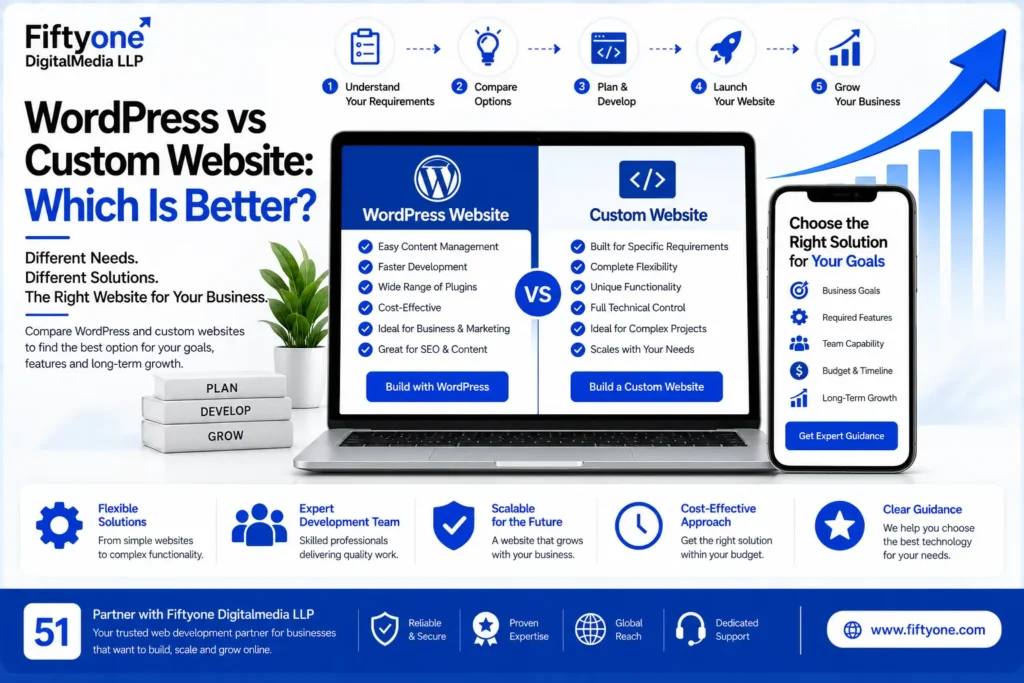
WordPress vs Custom Website at a Glance
| Factor | WordPress | Custom Website |
|---|---|---|
| Content management | Easy for most users | Depends on the system built |
| Development speed | Usually faster | Often requires more development |
| Flexibility | High with themes and plugins | Complete flexibility |
| Custom functionality | Possible with development | Built specifically for requirements |
| Maintenance | Regular updates required | Depends on the technology |
| Scalability | Suitable for many growing businesses | Designed around specific needs |
| Content publishing | Strong | Requires custom CMS or solution |
| Technical control | Shared with platform ecosystem | Full control over architecture |
The table gives a broad comparison, but the decision requires more context.
Choose WordPress If Content Is Important
WordPress is primarily a content management system.
Businesses that regularly publish blog posts, service pages, case studies, news, resources, or other content often benefit from its content management capabilities.
Teams can usually manage pages without depending on a developer for every small change.
This makes WordPress useful for:
- Company websites
- Blogs and publishing platforms
- Content-driven businesses
- Service businesses
- Marketing websites
- Lead generation websites
- Many ecommerce websites
For businesses investing heavily in SEO and content marketing, easy content management can be a major advantage.
The ability to create, edit, organize, and optimize content without rebuilding the system can reduce dependency on technical teams.
Choose a Custom Website When Requirements Are Highly Specific
Custom development becomes more useful when the website requires functionality that does not fit standard WordPress structures.
For example, a business may need:
- Complex user dashboards
- Proprietary workflows
- Advanced data processing
- Custom customer portals
- Unique booking systems
- Large-scale application functionality
- Specialized integrations
In these situations, trying to force everything into WordPress may create unnecessary complexity.
A custom website allows the technical architecture to be built around the exact requirements.
However, businesses should be careful not to choose custom development simply because it sounds more advanced.
Complex technology does not automatically create a better website.
The Real Difference: Website vs Web Application
One reason businesses become confused is because “custom website” can mean different things.
A standard business website and a web application are not the same thing.
A business website mainly provides information, generates leads, publishes content, or sells products.
A web application may involve users logging in, managing data, completing workflows, accessing dashboards, or interacting with complex systems.
WordPress is often an excellent choice for a business website.
A custom-built solution may be more appropriate for a product or platform that functions like software.
Understanding this difference can prevent businesses from overbuilding a simple website.
WordPress Offers More Flexibility Than Many Businesses Expect
WordPress is not limited to installing a theme and changing colors.
A professional WordPress development team can build:
- Custom themes
- Custom plugins
- Custom functionality
- Ecommerce systems
- Membership platforms
- API integrations
- Advanced forms
- Multi-language websites
The difference is that WordPress provides an existing foundation.
Custom development starts with fewer predefined components and gives developers complete control over the technology and architecture.
For many businesses, WordPress already provides enough flexibility without requiring everything to be built from scratch.
Content Management Is a Major Decision Factor
Ask one question before choosing a platform:
Who will manage the website after launch?
If the marketing team needs to regularly update pages, publish articles, change content, and manage campaigns, WordPress can make these tasks easier.
A custom-built website may also include a content management system, but that system needs to be developed or integrated.
WordPress already has an established administration environment designed for content management.
For marketing-focused businesses, this can be a practical advantage.
SEO: WordPress vs Custom Website
Neither WordPress nor custom development automatically ranks better on Google.
SEO performance depends on implementation.
Both can support:
- Clean URLs
- Metadata
- Structured content
- Mobile optimization
- Fast loading
- Internal linking
- Technical SEO
WordPress offers access to established SEO tools and plugins, which can make optimization easier for non-technical teams.
A custom website gives developers complete control over technical implementation.
The problem with custom development is not SEO itself. The problem appears when SEO requirements are ignored during development.
A well-built WordPress website can perform extremely well in search. A poorly built custom website can create technical SEO problems.
The platform alone does not determine rankings.
Maintenance Is Different for Both Options
WordPress requires ongoing maintenance.
Core updates, plugin updates, theme updates, backups, and security monitoring should be handled regularly.
This is not necessarily a disadvantage. It is simply part of operating a software-based platform.
A custom website also requires maintenance.
Dependencies, frameworks, security updates, servers, and integrations still need technical attention.
The difference is that WordPress maintenance is generally based on an established ecosystem, while custom systems may require developers who understand the specific technology used to build the website.
Businesses should consider long-term maintenance before choosing either option.
Scalability Depends on How the Website Is Built
A common misconception is that WordPress cannot scale.
WordPress powers websites ranging from small company sites to large publishing platforms and ecommerce businesses.
The real question is whether the website is built correctly for expected growth.
A poorly configured WordPress website can struggle as traffic and functionality increase.
A poorly designed custom website can have the same problem.
Scalability depends on architecture, hosting, development quality, caching, database management, and infrastructure.
WordPress can support significant growth, but businesses with highly specialized technical requirements may eventually need a more custom architecture.
WordPress vs Custom Website for Different Business Types
Small and Medium Businesses
WordPress is often practical because it provides flexibility without unnecessary development complexity.
Content and Marketing Businesses
WordPress is usually a strong option because content publishing and SEO management are central requirements.
Ecommerce Businesses
Both options can work. WordPress with WooCommerce can support many ecommerce stores, while highly complex ecommerce operations may require custom solutions.
SaaS and Technology Platforms
Custom development is often more suitable because the core product involves application functionality rather than standard website content.
Agencies
The decision depends on client requirements. Agencies can use WordPress for standard business websites and custom development for specialized projects.
For agencies needing flexible technical resources, White Label Web Development Solutions for Marketing Agencies explains how external development teams can support different project requirements.
When WordPress Is the Wrong Choice
WordPress is not the answer to every project.
It may not be the best option when:
- The project is primarily a software application
- The functionality is highly specialized
- The platform requires complex real-time data processing
- The business needs a completely custom technical architecture
- Existing plugins create unnecessary limitations
Trying to force complex application functionality into WordPress can eventually create maintenance problems.
In these cases, custom development may be the better long-term decision.
When Custom Development Is the Wrong Choice
Custom development can also be unnecessary.
It may not make sense when:
- The website has standard business requirements
- Content management is a major priority
- The required functionality already exists
- The business does not need a complex technical system
- The internal team needs easy website management
Building everything from scratch increases technical responsibility.
A business should have a clear reason for choosing custom development.
“More advanced” is not a valid business reason.
How to Make the Right Decision
Instead of starting with technology, start with requirements.
Ask:
- What is the primary purpose of the website?
- Will the team regularly publish and update content?
- Does the website require custom functionality?
- Will users interact with complex systems?
- How important is easy internal management?
- What technical requirements may appear in the future?
The answers usually make the decision clearer.
Businesses that need a marketing-focused website with strong content management often find WordPress suitable.
Businesses building complex digital products or specialized systems may benefit more from custom development.
Frequently Asked Questions
Is WordPress better than a custom website?
Neither is universally better. WordPress is often suitable for content-driven and business websites, while custom development may be better for highly specialized functionality.
Is WordPress good for SEO?
Yes, when properly developed and optimized. SEO performance depends on implementation, content, technical setup, and overall website quality.
Can WordPress websites be customized?
Yes. WordPress can support custom themes, plugins, integrations, ecommerce functionality, and advanced development.
Which is easier to maintain?
WordPress is generally easier for content updates, while custom systems may require specialized technical knowledge depending on how they are built.
Conclusion
The WordPress vs custom website decision should not be based on which technology appears more advanced.
The right choice depends on the purpose of the website.
WordPress is often a strong option for businesses that need flexible content management, marketing capabilities, SEO support, and scalable website development.
Custom development becomes more valuable when the project requires specialized functionality or behaves more like a web application than a traditional website.
The best approach is simple: choose the technology that solves the actual business problem without adding unnecessary complexity.
For businesses that need additional development capacity, Outsource Website Development Without Hiring Developers can help explain how external development teams support projects without permanent hiring.
