
How to Choose a WordPress Development Company
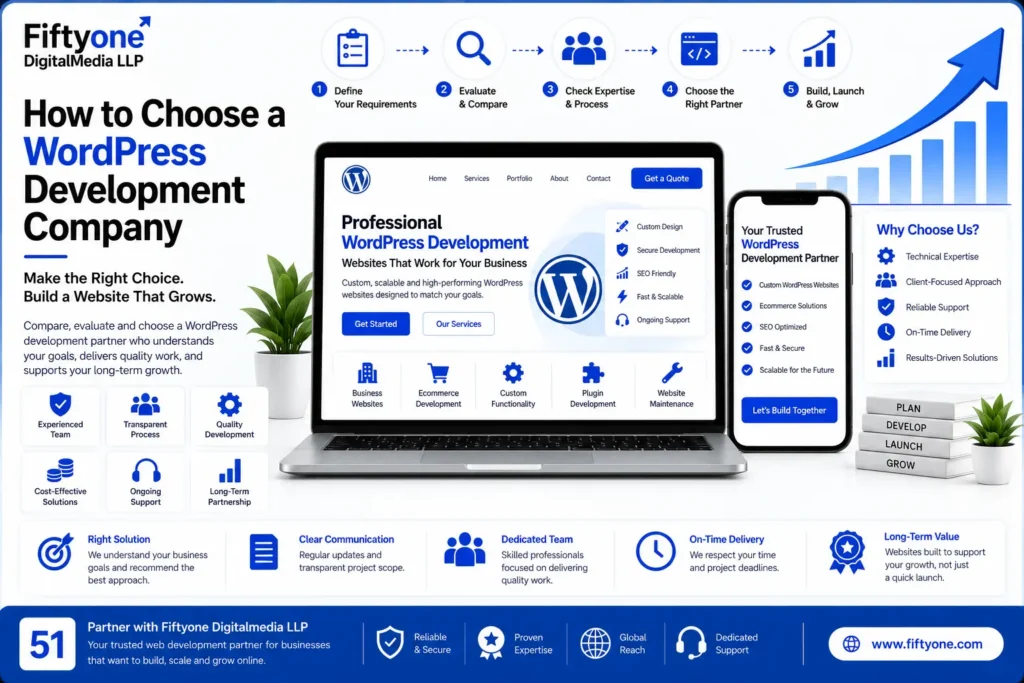
Choosing a WordPress development company is not difficult because there are too few options. It is difficult because almost every company claims to offer the same things: professional design, experienced developers, fast delivery, and affordable services.
Those claims tell you almost nothing.
A WordPress website can look good at launch and still become slow, difficult to maintain, dependent on too many plugins, or expensive to modify later. The real difference between development companies often appears after the project has started.
So instead of asking only for a portfolio and proposal, businesses need to examine how a company actually builds websites.
Start With Your Requirements
Before comparing development companies, define what you need.
A company cannot recommend the right solution if the project itself is unclear.
Your brief should answer questions such as:
- What is the main purpose of the website?
- Who will use it?
- How many pages are required?
- Do you need custom functionality?
- Will you manage content internally?
- Are integrations required?
- Does the website need ecommerce functionality?
- What are the future expansion plans?
Without a clear scope, every company will interpret the project differently. That makes proposals almost impossible to compare properly.
Do Not Judge the Portfolio by Design Alone
A portfolio screenshot can hide almost everything that matters.
Ask to see live websites.
Then check them yourself.
Open the websites on desktop and mobile. Look at navigation, responsiveness, loading behaviour, and overall usability.
More importantly, ask the company to explain the project.
A useful portfolio discussion should reveal:
- What problem the client had
- What solution was developed
- Which parts were customized
- What technical challenges existed
- How the website is maintained
A company that can only show attractive screenshots is giving you incomplete evidence.
Recent WordPress agency selection guides also emphasize reviewing relevant live projects and understanding the development process instead of relying only on portfolio visuals.
Ask How They Actually Build WordPress Websites
This is one of the most important questions.
Two agencies can create visually similar websites using completely different approaches.
One might use a large number of third-party plugins and a heavy page builder. Another might use a custom theme, native WordPress functionality, and a smaller technology stack.
The difference may not be visible on launch day.
It can become visible later through:
- Website speed
- Plugin conflicts
- Update problems
- Maintenance difficulty
- Development flexibility
Ask direct questions:
How many plugins are normally required?
Do you build custom themes when needed?
How do you handle custom functionality?
What happens when the business needs new features later?
The answers reveal more about a development company than a sales presentation.
Check Technical Knowledge Beyond WordPress Basics
A WordPress development company should understand more than themes and plugins.
Depending on your project, evaluate whether the team understands:
- Custom theme development
- Plugin development
- WooCommerce
- API integrations
- Performance optimization
- Security
- Database management
- Hosting environments
- Mobile responsiveness
- Technical SEO
You do not need to become a developer to evaluate technical capability.
You only need to listen for clear explanations.
A strong company can explain technical decisions in business terms. A weak company often responds with vague promises such as “we use the latest technology.”
Look at Performance Before Launch
Website performance should not be treated as something that gets fixed after development.
Ask the company how it approaches:
- Page speed
- Image optimization
- Core Web Vitals
- Mobile performance
- Script management
- Caching
- Plugin selection
Performance problems often begin with development decisions made early in the project. Technical structure, asset handling, and plugin dependency can affect how the website performs long after launch.
If a company does not discuss performance until you specifically ask about it, that is not a strong sign.
Check Whether SEO Is Considered During Development
A WordPress developer does not need to be an SEO agency, but the development process should not create SEO problems.
The company should understand basic requirements such as:
- Clean URL structures
- Mobile responsiveness
- Heading structure
- Page speed
- Crawlable website architecture
- Redirect management
- Basic schema readiness
SEO should not be treated as simply installing a plugin after the website is complete.
Development decisions affect how easily the website can be optimized later.
For businesses comparing different website approaches, WordPress vs Custom Website: Which Is Better? explains how development architecture can affect flexibility, content management, and long-term requirements.
Evaluate the Development Process
Ask the company to explain exactly what happens after you sign the agreement.
A structured process should normally include stages such as:
Discovery → Requirements → Design → Development → Testing → Review → Launch
The exact process can vary, but there should be a process.
Ask:
- When are requirements finalized?
- How are design approvals handled?
- Will development milestones be shared?
- How are changes managed?
- Who performs testing?
- What happens before launch?
Companies with a defined workflow are generally easier to work with because responsibilities are clearer.
Communication Can Make or Break the Project
Technical ability alone is not enough.
Website projects often involve changes, feedback, delays, new ideas, and unexpected technical issues.
Poor communication turns small problems into major delays.
Before hiring a company, observe how they communicate during the sales process.
Do they ask useful questions?
Do they understand the requirements?
Do they explain limitations?
Do they challenge unclear decisions?
A development partner that agrees with everything without asking questions may create bigger problems later.
Compare Proposals by Scope, Not Just Price
This is where many businesses make bad decisions.
Two companies may submit very different proposals for what appears to be the same website.
One may include design, development, testing, optimization, launch support, and maintenance guidance.
Another may only include development.
The lower proposal may look attractive until additional work starts appearing outside the original scope.
Compare:
| What to Check | Why It Matters |
|---|---|
| Project scope | Defines exactly what is being built |
| Design | Shows whether custom design is included |
| Functionality | Identifies technical requirements |
| Testing | Reduces launch problems |
| Revisions | Prevents scope disputes |
| Launch support | Clarifies deployment responsibility |
| Maintenance | Defines post-launch support |
The cheapest proposal is not automatically the lowest-cost project.
Ask About Website Ownership
This question should be answered before the project begins.
Clarify who owns:
- Website source code
- Domain
- Hosting account
- Premium plugin licenses
- Design files
- Content
- Third-party accounts
A business should not discover ownership problems after the development company relationship ends.
Everything important should be documented clearly.
Ownership and post-launch responsibilities are frequently highlighted as critical areas to clarify before hiring a WordPress development partner.
Understand Post-Launch Support
Launching the website is not necessarily the end of the relationship.
WordPress websites may require updates, security monitoring, backups, plugin management, technical fixes, and future development.
Ask the company:
- Is support available after launch?
- Who handles WordPress updates?
- How are backups managed?
- What happens if a plugin creates a conflict?
- Can the same team handle future development?
You do not necessarily need a long-term maintenance contract, but you should know what support options exist.
Red Flags to Watch For
Some warning signs should not be ignored.
Be cautious if a company:
- Promises everything without asking questions
- Cannot explain its development process
- Shows only screenshots instead of live work
- Avoids technical questions
- Recommends excessive plugins without explanation
- Provides unclear ownership terms
- Has no testing process
- Offers unrealistic timelines
- Focuses only on being cheaper than competitors
The biggest red flag is usually vagueness.
A reliable development company should be able to explain what it will do, how it will do it, and what happens after launch.
Agency, Freelancer, or Development Partner?
The right choice depends on the project.
A freelancer can be suitable for smaller or clearly defined projects.
A development company may be more appropriate when the project requires design, development, testing, project management, and long-term support.
For agencies with changing workloads, an external development partner can also provide technical capacity without permanent hiring.
Outsource Website Development Without Hiring Developers explains how businesses and agencies can use external development resources when project demand increases.
A Simple Checklist Before You Decide
Before selecting a WordPress development company, confirm that you understand:
- Their relevant experience
- Their technical approach
- Their development process
- Their testing standards
- Their communication structure
- Their performance approach
- Their SEO awareness
- Website ownership terms
- Post-launch support
- The complete project scope
If several of these answers remain unclear before signing, they will probably become bigger problems during development.
Why Fiftyone Digital Media
Fiftyone Digital Media provides WordPress development support for businesses and agencies serving international markets.
The focus is not simply on installing a theme and launching a website. Development requirements can include custom WordPress websites, business websites, ecommerce development, redesigns, performance optimization, maintenance, and technical support.
For agencies requiring additional development capacity, Fiftyone Digital Media can also support projects through flexible development resources while the agency maintains control over its client relationships.
Frequently Asked Questions
What should I look for in a WordPress development company?
Look beyond price and design. Evaluate relevant experience, technical skills, development process, performance knowledge, communication, testing, ownership, and post-launch support.
How do I check a WordPress company’s portfolio?
Ask for live websites rather than screenshots. Test the websites on mobile and review how the company explains the technical work behind each project.
Should I choose the cheapest WordPress development company?
No. Compare the complete scope of work. A cheaper proposal may exclude testing, support, optimization, or other important requirements.
Does a WordPress development company need SEO knowledge?
It should understand basic technical SEO requirements because development decisions can affect website structure, performance, and future optimization.
Conclusion
Choosing a WordPress development company should not be based on the portfolio, price, or sales promises alone.
The better decision comes from understanding how the company works.
Check its live projects, technical approach, development process, communication, testing standards, ownership policies, and post-launch support.
The right development company should not just build a website that looks good on launch day. It should build something that remains manageable, flexible, and technically reliable as the business grows.
