
Offshore SEO Services in India: Monthly Deliverables, Reporting and KPIs for US Agencies

Introduction
For a US digital agency, outsourcing SEO is not simply about assigning tasks to an external team. The real challenge is ensuring that work is delivered consistently, progress is measurable, and clients receive reports they can understand.
This is where offshore SEO services in India can support agency operations. An offshore team may handle keyword research, on-page optimization, technical SEO, content, and reporting while the US agency retains its client relationships and brand.
But what should an agency actually receive every month? Which SEO activities should be completed, what should a report include, and which KPIs show whether a campaign is moving in the right direction?
A clear delivery framework helps agencies set expectations with their fulfillment partner and avoid confusing activity with results.
What Should a Monthly Offshore SEO Plan Include?
Monthly deliverables should reflect the client’s website, industry, competition, and campaign goals. A local service business, a national ecommerce store, and a B2B company will not need identical SEO work.
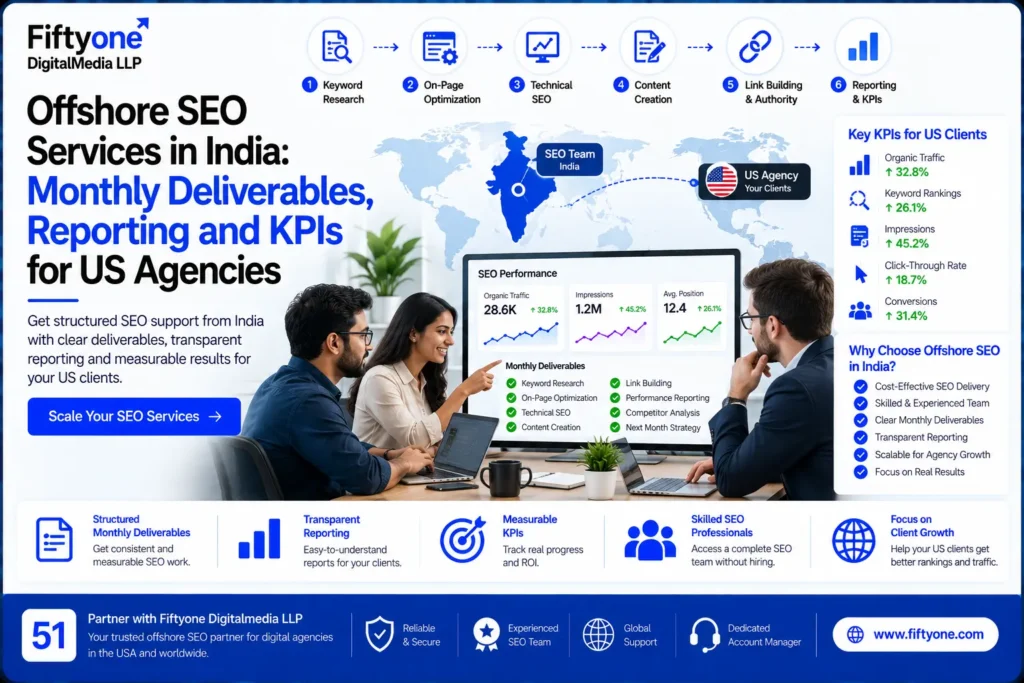
A practical monthly plan usually combines ongoing optimization with performance review and the next set of priorities.
| SEO Area | Typical Monthly Deliverables |
|---|---|
| Keyword Research | Query analysis, keyword mapping, search-intent review |
| On-Page SEO | Page optimization, titles, headings, internal links |
| Technical SEO | Crawl checks, indexing review, issue recommendations |
| Content | Content briefs, new pages, updates, optimization |
| Authority Building | Relevant outreach or agreed link-building activities |
| Reporting | Performance summary, completed work, next steps |
These are possible deliverables, not a checklist that every client must receive every month. The scope should be agreed before work begins.
Monthly Deliverables: What Agencies Should Expect
1. Keyword and Search-Intent Review
Keyword research should not stop after the initial campaign setup. Search behavior, competitors, and business priorities can change, so the SEO team should periodically review which queries are relevant to the client.
For a US business, this may include reviewing location-specific searches, commercial keywords, informational queries, and terms that indicate a potential customer is ready to take action.
The important deliverable is not a large spreadsheet of keywords. It is a clear understanding of which pages should target which search intent, and whether the current website has suitable pages for those searches.
2. On-Page Optimization
On-page work connects target queries with the pages most likely to satisfy them. Depending on the campaign, monthly work may include improving title tags, meta descriptions, headings, page content, image alt text, and internal links.
An offshore team should explain which URLs were updated and why. For example, optimizing a service page to better match commercial search intent is more meaningful than reporting that “on-page SEO was completed.”
Agencies should also check that changes support the client’s brand voice and conversion goals, not just keyword placement.
3. Technical SEO Monitoring
Technical SEO work varies according to the website’s condition. A new campaign may need a deeper audit, while an established website may need monitoring and prioritization of newly discovered issues.
Monthly checks may cover crawlability, indexation, broken links, redirects, canonical tags, sitemap issues, mobile usability, and site performance.
Not every technical issue needs immediate implementation. The report should distinguish between critical problems, recommended improvements, and items that require developer involvement.
4. Content Planning and Optimization
Content deliverables should be connected to a defined purpose. That may mean creating a new service page, improving an existing article, filling a topic gap, or updating content that no longer reflects the client’s offering.
For US agencies, content should reflect the audience’s terminology, market context, and search intent. Simply producing articles around keywords is not a complete content strategy.
A useful content deliverable identifies the target page, intended audience, primary topic, supporting questions, and the action the reader should take.
5. Link Building and Authority Work
If link building is part of the agreement, the monthly report should describe the work completed and provide enough information for the agency to assess relevance and quality.
Agencies should not judge link-building performance only by the number of links. Relevance, placement context, destination page, and the provider’s methods matter.
The scope should clearly state whether the partner provides outreach, content creation, placement coordination, digital PR, or another agreed activity. Avoid vague reporting such as “authority building completed” without supporting details.
What Should an SEO Report Show?
A useful SEO report answers three questions:
- What changed?
- What work was completed?
- What should happen next?
Google Search Console provides performance data such as clicks, impressions, click-through rate, and average position, with views by query, page, country, and device. These dimensions help agencies understand where search visibility is changing rather than relying on one overall number. <Cite ref=”turn869099search0″/>
For a US client, reports should use the relevant country filter when evaluating US search performance. If the client also targets other markets, those countries should be reviewed separately rather than combined without explanation.
A strong monthly report should include a short executive summary, performance trends, completed deliverables, important observations, and next month’s priorities. It should explain the meaning of the data instead of simply displaying screenshots.
The KPIs US Agencies Should Track
Not every SEO metric is a KPI. A metric becomes useful when it helps assess progress toward a defined business objective.
Search Visibility: Impressions and Average Position
Impressions show how often a website appeared in Google Search results. Average position provides a broad view of where the site’s top result appeared across the selected data.
These metrics can help identify growing visibility, new query opportunities, and pages that are appearing in search but may need improvement. However, average position is an aggregate metric, so it should not be treated as the exact ranking for every keyword. <Cite ref=”turn869099search2″/>
Organic Clicks and CTR
Clicks show visits from search results, while click-through rate (CTR) is the number of clicks divided by impressions.
If impressions increase but clicks remain flat, the agency may need to review the queries, search intent, title, and meta description. If CTR changes, consider the page’s position and the type of search results appearing for those queries before drawing conclusions.
CTR should be reviewed by page and query where possible, not only as a sitewide average. <Cite ref=”turn869099search0″/>
Organic Conversions and Leads
For most businesses, traffic is not the final goal. The campaign should also measure meaningful actions such as enquiry submissions, calls, booked consultations, demo requests, or purchases.
These actions usually require analytics and conversion tracking to be configured correctly. Agencies should agree with the client on what counts as a qualified lead and how it will be measured.
Keyword and Landing-Page Progress
Keyword tracking can help monitor selected priority terms, but it should not replace Search Console data. A useful report connects target topics to landing pages and reviews whether those pages are gaining relevant visibility and engagement.
Technical Health
Technical KPIs may include the status of important indexing issues, crawl errors, broken pages, and agreed technical fixes.
The goal is not to create a long list of technical scores. It is to show whether issues affecting search access or user experience have been identified and addressed.
A Practical Monthly Reporting Format
A useful monthly SEO report should tell the story behind the campaign’s performance, not just display a collection of numbers. The report can begin by explaining how organic clicks, impressions, CTR, and conversions changed during the month. It should then connect those changes with the work completed, such as page improvements, content updates, or technical fixes. Most importantly, the report should explain what the results mean for the client: which activities are contributing to progress, where performance has declined, and what may need further investigation.
The final part should set out the priorities for the coming month and explain how they support the campaign’s goals. This gives the US agency a clear view of the work delivered and makes it easier to communicate progress to its own clients..
How to Keep Offshore SEO Reporting Relevant to US Clients
An offshore team may be working from a different time zone, but the report should reflect the client’s market and business priorities.
For US campaigns, clarify which locations are being targeted, whether the client serves a national or local audience, and which conversions matter most. A local business may care about calls and location-based enquiries, while a SaaS company may prioritize qualified demo requests.
The agency should also agree on reporting dates, data sources, naming conventions, and who reviews the report before it reaches the client.
For more agency-focused SEO resources, you can explore the Fiftyone Digitalmedia LLP blog archive.
How Agencies Can Evaluate an Offshore SEO Partner
Before starting a campaign, ask the provider to show a sample report and explain how monthly deliverables are planned.
Check whether the partner can identify completed work by URL, explain why a task was prioritized, and connect SEO activity to the client’s objectives. Also clarify who handles strategy, content approval, technical implementation, and client-facing communication.
A reliable fulfillment process should make responsibilities visible. If the offshore team only provides task completion updates, the agency may still have to do all the analysis and interpretation itself.
The scope should also define how revisions, urgent technical issues, and changes in client priorities will be handled.
Why Choose Fiftyone Digitalmedia LLP?
Fiftyone Digitalmedia LLP supports agencies that need offshore SEO fulfillment for international clients.
Depending on the agreed scope, support can include keyword research, on-page optimization, technical SEO, content assistance, link-building activities, and reporting.
For US agencies, the work should be aligned with the client’s target audience, business goals, and agreed KPIs. Clear deliverables and reporting help the agency review fulfillment while retaining its own client relationship and brand.
Frequently Asked Questions
What should offshore SEO services deliver every month?
Deliverables depend on the campaign, but may include keyword review, on-page optimization, technical monitoring, content work, agreed link-building activities, and a performance report.
Which KPIs matter most for US SEO clients?
Common KPIs include organic clicks, impressions, CTR, relevant landing-page performance, organic conversions, and progress on agreed technical priorities. The right set depends on the client’s business goals.
Should offshore SEO reports include keyword rankings?
They can include selected keyword tracking, but rankings should be considered alongside Search Console performance, landing-page visibility, and conversions.
How can an agency check whether its SEO partner is doing the work?
Request deliverables mapped to specific URLs, completed-task records, supporting reports, and a clear plan for the next month. This makes fulfillment easier to review than a general activity summary.
Conclusion
Offshore SEO services in India can help US agencies extend their delivery capacity, but successful outsourcing requires more than assigning monthly tasks. Agencies need a clear scope, relevant deliverables, transparent reporting, and KPIs connected to client outcomes.
The most useful monthly report shows what changed, what the team completed, what the data indicates, and what should happen next. When both the agency and fulfillment partner agree on these expectations, SEO delivery becomes easier to manage and explain to clients.
CTA
Looking for offshore SEO fulfillment for your agency’s US clients? Contact Fiftyone Digitalmedia LLP to discuss monthly deliverables, reporting requirements, and a campaign workflow aligned with your clients’ goals.
