
Best Offshore SEO Services Company in India for International Businesses
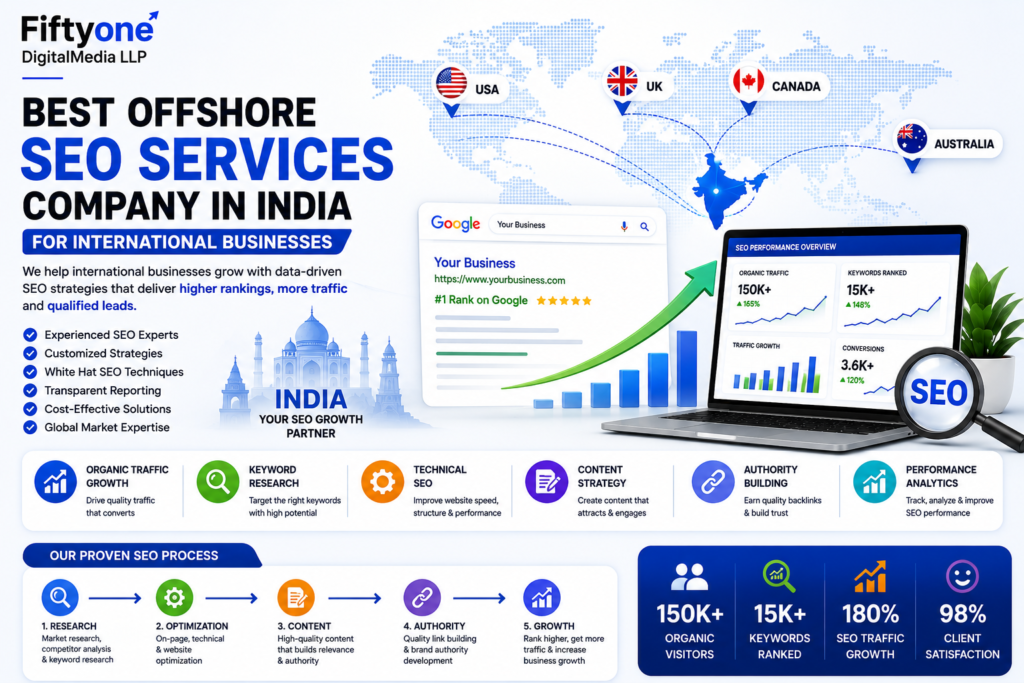

International businesses need more than occasional keyword optimization to compete in organic search. They need a structured SEO process that covers technical improvements, content planning, search intent analysis, competitor research, and continuous performance monitoring.
Managing all these activities internally can require multiple specialists and significant operational resources. Working with an offshore SEO services company in India can provide additional execution capacity while allowing businesses to retain control over their marketing strategy and commercial priorities.
However, successful offshore SEO depends on more than outsourcing individual tasks. The provider must understand the target market, follow an agreed delivery process, maintain quality standards, and report work transparently.
Fiftyone Digitalmedia LLP provides offshore SEO support for businesses and digital agencies that need assistance with ongoing SEO activities and international search campaigns.
Why International Businesses Outsource SEO Services
SEO involves several connected activities. Technical problems can affect indexing, weak content can limit search visibility, and poor keyword targeting can attract visitors who are unlikely to become customers.
Building an internal team to manage every activity may not be practical for businesses with changing workloads or limited specialist resources.
Offshore SEO services can help address these operational requirements.
Access to Specialist SEO Support
Businesses may need different skills for technical audits, keyword research, content optimization, competitor analysis, and link building.
An offshore SEO arrangement can provide access to specialists for these activities without requiring the business to recruit every role internally.
Flexible Campaign Execution
SEO workloads are not always consistent. A website redesign, international expansion, new product launch, or content project can temporarily increase the amount of work required.
An offshore team can support specific projects or recurring SEO activities according to the agreed scope.
Better Control Over Internal Resources
Businesses can retain responsibility for brand positioning, business strategy, customer relationships, and commercial decisions while assigning defined SEO execution tasks to an external team.
This arrangement can help internal employees concentrate on activities that require direct business knowledge.
Support for Multiple Target Markets
International SEO requires research into the language, search behavior, competition, and commercial intent of each target market.
Businesses targeting the United States, United Kingdom, Canada, Australia, or European markets should not automatically use the same keyword strategy for every location.
An offshore SEO provider should adapt research and optimization activities to the specific markets included in the campaign.
What Offshore SEO Services Should Include
The scope of an offshore SEO engagement depends on the website’s condition, business objectives, and available internal resources.
A structured service arrangement may include the following activities.
Keyword Research and Search Intent Analysis
Keyword research identifies the searches relevant to a business, its services, and its target audience.
For international campaigns, research should consider country-specific search behavior, keyword variations, competition, and commercial intent.
The process should also map relevant keywords to existing website pages. This helps reduce unnecessary content overlap and identifies pages that need new or improved content.
Technical SEO Audits
Technical SEO helps search engines access, crawl, and understand website content.
Typical activities include:
- Website crawling and indexing analysis
- XML sitemap review
- Robots.txt checks
- Canonical tag validation
- Core Web Vitals analysis
- Mobile usability checks
- Internal linking and website structure review
- Structured data validation
An audit should not simply provide a list of errors. It should explain the impact of each issue and prioritize fixes according to their importance.
On-Page SEO Optimization
On-page SEO improves the relevance and usability of individual website pages.
Activities may include title tag optimization, meta descriptions, heading improvements, content refinement, image optimization, internal linking, and search intent alignment.
The objective is to make each page useful for its intended audience and clearly focused on its primary topic.
Content Optimization and Planning
Existing content should be reviewed before new articles are recommended.
An offshore SEO team can identify outdated information, missing sections, weak search intent alignment, overlapping pages, and opportunities to improve existing rankings.
Content planning should connect informational articles with relevant service pages instead of publishing large numbers of unrelated keyword-focused posts.
Competitor Analysis
Competitor research helps businesses understand how other websites are targeting relevant search opportunities.
It may include reviewing competitor landing pages, keyword coverage, content structure, backlink profiles, and gaps in the existing website.
The findings should lead to specific recommendations rather than simply copying competitor content.
Off-Page SEO Support
Off-page SEO activities can support website authority and visibility through relevant external signals.
Depending on the agreed campaign, this may include backlink opportunity research, relevant outreach, digital PR support, and backlink profile monitoring.
Quality and relevance should take priority over the number of links acquired.
How Offshore SEO Supports Different International Markets
An effective international SEO campaign needs to reflect the market being targeted.
A keyword that performs well in one country may have different search demand, competition, or commercial meaning in another.
United States
Businesses targeting the US market need to consider industry competition, search intent, regional terminology, and the requirements of their target audience.
Keyword selection should focus on relevant commercial opportunities rather than search volume alone.
United Kingdom
UK campaigns may require adjustments to terminology, spelling, local search behavior, and competitor analysis.
Content should reflect how the intended UK audience searches for and evaluates products or services.
Canada
Canadian SEO campaigns may need to account for regional differences and, where relevant, English and French language requirements.
The website structure and content strategy should reflect the locations and audiences the business actually serves.
Australia
Businesses targeting Australia should use market-specific keyword research and competitor analysis.
Search terminology, local business requirements, and customer expectations should be considered when planning landing pages and content.
European Markets
European campaigns may require additional planning for different languages, countries, and regional search requirements.
Where multiple language versions are used, the website should have an appropriate international URL structure and correctly implemented hreflang annotations where applicable.
How Offshore SEO Services Are Delivered
A defined delivery process helps international businesses maintain visibility and control when SEO activities are handled remotely.
Step 1: Understand Business Requirements
The engagement begins with understanding the website, industry, target audience, services, competitors, and countries being targeted.
The business should also identify its priorities, existing SEO challenges, and expected outcomes.
Step 2: Conduct SEO Research
The SEO team reviews the website’s technical condition, existing organic performance, keyword opportunities, competitor activity, and content gaps.
The findings provide the basis for prioritizing work.
Step 3: Prepare an SEO Action Plan
The action plan defines which pages require optimization, which technical issues need attention, and what content or off-page activities are required.
Responsibilities and delivery expectations should be agreed upon before execution begins.
Step 4: Execute the Agreed Activities
The team completes the approved work according to the project scope.
Depending on the campaign, this can include technical fixes, keyword mapping, on-page optimization, content improvements, internal linking, and relevant off-page SEO activities.
Step 5: Review and Quality Check
Completed work should be checked before delivery.
Quality review may include verifying page changes, checking metadata, reviewing content relevance, validating technical implementations, and confirming that agreed requirements have been followed.
Step 6: Report and Improve
Performance reporting helps businesses understand completed activities and identify the next priorities.
The SEO plan should be reviewed regularly as search performance, website requirements, and market conditions change.
Offshore SEO for Digital Agencies and Growing Businesses
Offshore SEO is not limited to businesses managing their own websites. Digital marketing agencies can also use external SEO support when their client workload increases.
An agency may manage client communication and strategy internally while assigning defined research, optimization, and fulfillment activities to an offshore team.
This arrangement can be useful when agencies need additional delivery capacity without immediately expanding their permanent workforce.
For this model to work, the responsibilities of the agency and offshore provider should be clearly defined.
Important areas include:
- Client and project communication
- Task allocation and deadlines
- Access permissions and data security
- Content approval procedures
- Quality control
- Reporting responsibilities
- Revision and escalation processes
Agencies exploring this delivery model can also read SEO Outsourcing Services for Growing Agencies.
How to Measure Offshore SEO Performance
The success of an offshore SEO engagement should be evaluated through both delivery quality and business performance.
The relevant measurements depend on the objectives of the campaign.
Organic Search Visibility
Search impressions, clicks, click-through rate, and average position help show how website pages perform in organic search.
These metrics should be reviewed by page, query, and target market where data is available.
Qualified Organic Traffic
Traffic growth alone does not establish business value.
Businesses should examine whether visitors are reaching relevant service pages, engaging with important content, and taking meaningful actions.
Leads and Conversions
Where conversion tracking is configured correctly, businesses should monitor enquiries, form submissions, calls, purchases, and other relevant actions.
This helps connect SEO performance with business objectives.
Delivery and Quality Metrics
Operational measurements are also important for offshore partnerships.
These may include completed tasks, delivery timelines, revision rates, reporting consistency, and the quality of implemented recommendations.
Regular reporting should explain what was completed, what changed, and what needs attention next.
Common Mistakes in Offshore SEO Engagements
Outsourcing SEO without clear responsibilities can create problems even when the provider has relevant technical skills.
Common mistakes include:
Unclear campaign objectives: Without defined business and SEO priorities, teams may spend time on activities that have little relevance to the actual campaign.
Generic keyword strategies: Applying the same keywords and content plan across multiple countries ignores differences in search behavior and competition.
Excessive content production: Publishing more articles without reviewing existing pages can create topic overlap and unnecessary maintenance work.
Poor quality control: Technical changes, metadata, content, and link building activities should be reviewed before they are considered complete.
Unclear reporting: Businesses need visibility into completed work, performance changes, and upcoming priorities.
Unrealistic ranking expectations: SEO results depend on competition, website condition, implementation quality, and many other factors. Guaranteed ranking claims should be treated cautiously.
Why Choose Fiftyone Digitalmedia LLP for Offshore SEO Support?
Fiftyone Digitalmedia LLP provides offshore SEO support for businesses and agencies that require assistance with ongoing search optimization activities.
The service areas include keyword research, technical SEO, on-page optimization, content planning, competitor analysis, internal linking, and SEO reporting.
The objective is to support defined SEO requirements through a structured delivery approach while allowing businesses to retain control over their strategy, priorities, and customer relationships.
Businesses considering an offshore SEO engagement should discuss their target markets, website requirements, expected deliverables, reporting arrangements, and project responsibilities before starting.
Visit Fiftyone Digitalmedia LLP to explore its digital marketing and SEO solutions.
Frequently Asked Questions
1. What are offshore SEO services?
Offshore SEO services involve assigning search engine optimization activities to a team located outside the client’s primary country. These activities may include technical SEO, keyword research, content optimization, competitor analysis, and reporting.
2. Can offshore SEO services support international businesses?
Yes. Offshore SEO teams can support international campaigns when research and optimization are adapted to the target countries, audiences, languages, and search competition.
3. What is included in an offshore SEO service package?
The scope may include technical audits, keyword research, on-page optimization, content planning, competitor research, internal linking, off-page SEO, and performance reporting. The actual deliverables depend on the agreement.
4. Is offshore SEO suitable for digital marketing agencies?
It can be suitable for agencies that need additional SEO fulfillment capacity. Agencies should define task ownership, communication, quality control, client confidentiality, and reporting responsibilities.
5. How do offshore SEO companies report campaign performance?
Reporting commonly includes organic clicks, impressions, CTR, rankings, landing-page performance, completed activities, and relevant conversions where tracking is available.
6. How long does it take to see offshore SEO results?
There is no fixed timeline. Results depend on the website’s current condition, competition, target market, implementation quality, and the amount of work required.
7. What should businesses share before starting an offshore SEO campaign?
Businesses should provide relevant website information, target markets, business objectives, priority services, competitor details, available performance data, and the access required to complete approved tasks.
Conclusion
Choosing an offshore SEO services company in India can help international businesses access additional SEO execution capacity without relying entirely on an in-house team.
The right arrangement should include market-specific research, a defined service scope, technical and content optimization, quality checks, transparent reporting, and regular communication.
For businesses and agencies targeting international markets, Fiftyone Digitalmedia LLP provides offshore SEO support across key optimization activities. A clear understanding of project requirements and responsibilities helps establish a more manageable and scalable SEO partnership.
