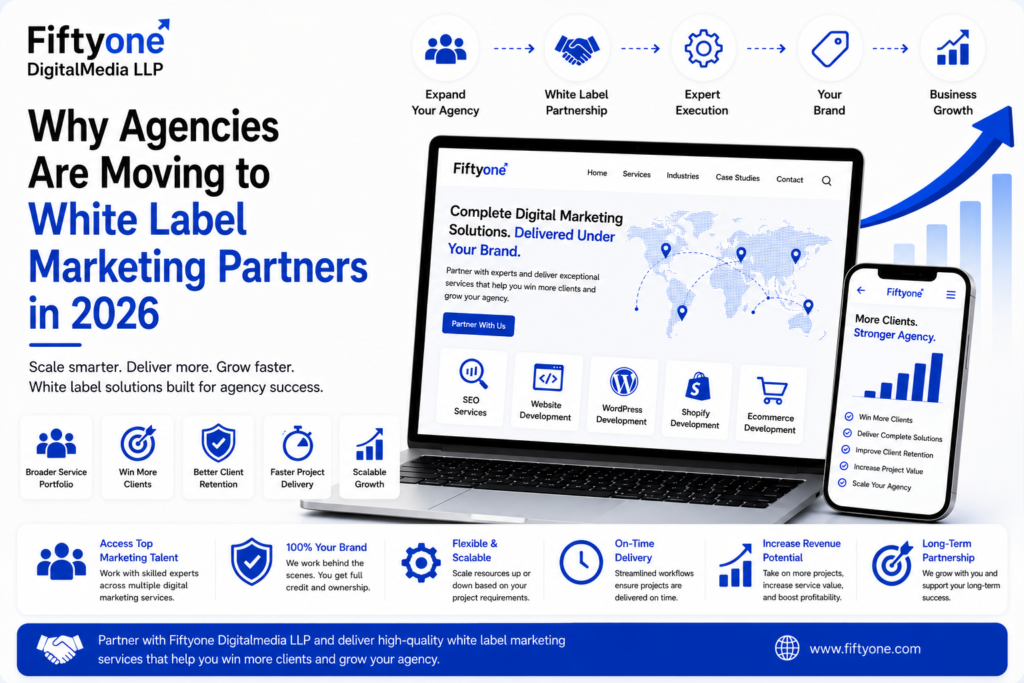
Why Agencies Are Moving to White Label Marketing Partners in 2026

Introduction
Digital agencies are under constant pressure to deliver more services without allowing operational costs to grow at the same rate. Clients increasingly expect agencies to provide complete digital solutions covering SEO, website development, content, paid advertising, social media, ecommerce, and ongoing optimization.
Building an internal specialist for every service can become difficult as the agency grows. Recruitment takes time, specialist salaries increase fixed costs, and workloads can fluctuate from one period to another.
This is why more agencies are considering White Label Marketing Partners as an extension of their existing delivery teams. Instead of building every capability internally, agencies can outsource selected services while maintaining their own branding, client relationships, pricing, and strategic control.
Fiftyone Digitalmedia LLP supports agencies that need additional digital marketing fulfillment capacity while continuing to operate under their own brand.
What Is a White Label Marketing Partner?
A white label marketing partner is an external company that provides marketing services behind an agency’s brand. The agency sells the service to its client, manages the relationship, and remains responsible for the final customer experience.
The external partner handles the agreed fulfillment work according to the agency’s requirements.
This model can cover individual services or multiple marketing functions.
Common areas include:
- SEO
- Website development
- Ecommerce development
- Content marketing
- Social media
- Paid advertising
- Technical optimization
- Analytics and reporting
The agency decides which functions should remain internal and which can be handled externally.
Why Agencies Are Changing Their Delivery Model
Agency growth changes the economics of service delivery. A small agency may be able to manage every project internally, but that model becomes harder to maintain when client numbers increase.
Every additional service can require new employees, software, training, management, and quality-control processes.
White label partnerships provide agencies with another way to increase capacity.
The model can help agencies:
- Accept more client projects
- Add new services faster
- Access specialist expertise
- Reduce recruitment pressure
- Manage changing workloads
- Improve delivery capacity
- Maintain their own branding
- Serve international clients
- Protect operational flexibility
The important point is that outsourcing does not have to mean outsourcing everything. Agencies can selectively use external resources where they provide the greatest operational advantage.
Rising Demand for Specialized Services
Modern digital marketing is increasingly specialized. SEO alone can involve technical optimization, content strategy, keyword research, competitor analysis, internal linking, authority development, analytics, and international search optimization.
Website projects can require designers, frontend developers, backend developers, ecommerce specialists, QA resources, and maintenance teams.
Trying to hire every specialist internally can create unnecessary complexity.
A white label partner gives agencies access to specialized execution without requiring permanent employment for every skill.
This can be particularly useful for agencies serving clients across the USA, UK, Canada, Australia, Europe, and other international markets.
White Label Marketing and Agency Scalability
Scalability is one of the strongest reasons agencies use external fulfillment. Client acquisition can happen faster than internal recruitment.
Suppose an agency wins several new SEO and website projects within the same month. An internal team may immediately become overloaded. Recruiting additional employees could take weeks or months.
A white label partner can provide additional resources according to project demand.
This allows the agency to scale delivery without maintaining maximum internal staffing throughout the year.
The agency can therefore keep its core team focused on:
- Strategy
- Sales
- Client relationships
- Project direction
- Business development
- Account management
External specialists handle the execution work assigned to them.
Reducing Fixed Operational Pressure
Hiring full-time employees creates recurring expenses regardless of the agency’s monthly workload. Salaries, benefits, equipment, software, training, management, and recruitment all contribute to the total cost.
White label fulfillment can create a more flexible cost structure because resources are connected more closely to active client requirements.
However, agencies should not choose a partner simply because the price is lower. Cheap fulfillment that creates poor-quality work, repeated revisions, or client complaints can damage profitability.
The real objective is better delivery economics, not simply lower outsourcing costs.
Expanding Services Without Building New Departments
An agency known primarily for web design may begin receiving SEO enquiries. A branding agency may start getting requests for website development. A PPC agency may have clients asking for organic search services.
Without external support, the agency has two options: reject the opportunity or build a new department.
White label fulfillment creates a third option.
The agency can add the service, test demand, and determine whether it makes sense to develop deeper internal capabilities later.
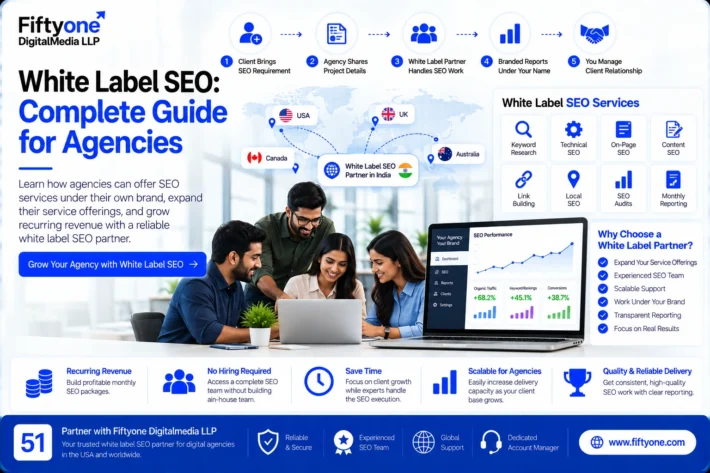
Agencies looking specifically at SEO expansion can also explore White Label SEO Agency for Digital Agencies, which covers the use of external SEO resources to expand agency delivery.
Better Access to Specialist Expertise
White label partners often operate across multiple client projects and industries. This can provide agencies with access to specialists who have experience with different platforms, industries, campaign types, and technical requirements.
Instead of expecting one internal employee to manage every marketing discipline, agencies can allocate work according to specialist expertise.
This becomes especially valuable when projects require capabilities that the internal team does not use frequently enough to justify permanent hiring.
White Label Partners for International Clients
Agencies targeting international businesses need delivery capabilities that can support different markets and industries. A client targeting the US market may have different SEO, content, advertising, or website requirements from a company targeting Australia or the UK.
External marketing resources can help agencies handle these requirements without building separate teams for every market.
International agencies can use white label support for:
- Country-specific SEO
- International content
- Website development
- Ecommerce projects
- Technical optimization
- Marketing reporting
- Campaign execution
The agency continues managing the client relationship while the white label partner provides the required execution capacity.
Maintaining Agency Branding and Client Ownership
One of the main reasons agencies choose white label partnerships is control. The agency remains the visible provider while the external team works behind the scenes.
The agency can control:
- Client communication
- Pricing
- Contracts
- Branding
- Strategy
- Final approvals
- Reporting presentation
- Customer relationships
Confidentiality agreements, access controls, and client ownership terms should be established before work begins.
A white label relationship should strengthen the agency’s brand rather than make clients dependent on an outside provider.
Why Fiftyone Digitalmedia LLP
A white label partnership should function as an extension of an agency’s delivery operation. Reliability, communication, quality control, scalability, and confidentiality are therefore more important than simply having a large service list.
Fiftyone Digitalmedia LLP provides digital marketing fulfillment support for agencies requiring additional resources across SEO, website development, ecommerce, content, and related digital services.
The agency retains control of its clients and brand while external specialists handle agreed execution requirements.
White Label Partnerships and Agency Profitability
White label marketing can improve agency profitability when delivery costs remain controlled while client revenue increases. The agency can sell a broader service portfolio without carrying the full employment cost of every specialist required to deliver those services.
Profitability depends on more than the provider’s monthly fee. Agencies should consider account management, client communication, revisions, reporting, quality control, and retention when calculating the actual margin of each service.
A strong white label model should allow the agency to increase revenue without creating the same level of fixed operational costs.
Build a Structured Fulfillment Workflow
A white label partnership becomes difficult to manage when requirements are communicated differently for every project. Agencies should establish a repeatable fulfillment process that both teams follow.
A practical workflow includes:
- Client requirement collection
- Scope confirmation
- Strategy planning
- Task assignment
- Service execution
- Quality assurance
- Agency approval
- Client delivery
- Performance reporting
- Ongoing optimization
Once this workflow is established, agencies can manage more client accounts without creating unnecessary communication problems.
Quality Control Protects the Agency Brand
The client sees the agency as responsible for the final result. Poor work from an external partner can therefore damage the agency’s reputation even when the client never knows another team was involved.
Agencies should review important deliverables before client presentation. SEO recommendations, website functionality, content quality, advertising campaigns, and reports should all meet predefined standards.
A reliable partner should make quality control easier through consistent documentation, clear deliverables, and predictable turnaround times.
White Label Reporting Should Match the Agency
Reporting is one of the most visible parts of a digital marketing service. Agencies should be able to present results using their own branding and communication style.
Reports can include:
- Campaign progress
- Organic visibility
- Traffic
- Conversions
- Completed activities
- Technical improvements
- Content performance
- Campaign priorities
- Client recommendations
The external team provides the data and analysis while the agency remains responsible for the final client-facing presentation.
For agencies managing SEO campaigns, SEO Reporting Metrics Every Business Should Track Before Hiring an SEO Agency can provide useful guidance on which performance measurements deserve attention.
Choosing the Right White Label Marketing Partner
The wrong partner can create more work instead of reducing it. Agencies should evaluate the provider’s actual delivery capability before transferring important client campaigns.
Key evaluation areas include:
- Relevant service expertise
- International market experience
- Communication
- Project management
- Quality assurance
- Reporting
- Turnaround time
- Confidentiality
- Resource capacity
- Scalability
- Technical capabilities
Agencies should also start with a controlled project or limited workload before moving a large client portfolio to a new partner.
Common Mistakes Agencies Make
White label outsourcing becomes ineffective when agencies focus entirely on cost or try to outsource every service without a clear strategy.
Common mistakes include:
- Choosing only by price
- Offering services without sufficient demand
- Poor project documentation
- Weak quality control
- Unrealistic deadlines
- Undefined responsibilities
- Poor communication
- No confidentiality agreement
- Accepting deliverables without review
- Taking on more clients than delivery capacity allows
The purpose of outsourcing is controlled growth. Maximum outsourcing is not the objective.
White Label Web Development as an Agency Service
Website development is one of the strongest complementary services for digital agencies because many SEO, branding, PPC, and marketing clients eventually require website improvements.
Instead of hiring permanent developers for every technology, agencies can use external development resources for specific projects.
White label development can support:
- Business websites
- Ecommerce platforms
- Landing pages
- Website redesigns
- CMS development
- Custom functionality
- API integrations
- Website maintenance
Agencies can explore White Label Website Development Services for Agencies when they need additional technical capacity without building a large internal development department.
Scaling Without Increasing Internal Headcount
The biggest advantage of a white label model is the ability to increase delivery capacity as client demand changes.
An agency can add external resources when:
- Several new clients sign simultaneously
- Existing accounts require additional work
- A new service becomes commercially attractive
- Specialist skills are required
- International expansion increases workload
- Internal employees reach capacity
This creates a more flexible structure than maintaining a permanent internal team sized for the agency’s highest possible workload.
White Label Partners and Long-Term Agency Growth
A long-term white label relationship should become more efficient as both teams understand each other’s processes. Reporting formats, quality expectations, communication methods, project workflows, and client requirements become easier to manage.
The agency can then concentrate more heavily on:
- Client acquisition
- Account management
- Strategy
- Business development
- Service positioning
- Client retention
The external team provides the execution capacity required to support that growth.
Why Fiftyone Digitalmedia LLP
Fiftyone Digitalmedia LLP provides scalable digital marketing and development support for agencies serving international clients. Agencies can use external specialists for SEO, website development, ecommerce, content, and other digital execution requirements while retaining control over their brand and client relationships.
The objective is to function as an extension of the agency’s delivery operation rather than as a separate client-facing business.
Frequently Asked Questions
Why are agencies using white label marketing partners?
Agencies use white label partners to increase delivery capacity, access specialist expertise, add services, and manage growing client workloads without continuously expanding internal teams.
Is white label marketing profitable?
It can be profitable when agencies maintain healthy margins, control fulfillment quality, manage client relationships effectively, and retain customers.
Can white label partners support international clients?
Yes. External teams can provide execution support for agencies serving businesses across the USA, UK, Canada, Australia, Europe, and other international markets.
Should agencies outsource every service?
No. Agencies should outsource services where external expertise or flexible capacity provides a clear business advantage.
How should an agency choose a white label partner?
Evaluate service expertise, quality, communication, reporting, confidentiality, scalability, turnaround time, and previous experience with similar client requirements.
Conclusion
White label marketing partnerships are becoming an important growth model for agencies that want to expand their services without creating a large permanent delivery structure.
The model provides access to specialist resources while allowing agencies to retain control over branding, pricing, strategy, and client relationships. When supported by clear workflows and strong quality control, it can make agency operations more flexible and scalable.
For agencies targeting international clients, the right white label partner can provide the delivery capacity required to grow without making internal hiring the only solution.
Scale Your Agency With Flexible Delivery
Fiftyone Digitalmedia LLP helps growing agencies increase digital delivery capacity through scalable SEO, website development, ecommerce, content, and related services. The agency remains in control of its clients and brand while external specialists handle agreed fulfillment requirements.