What Is White Label SEO? Complete Guide for Agencies
Introduction
Digital agencies often want to offer SEO services but face a simple capacity problem. Building a complete SEO department requires specialists for technical SEO, keyword research, content optimization, competitor analysis, link building, analytics, and reporting. Hiring all these professionals internally can become expensive, especially when an agency is still growing.
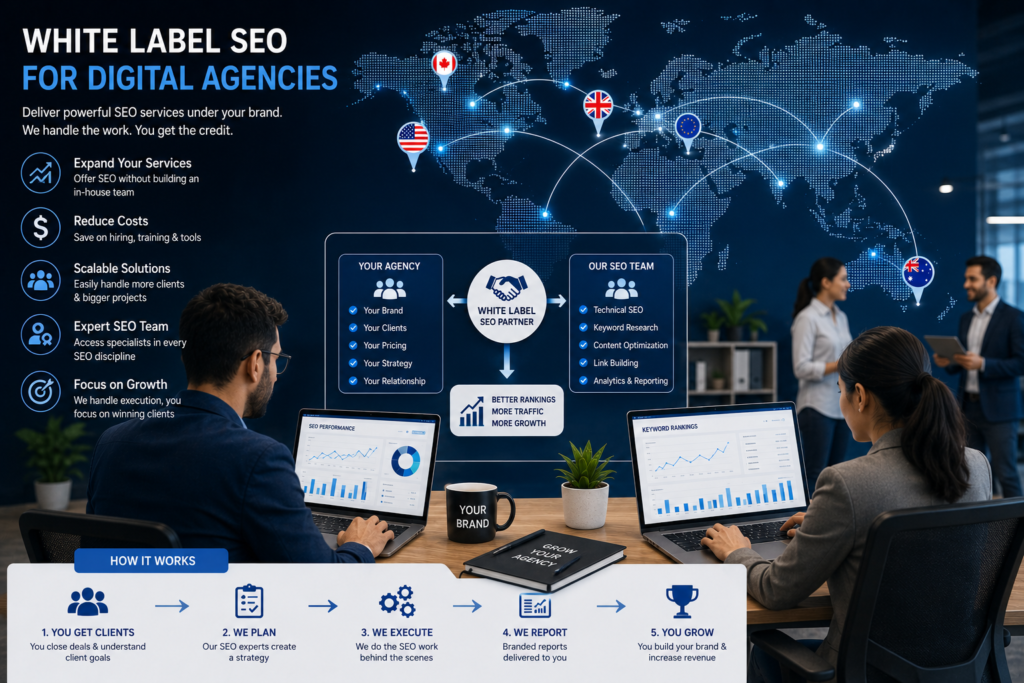
White label SEO provides another way to deliver SEO services. An agency partners with an external SEO team that performs the required work behind the scenes while the agency presents the service under its own brand.
This allows agencies targeting clients in the USA, UK, Canada, Australia, Europe, and other international markets to expand their SEO offerings without building every SEO function internally.
Fiftyone Digitalmedia LLP provides white label SEO support for agencies that need scalable execution while maintaining control over their client relationships, branding, pricing, and strategy.
What Is White Label SEO?
White label SEO is a business-to-business service model where an SEO provider performs search engine optimization work for another agency, which then delivers that service to its own clients under its own brand.
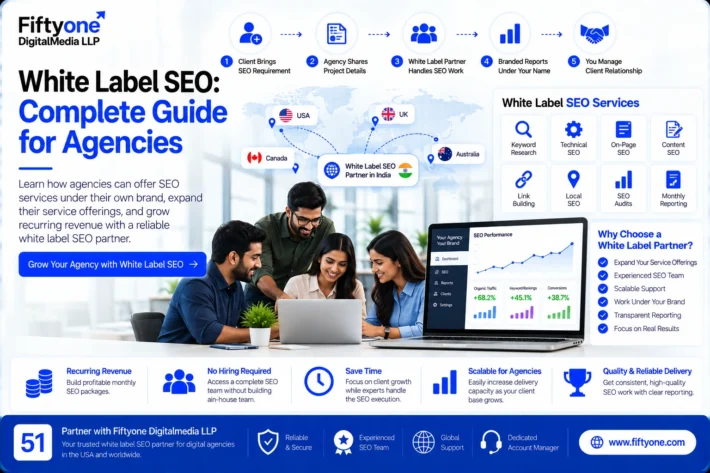
The end client generally communicates with the agency rather than the SEO provider. The agency manages the client relationship, pricing, proposals, and account strategy, while the white label team handles agreed SEO execution.
For example, a digital agency in the USA may sell monthly SEO services to a local business, SaaS company, ecommerce brand, or professional service company. Instead of hiring an internal SEO team, the agency can use a white label partner to handle technical audits, keyword research, content optimization, reporting, and other campaign activities.
The agency remains the primary service provider from the client’s perspective.
How White Label SEO Works
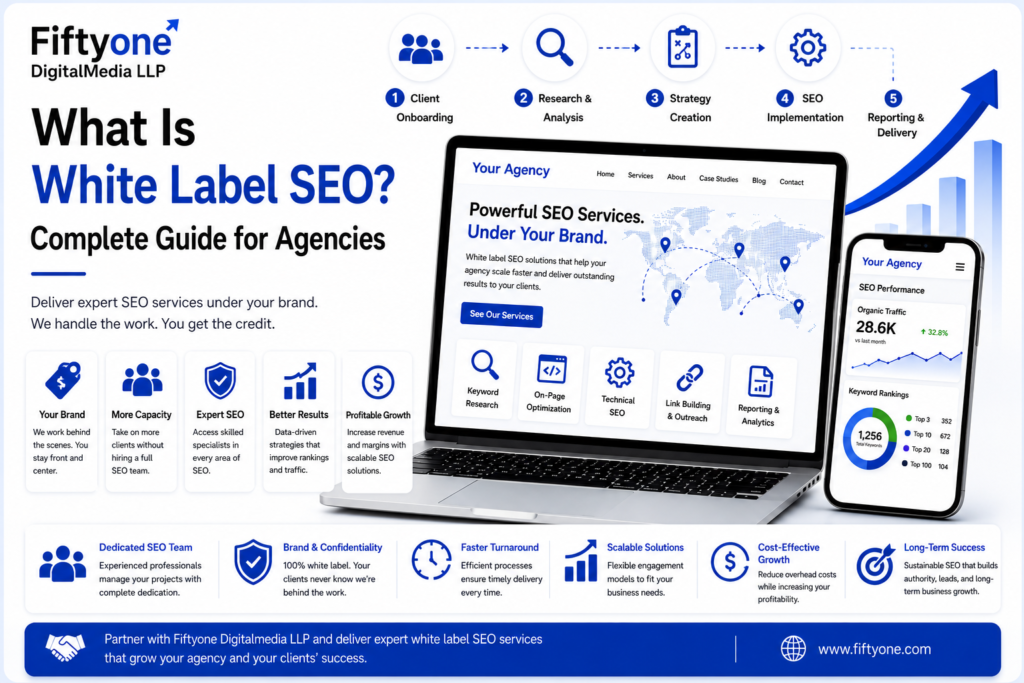
A white label SEO relationship normally follows a structured workflow. The agency first collects the client’s requirements and defines the campaign objectives. Those requirements are then shared with the white label SEO team.
The SEO team performs research, creates recommendations, completes agreed optimization work, and prepares reports or deliverables. The agency reviews the work before presenting it to the client.
A typical process includes:
- Client onboarding
- SEO requirements collection
- Website and competitor analysis
- Keyword research
- Strategy development
- SEO implementation
- Content optimization
- Authority-building activities
- Performance tracking
- Reporting
- Agency review
- Client delivery
The exact workflow can change depending on whether the agency outsources the complete campaign or only specific SEO activities.
What Services Can Be White Labelled?
White label SEO is not limited to keyword research. Agencies can outsource individual SEO functions or combine several services into a complete campaign.
Common services include:
- Technical SEO
- Keyword research
- Competitor analysis
- On-page SEO
- Content optimization
- SEO content briefs
- Internal linking
- Local SEO
- Ecommerce SEO
- International SEO
- Link-building support
- SEO audits
- Performance reporting
The agency should decide which responsibilities remain internal and which are handled by the external team. Clear ownership prevents duplicated work and missed deliverables.
Why Agencies Use White Label SEO
The main reason agencies use white label SEO is scalability. Client acquisition can increase faster than internal delivery capacity. Without additional resources, new accounts can overload existing employees and reduce campaign quality.
White label SEO allows agencies to increase delivery capacity without immediately recruiting a complete internal SEO department.
Agencies can use the model to:
- Accept more SEO clients
- Expand service offerings
- Access specialist expertise
- Reduce recruitment pressure
- Handle larger workloads
- Improve delivery consistency
- Increase recurring revenue
- Enter new service categories
- Support international clients
- Scale operations more flexibly
For agencies targeting international markets, this flexibility can be particularly useful because SEO requirements vary across countries and industries.
White Label SEO for International Agencies
International agencies often manage clients from different industries and countries. A campaign targeting the USA may require different keyword research and competitor analysis from a campaign targeting the UK or Australia.
A white label SEO team can provide additional execution resources without requiring the agency to recruit separate specialists for every market.
The agency can maintain strategic control while the external team supports:
- Country-specific keyword research
- Competitor analysis
- Technical optimization
- International content
- Search intent analysis
- Landing-page optimization
- SEO reporting
Agencies expanding their SEO delivery can also use SEO Outsourcing Services for Growing Agencies as a related resource for understanding how external SEO resources can support increasing client workloads.
White Label SEO vs Traditional SEO Outsourcing
White label SEO and SEO outsourcing are closely related, but the business relationship is different.
With traditional outsourcing, a business may openly work with an external SEO provider. With white label SEO, the agency generally presents the service as part of its own offering.
The agency controls:
- Client communication
- Service pricing
- Branding
- Account management
- Strategic positioning
- Final deliverables
The white label provider focuses on technical and operational SEO execution according to the agency’s requirements.
White Label SEO vs Building an In-House SEO Team
An internal SEO department provides direct control over employees, processes, and daily communication. It can be effective for large agencies with consistent SEO demand.
However, building a complete team requires several specialists and creates ongoing employment costs. White label SEO offers a more flexible alternative when an agency wants SEO capacity without permanently hiring every specialist.
A hybrid model can also work well. Agencies can keep SEO strategy and senior account management internally while outsourcing execution-heavy activities.
How White Label SEO Can Improve Agency Profitability
SEO services can create recurring revenue, but margins depend on delivery costs. Hiring employees for every new client can increase fixed expenses and reduce flexibility when workloads change.
White label SEO allows agencies to structure delivery costs around actual client requirements. Instead of maintaining maximum internal capacity throughout the year, agencies can use external resources as their account portfolio grows.
The financial advantage should not be judged only by the provider’s monthly price. Agencies should also consider quality control, management time, revisions, reporting, and client retention.
A cheap provider that produces poor work can reduce profitability rather than improve it.
Maintaining Client Ownership
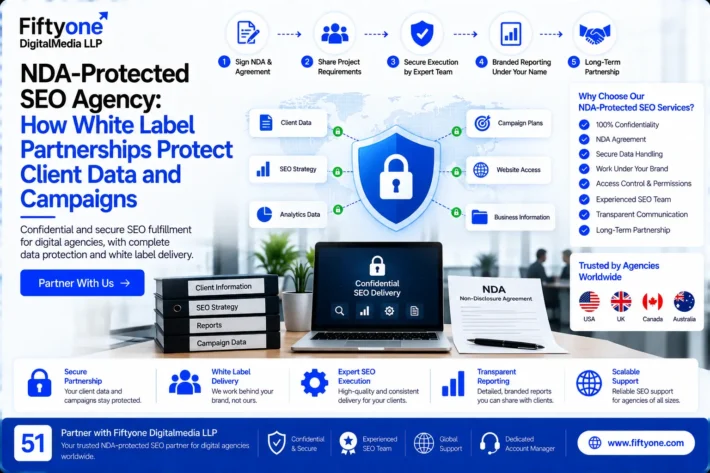
One of the most important parts of white label SEO is maintaining the agency’s client relationship. The external provider should operate according to clearly defined confidentiality and communication terms.
Agencies should establish:
- NDA agreements
- Client ownership clauses
- Confidentiality requirements
- Controlled account access
- Secure credential sharing
- Defined communication procedures
- Intellectual property terms
- Approval responsibilities
This keeps the agency in control of the customer relationship while the white label team performs its assigned SEO responsibilities.
Why Choose Fiftyone Digitalmedia LLP
White label SEO requires more than completing individual SEO tasks. Agencies need a development partner that understands deadlines, reporting requirements, client expectations, confidentiality, and consistent campaign execution.
Fiftyone Digitalmedia LLP supports agencies with scalable SEO resources across technical optimization, keyword research, content optimization, competitor analysis, reporting, and other recurring SEO requirements.
The agency remains responsible for its brand and customer relationships while the white label team provides the technical and operational SEO support required to deliver campaigns.
White Label SEO Pricing Models
White label SEO pricing should fit the agency’s client model and workload. Agencies may use fixed monthly packages for recurring campaigns, project-based pricing for audits and one-time work, or dedicated SEO resources when several client accounts require continuous support.
The cheapest provider is not automatically the most profitable. Agencies should consider SEO quality, revisions, reporting, management time, and client retention alongside the outsourcing cost.
Quality Control for White Label SEO
The agency remains responsible for the work delivered to its clients. Every outsourced campaign should therefore pass an internal quality review before reaching the customer.
Important checks include:
- Keyword relevance
- Search intent
- Technical recommendations
- Content quality
- On-page optimization
- Internal linking
- Link quality
- Reporting accuracy
- Client-specific requirements
A clear review process protects the agency’s reputation while allowing the external team to handle larger workloads.
White Label SEO Reporting
SEO reports should help clients understand progress rather than simply displaying large amounts of data. Agencies should decide in advance which metrics and reporting formats they want the white label team to follow.
Useful reporting can include:
- Organic clicks
- Search impressions
- Keyword visibility
- Organic conversions
- Landing-page performance
- Technical improvements
- Content performance
- Link-building progress
- Completed SEO activities
- Next campaign priorities
The agency can then review the report and deliver it to the client under its own branding.
Choosing a White Label SEO Partner
Selecting a white label SEO partner based only on price creates unnecessary risk. Agencies should evaluate the provider’s actual SEO capabilities, communication process, quality standards, and ability to handle increasing client volumes.
Before choosing a partner, review:
- Technical SEO expertise
- International SEO experience
- Content quality
- Keyword research process
- Link-building practices
- Reporting standards
- Communication
- Confidentiality
- Resource capacity
- Scalability
- Post-campaign support
The provider should also be transparent about the techniques it uses. Ranking guarantees and bulk low-quality link packages are warning signs.
White Label SEO for Growing Client Portfolios
As agencies acquire more SEO clients, repetitive execution work can consume a significant amount of internal time. Technical audits, keyword research, content optimization, reporting, and campaign monitoring all increase with every additional account.
A white label team can absorb part of this workload while the agency focuses on strategy, sales, client communication, and account management.
This allows agencies to increase their client portfolio without making every new account dependent on another permanent hire.
Scaling International SEO Services
International agencies may eventually manage SEO campaigns across several countries. Each market can require separate keyword research, competitor analysis, content planning, and performance tracking.
White label SEO can provide additional resources for this expansion without requiring the agency to establish separate internal teams for every market.
Businesses targeting multiple international markets should maintain country-specific strategies rather than simply translating one campaign into different languages. Search behaviour, competition, terminology, and commercial intent can vary significantly between countries.
Common White Label SEO Mistakes
Agencies can damage their SEO services when outsourcing is treated as a simple cost-cutting exercise.
Common mistakes include:
- Choosing the cheapest provider
- Accepting ranking guarantees
- Using bulk backlinks
- Publishing unreviewed content
- Poor campaign documentation
- Weak communication
- Undefined responsibilities
- No quality control
- Identical strategies for every client
- Focusing only on rankings
- Ignoring conversions
Outsourcing should increase delivery capacity without reducing the quality of the agency’s SEO service.
Building a Long-Term White Label Partnership
A strong white label relationship becomes more efficient as the external team understands the agency’s processes. Reporting formats, quality expectations, campaign workflows, communication preferences, and client requirements become easier to manage over time.
Agencies should therefore look for partners capable of supporting long-term growth rather than switching providers whenever they find a slightly lower price.
Fiftyone Digitalmedia LLP can operate as an extension of an agency’s SEO delivery team, providing recurring SEO resources while the agency retains ownership of its clients and brand.
Related SEO Resources for Agencies
Agencies looking to expand their SEO delivery capacity can also explore White Label SEO Agency for Digital Agencies, which focuses specifically on how digital agencies can use a white label SEO model to expand services and manage increasing client workloads.
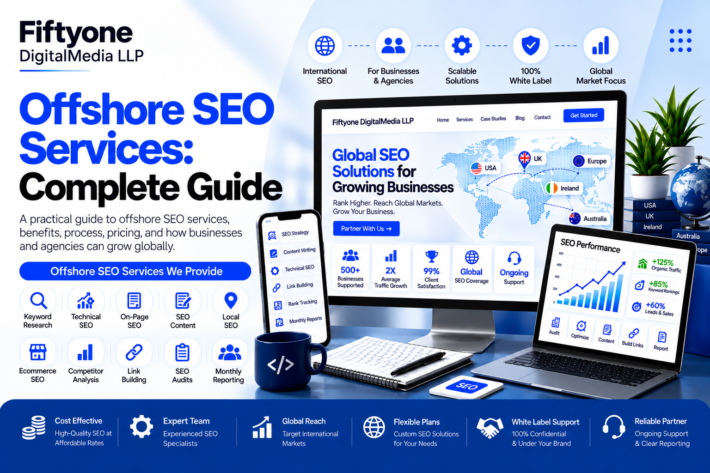
For agencies considering a broader outsourcing structure, Offshore SEO Services for Global Businesses is another relevant resource covering scalable SEO execution for businesses targeting international markets.
Frequently Asked Questions
What is the difference between white label SEO and SEO outsourcing?
SEO outsourcing means assigning SEO work to an external provider. White label SEO adds the agency-branding element, allowing the agency to deliver the outsourced service under its own brand.
Can a small agency use white label SEO?
Yes. Small agencies can use white label SEO to offer professional SEO services without building a complete internal SEO department.
Can white label SEO support international clients?
Yes. White label teams can support international keyword research, technical SEO, content optimization, competitor analysis, and reporting across different markets.
How can agencies protect their clients?
Agencies should use confidentiality agreements, client ownership terms, controlled access, secure credentials, and clearly defined communication responsibilities.
Should agencies choose the cheapest white label SEO provider?
No. Price should be evaluated alongside SEO quality, reporting, communication, scalability, and long-term reliability.
Conclusion
White label SEO gives digital agencies a scalable way to provide professional SEO services without building every specialist function internally. Agencies can maintain their branding and client relationships while an external team handles agreed SEO execution.
For agencies targeting international clients, the model can provide additional resources for technical SEO, keyword research, content optimization, competitor analysis, and ongoing campaign management across different markets.
The right white label partner should be selected for reliable execution and scalability, not simply the lowest price.
Expand Your Agency’s SEO Services
Fiftyone Digitalmedia LLP provides white label SEO support for agencies that need additional technical and operational capacity. The model allows agencies to expand their SEO services, manage more client accounts, and maintain their own brand while external specialists handle campaign execution.