White-Label Web Development for Agencies: Pricing, Process, and How to Start

White-label web development allows digital agencies to offer professional website development services under their own brand without hiring and managing a complete in-house development team.
For digital marketing agencies, SEO companies, and creative studios, this model creates an opportunity to expand services, manage more client projects, and generate additional revenue while keeping the focus on client relationships and business growth.
However, a successful white-label partnership requires more than finding an affordable developer. Agencies need to understand pricing models, project workflows, quality standards, client confidentiality, and profit margins before choosing a development partner.
In this guide, we explain how white-label web development works, what affects its cost, how agencies can earn revenue, and how to start a reliable partnership.
What Is White-Label Web Development?
White-label web development is a business arrangement in which one company develops a website or web application while another company sells and delivers the service under its own brand.
For example, a digital marketing agency may have a client who needs a new business website. Instead of hiring developers internally, the agency partners with a white-label development company to complete the project.
The agency manages the client relationship, project requirements, pricing, and approvals. The development partner handles the agreed technical work behind the scenes.
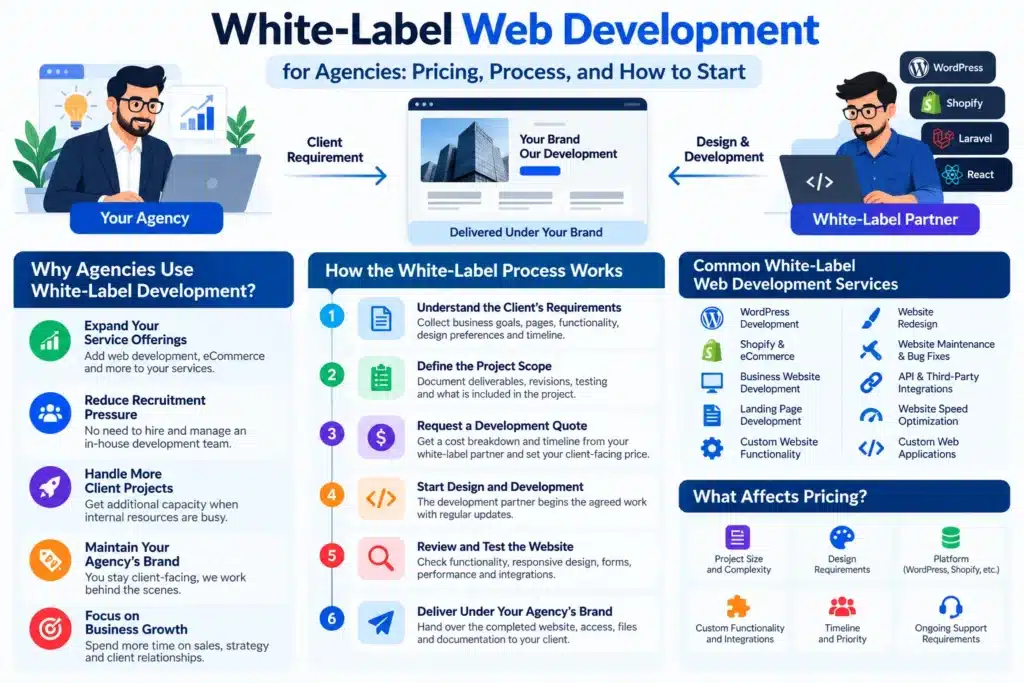
Common white-label web development services include:
- WordPress website development
- Shopify and eCommerce development
- Business website design and development
- Landing page development
- Custom website functionality
- Website redesign
- Website maintenance and bug fixes
- API and third-party integrations
- Website speed and performance improvements
The exact responsibilities depend on the partnership agreement and the services an agency wants to offer.
Why Do Agencies Use White-Label Web Development?
Digital agencies often receive requests for services outside their core expertise. An SEO agency, for example, may have clients who need website redesigns, landing pages, or technical development.
A white-label partnership allows the agency to fulfil these requirements without building every capability internally.
Expand Your Service Offerings
Agencies can add website development, eCommerce solutions, and ongoing technical support to their existing services. Clients can receive more digital services through one trusted provider.
Reduce Recruitment Pressure
Hiring developers involves recruitment, onboarding, salaries, tools, and ongoing management. White-label development can provide access to technical resources without requiring an immediate permanent hire.
Handle More Client Projects
When internal developers are busy, agencies may need to delay or decline new projects. An external development partner can provide additional capacity when its resources are available.
Maintain Your Agency’s Brand
The agency remains the primary client-facing business. The development partner works behind the scenes according to the agreed branding, communication, and confidentiality arrangements.
Focus on Business Growth
By delegating technical implementation, agency owners and internal teams can spend more time on sales, strategy, client relationships, and business development.
How Does the White-Label Web Development Process Work?
A clear workflow helps agencies maintain quality, manage deadlines, and avoid misunderstandings.
Step 1: Understand the Client’s Requirements
Start by collecting the client’s business goals, website requirements, preferred design, required pages, functionality, integrations, and expected launch date.
Prepare a written project brief so that the development partner understands exactly what needs to be delivered.
Step 2: Define the Project Scope
Document the number of pages, design requirements, functionality, responsive layouts, revisions, testing, and handover requirements.
Clearly identify what is included and what would be treated as additional work. This prevents disagreements about pricing and delivery later.
Step 3: Request a Development Quote
Share the project brief with your white-label partner and request a breakdown of development fees, deliverables, milestones, and estimated timelines.
Once the quote is approved, calculate your own client-facing price based on the development cost, management effort, business expenses, and desired profit margin.
Step 4: Start Design and Development
The development partner begins the agreed work. Depending on the project, this may include design implementation, WordPress or Shopify development, custom coding, integrations, and content implementation.
The agency should receive regular progress updates and communicate any client feedback promptly.
Step 5: Review and Test the Website
Before presenting the project to the client, verify the website’s functionality, responsive layouts, forms, navigation, performance, and important integrations.
Create a consistent quality checklist that can be reused across projects.
Step 6: Deliver Under Your Agency’s Brand
After internal testing and approval, deliver the completed website to your client through your agency’s normal communication process.
Confirm ownership, website access, source files, documentation, and any ongoing support arrangements before closing the project.
White-Label Web Development Pricing: What Affects the Cost?
White-label development pricing varies according to the website’s complexity, platform, functionality, delivery requirements, and the development partner’s pricing model.
There is no single price that applies to every project.
| Pricing factor | How it affects cost |
|---|---|
| Number of pages | Larger websites generally require more implementation work |
| Design complexity | Custom layouts and interactions require additional effort |
| Website platform | WordPress, Shopify, and custom applications have different requirements |
| Custom functionality | Advanced features and integrations add complexity |
| Content requirements | Content creation and migration may involve extra work |
| Delivery timeline | Urgent deadlines may require additional resources |
| Testing requirements | Complex functionality requires more extensive quality assurance |
| Ongoing maintenance | Support may be charged separately |
Before accepting a quote, confirm whether the price includes design implementation, revisions, testing, content uploads, migration, and post-launch support.
Requesting a written quote with clearly defined deliverables makes it easier to compare providers and calculate your own selling price.
Which Pricing Model Should Agencies Choose?
White-label development partners may offer different engagement models. The right choice depends on your project volume and how predictable your workload is.
Fixed-Price Projects
A fixed-price model works well when the project scope and deliverables are clearly defined.
The agency agrees on a development fee before work begins and can calculate its selling price in advance. Changes outside the original scope should have a separate approval process.
Hourly Development
Hourly pricing can work for ongoing improvements, troubleshooting, or projects where requirements may change during development.
Agencies should agree on hourly rates, reporting methods, estimated hours, and approval requirements for additional work.
Monthly Development Support
A monthly arrangement may suit agencies with regular development requirements. The agreement should explain the included hours, availability, response expectations, and charges for additional work.
Dedicated Development Resources
Agencies with a consistent workload may choose dedicated developers or a team for ongoing projects.
This model can offer greater continuity, but the agency should understand the commitment, working hours, and responsibilities included in the agreement.
How Can Agencies Make Money from White-Label Development?
White-label development allows agencies to purchase technical services from a provider and sell the completed service to their clients.
The agency’s profit depends on the selling price and all expenses associated with delivering the project.
Consider this hypothetical example:
- Client price: $2,000
- Development partner fee: $1,200
- Other project expenses: $200
- Remaining project profit: $600
The calculation is:
Project profit = Client price − Development fee − Other project expenses
In this example:
$2,000 − $1,200 − $200 = $600
The remaining project profit is $600, or 30% of the client price, before additional business overhead and applicable taxes.
These figures are illustrative only and are not standard market prices.
When setting your prices, include project management, client communication, quality assurance, payment processing, revisions, and support obligations. Otherwise, a project that appears profitable may generate less profit than expected.
How to Choose the Right White-Label Development Partner
Your development partner affects your agency’s reputation, client satisfaction, and delivery timelines. Evaluate providers carefully before committing to a long-term relationship.
Technical Experience
Review the provider’s portfolio and confirm experience with the technologies your clients need, such as WordPress, Shopify, WooCommerce, React, or custom web applications.
Ask for relevant examples and clarify which work the development team completed.
Communication and Project Management
Confirm how progress updates are shared, who manages tasks, and how issues are escalated.
If your agency and development partner work in different time zones, agree on overlapping working hours and meeting schedules.
Quality Assurance
Ask how the provider tests websites before delivery. Testing should cover responsive layouts, essential functionality, forms, integrations, and relevant performance requirements.
Transparent Pricing
Choose a partner that clearly explains fees, included services, revision limits, payment terms, and additional charges.
Confidentiality and Client Ownership
Agree on confidentiality, intellectual property ownership, source code delivery, account access, and whether the provider may communicate directly with your client.
Scalability and Support
Check whether the provider can handle changing project volumes and offer ongoing maintenance when needed.
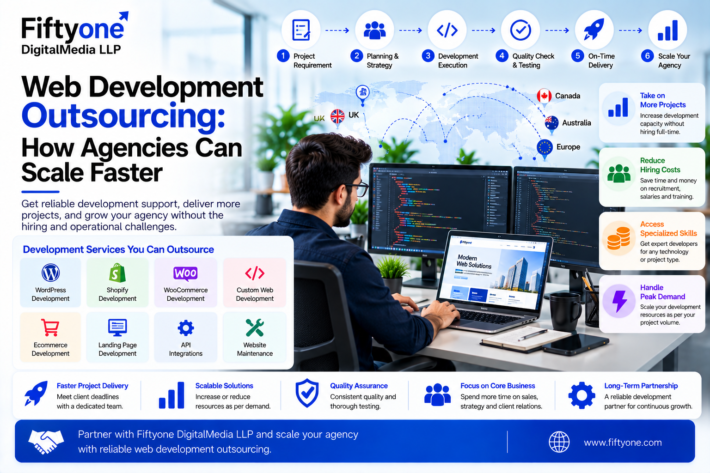
For a broader overview of how agencies can expand delivery capacity, read Web Development Outsourcing: How Agencies Can Scale Faster.
Common Mistakes to Avoid
Agencies can prevent many operational problems by addressing common mistakes before starting a project.
- Choosing a provider only because its quote is the cheapest.
- Starting development without a detailed project brief.
- Promising a delivery date before confirming resource availability.
- Failing to define revision limits and additional charges.
- Skipping quality testing before client delivery.
- Ignoring confidentiality and intellectual property agreements.
- Failing to calculate the full cost of project delivery.
- Depending on a single provider without a backup plan.
- Leaving post-launch support responsibilities undefined.
- Accepting projects without confirming that the development partner can deliver them.
A consistent workflow helps agencies protect their reputation and maintain reliable service quality as the number of projects increases.
How to Start a White-Label Web Development Partnership
If your agency is considering white-label development for the first time, start with a manageable process.
- Identify the development services your clients request most frequently.
- Choose the platforms and technologies your agency wants to offer.
- Shortlist development partners with relevant experience.
- Request quotes for clearly defined sample projects.
- Compare pricing, quality, communication, and delivery processes.
- Establish a written partnership agreement.
- Start with a small project to evaluate the workflow.
- Create standard processes for briefs, approvals, testing, and handover.
- Review project profitability and client feedback.
- Expand the partnership when delivery quality and communication are consistent.
You do not need to offer every development service immediately. Begin with services that match your existing clients’ needs and expand as your processes improve.
Frequently Asked Questions
What is white-label web development for agencies?
It is a partnership model in which a development provider builds websites or web applications that an agency sells and delivers under its own brand.
Is white-label web development profitable?
It can be profitable when the agency sets suitable prices and manages development fees, project management, revisions, and other delivery expenses.
Can a small digital agency use white-label development?
Yes. It can help small agencies expand their service offerings without hiring a full in-house development team.
Who communicates with the end client?
Usually, the agency manages client communication while the development partner handles technical implementation. The exact arrangement should be documented in the agreement.
What should a white-label development agreement include?
It should cover project scope, pricing, deadlines, revision limits, confidentiality, intellectual property ownership, communication, security, and ongoing support.
How can an agency maintain website quality?
Use clear project requirements, agreed development standards, milestone reviews, testing checklists, and final internal approval before delivery.
Conclusion
White-label web development gives digital agencies a practical way to expand their services, access technical expertise, and manage more client projects without continuously growing an internal development team.
Success depends on selecting a reliable partner, defining project requirements clearly, maintaining quality standards, and calculating costs accurately.
Start with a small project, establish a repeatable workflow, and review the results before expanding the partnership. With the right processes, white-label development can become a valuable part of your agency’s long-term growth strategy.