Shopify vs WooCommerce for a Growing Business: Total Cost and Limitations


Choosing between Shopify and WooCommerce is an important decision for a growing ecommerce business. Both platforms help businesses sell products online, manage orders, accept payments, and build a recognizable brand. However, their pricing models, customization options, maintenance requirements, and long-term limitations are different.
Shopify is a hosted ecommerce platform that combines hosting, security, and store management tools in one subscription. WooCommerce is a free, open-source ecommerce plugin for WordPress that gives businesses more control over their website and hosting environment.
The best choice depends on your budget, technical resources, expected sales volume, and plans for growth. This guide compares Shopify vs WooCommerce costs, hidden expenses, scalability, and limitations to help you make an informed decision.
1. Shopify vs WooCommerce: Key Differences
Before comparing costs, it helps to understand how each platform works.
| Feature | Shopify | WooCommerce |
|---|---|---|
| Platform model | Hosted ecommerce platform | Open-source WordPress plugin |
| Starting platform cost | Paid subscription | Core plugin is free |
| Hosting | Included | Purchased separately |
| Security and SSL | Core hosting security included | Depends on hosting and configuration |
| Customization | Themes, apps, and supported custom development | Themes, plugins, and code-level control |
| Maintenance | Much of the infrastructure is managed | Owner or developer manages more of the stack |
| Payment processing | Provider fees apply | Provider fees apply |
| Technical skills | Generally easier for beginners | More technical responsibility |
| Store ownership and control | Subject to Shopify’s platform and service terms | Greater control over website files and hosting |
| Best suited for | Businesses seeking a managed solution | Businesses needing flexibility and control |
Both platforms can support growing online stores. The difference is how much control you want and how much responsibility your team is willing to manage.
2. Shopify vs WooCommerce: Total Cost of Ownership
The platform’s starting price does not tell you the full cost of running an ecommerce business. A realistic budget should include development, hosting, payment processing, extensions, maintenance, security, and marketing integrations.
Shopify costs
Shopify charges a recurring subscription fee. Its published US pricing lists the Basic plan at $29 per month when billed annually, with higher plans available for businesses needing additional features.
Typical expenses include:
- Monthly subscription: The selected Shopify plan.
- Domain name: A custom domain, if you need to purchase one.
- Theme and design: A free theme or a paid theme and custom design work.
- Apps: Additional features for reviews, subscriptions, reporting, shipping, and marketing.
- Payment processing: Fees vary by provider, plan, location, and payment method.
- Third-party transaction fees: These may apply when using an external payment provider, depending on the plan and payment setup.
- Development: Custom themes, integrations, and advanced functionality.
Shopify includes hosting and an SSL certificate in its plans, so you generally do not need to arrange separate web hosting.
WooCommerce costs
WooCommerce’s core plugin is free, but operating a store requires a WordPress website and supporting services.
Typical expenses include:
- Hosting: A suitable hosting plan for your traffic and performance needs.
- Domain name: Registration and renewal.
- Theme and design: Free or paid themes and custom development.
- Extensions: Paid plugins for advanced ecommerce features.
- Payment processing: Fees charged by your payment provider.
- Security and backups: Depending on what your hosting package includes.
- Maintenance: Updates, troubleshooting, compatibility checks, and performance optimization.
- Development: Custom features, integrations, and technical support.
WooCommerce’s published pricing guidance estimates hosting at approximately $25 to $350 per month for many stores, with paid extensions commonly costing $29 to $299 per year each. Actual costs can be lower or higher depending on your setup.
Important: These figures are reference prices, not a complete quote for a particular business. Actual costs depend on location, traffic, sales volume, the required features, and the service providers you choose.
3. Hidden Costs That Can Affect Your Budget
The biggest difference between Shopify and WooCommerce is not simply the subscription fee. It is how additional expenses develop as your store grows.
Shopify’s potential hidden costs
Shopify can simplify store management, but the total bill may increase when you add premium apps, advanced features, custom development, or a more expensive subscription plan.
For example, a business may start with a basic store and later require subscription management, advanced reporting, loyalty programs, or complex product bundles. Some features may require paid apps or custom work.
Payment fees also deserve attention. If your business uses a third-party payment provider, Shopify may charge an additional platform transaction fee depending on your plan and circumstances.
WooCommerce’s potential hidden costs
WooCommerce offers greater freedom to choose hosting, plugins, and developers. However, that freedom can create additional operating responsibilities.
Costs may increase when your business needs:
- A more powerful hosting environment.
- Premium plugins or recurring extension licenses.
- Developer support for plugin conflicts.
- Performance optimization as traffic grows.
- Security monitoring and reliable backups.
- Custom integrations with inventory, shipping, accounting, or CRM systems.
A free plugin does not necessarily mean a free feature. If a business depends on several paid extensions and regular technical support, its total cost may become substantial.
To compare both platforms accurately, calculate the expected cost over 12 or 24 months instead of looking only at the initial setup price.
4. Shopify Limitations for Growing Businesses
Shopify is designed to reduce the technical work involved in operating an online store. However, a managed platform also means working within its rules and supported capabilities.
Limited control over infrastructure
You cannot manage Shopify’s underlying hosting environment in the same way you can with a self-hosted WooCommerce website. Businesses that require unusual server configurations or direct infrastructure control may find this restrictive.
Recurring subscription expenses
The subscription continues even when sales fluctuate. Businesses should consider the plan cost alongside payment fees, apps, advertising, and fulfilment expenses.
App dependency
Some advanced features depend on third-party apps. This can introduce additional costs, overlapping functionality, and dependencies on external developers.
Customization boundaries
Shopify supports theme customization, APIs, and custom applications, but not every part of the platform is equally flexible. Checkout customization and advanced capabilities depend on the plan and feature being used.
Platform dependency
Your store operates within Shopify’s ecosystem and terms. If you later move to another platform, you may need to migrate products, customer information, orders, theme designs, integrations, and store functionality. Not every element transfers automatically.
Shopify is still a strong choice for many growing businesses, particularly those that value a managed environment over direct infrastructure control.
5. WooCommerce Limitations for Growing Businesses
WooCommerce gives businesses substantial control over their online stores, but that control comes with greater responsibility.
Hosting and performance management
Your website’s performance depends on hosting quality, database health, caching, image optimization, plugins, and configuration. As traffic and orders increase, you may need better hosting or technical optimization.
Plugin compatibility
Different plugins and themes may conflict after updates or changes. A poorly tested update can affect product pages, checkout, payment processing, or other important features.
Security responsibilities
WordPress core, themes, plugins, hosting, and access permissions need appropriate maintenance. SSL alone does not protect a store from every security risk.
Ongoing maintenance
Businesses may need regular backups, updates, staging tests, troubleshooting, and developer support. Without a maintenance process, small issues can become costly disruptions.
Variable total cost
WooCommerce lets you choose where to spend, but it does not guarantee that the final setup will be cheaper. Costs depend on the quality of hosting, the number of extensions, custom development, and the support your team requires.
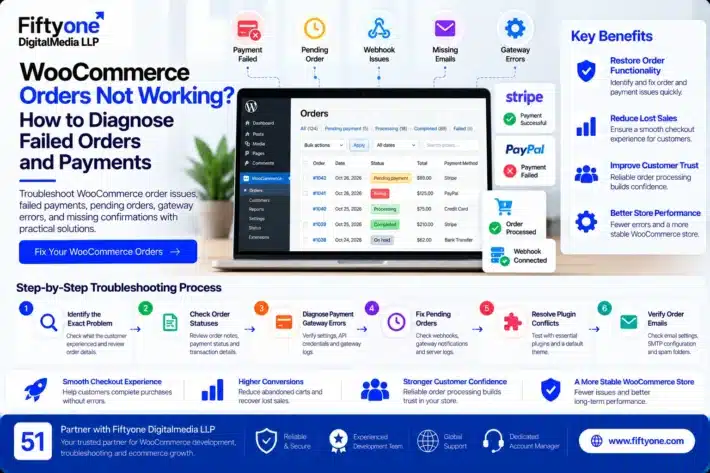
For stores that rely heavily on WooCommerce, reliable payment processing is especially important. Businesses can use this guide to troubleshoot common issues: How to Fix WooCommerce Checkout Errors.
6. Which Platform Scales Better as Your Business Grows?
Both Shopify and WooCommerce can support substantial ecommerce operations. Scalability depends on more than the platform itself: product complexity, traffic patterns, integrations, fulfilment processes, and the quality of implementation all matter.
Shopify for operational simplicity
Shopify can be a good fit when a business wants to focus on product development, marketing, customer service, and sales rather than managing server infrastructure.
It can simplify routine store operations through a central dashboard, managed hosting, integrated commerce features, and an app ecosystem.
However, growing businesses should monitor app costs, payment fees, plan requirements, and any feature limitations that may affect their operating model.
WooCommerce for flexibility and control
WooCommerce can be a good fit when a business needs a customized shopping experience, close integration with WordPress content, control over hosting, or specialized functionality.
Its open-source structure offers significant flexibility. With suitable hosting, development practices, and maintenance, a WooCommerce store can support a growing catalogue and increasing traffic.
The trade-off is that the business or its development partner must take greater responsibility for performance, security, compatibility, and infrastructure decisions.
Questions to ask before choosing
- Will your business need extensive custom functionality?
- Do you have an internal technical team or a reliable development partner?
- How important is control over hosting and website code?
- Will your business depend on multiple paid apps or extensions?
- How much time can your team spend on maintenance?
- Which platform provides the most suitable checkout, payment, and fulfilment options for your target markets?
The right platform is the one that supports your business model without creating unnecessary technical or financial complexity.
7. Shopify vs WooCommerce: Which Is Better for Your Business?
There is no universal winner. Your business requirements should determine the decision.
Choose Shopify if:
- You want a managed ecommerce platform with hosting included.
- Your team prefers a simpler store-management workflow.
- You want to reduce direct responsibility for server maintenance.
- Your required features are available through the platform and its apps.
- Predictable core platform billing is a priority.
Choose WooCommerce if:
- You want greater control over your website and hosting.
- Your business already uses WordPress extensively.
- You need deep customization or specialized integrations.
- You want to choose individual hosting and extension providers.
- You have the resources to manage technical maintenance or outsource it.
If you are comparing development options before building your store, explore Best Shopify and Ecommerce Development Company in India for additional ecommerce development considerations.
Before making the final decision, list your essential features, estimate your recurring costs, and evaluate the work required to maintain the store over the next two years.
Frequently Asked Questions
Is Shopify cheaper than WooCommerce?
Not in every situation. Shopify has a recurring subscription with hosting included, while WooCommerce has no core plugin subscription but requires hosting and may need paid extensions and maintenance. The less expensive option depends on your actual store requirements and operating costs.
Is WooCommerce completely free?
The core WooCommerce plugin is free to download and use. However, running a live store usually involves expenses such as hosting, a domain, payment processing, and potentially paid themes, extensions, and technical support.
Which platform is easier for beginners?
Shopify is generally easier for beginners because hosting and much of the store infrastructure are managed. WooCommerce can also be user-friendly, but managing a WordPress website, extensions, backups, and technical issues may require additional learning or support.
Can WooCommerce handle a large online store?
Yes. WooCommerce can support large catalogues and growing stores when the hosting environment, database, integrations, and code are appropriately designed and maintained. Performance is not guaranteed by the platform alone.
Can I migrate from Shopify to WooCommerce or the other way around?
Yes, migration is possible. However, products, customers, orders, URLs, design elements, apps, and custom functionality may require different migration methods. Plan redirects, data validation, payment configuration, and testing before switching platforms.
Which platform is better for international ecommerce?
Both can support international selling. The best option depends on your target countries, available payment providers, currencies, shipping arrangements, tax requirements, and localization needs. Verify feature availability and fees for the countries where your business operates.
Conclusion
Shopify and WooCommerce serve different priorities. Shopify offers a managed ecommerce experience that can reduce technical overhead, while WooCommerce provides greater flexibility and control over the website environment.
For a growing business, the best decision is not necessarily the platform with the lowest starting price. It is the platform that delivers the required features, fits your team’s technical capabilities, and maintains a sustainable total cost as sales increase.
Compare subscription fees, hosting, extensions, payment processing, development, and maintenance before committing. A realistic cost estimate and a clear growth plan will help you select an ecommerce platform that supports your business over the long term.
About Fiftyone Digitalmedia LLP: Fiftyone Digitalmedia LLP provides website development and digital solutions for businesses looking to build, improve, and scale their online presence. Visit 51DigitalMedia to explore its services.