Shopify Development Outsourcing for Growing E-commerce Agencies
Introduction
E-commerce agencies are constantly looking for ways to increase their project capacity without allowing development workloads to slow down business growth.
As an agency wins more Shopify projects, the workload can quickly extend beyond simple store setup. Clients may require custom sections, theme modifications, third-party integrations, product functionality, migrations, performance improvements, and ongoing technical support.
Managing every project internally can become difficult when the development team is already busy.
Hiring additional Shopify developers may solve the capacity problem, but recruitment also introduces salaries, onboarding, management, training, software costs, and long-term commitments.
Shopify development outsourcing offers another approach.
By working with an external Shopify development team such as Fiftyone DigitalMedia LLP, growing e-commerce agencies can increase their technical capacity while continuing to manage client relationships, project strategy, pricing, and business development internally.
This allows agencies to accept more Shopify work without making every increase in demand dependent on internal hiring.
What Is Shopify Development Outsourcing?
Shopify development outsourcing means using an external development team to handle some or all of the technical work required for Shopify projects.
The agency remains responsible for the client relationship and project direction, while the development partner handles the agreed technical implementation.
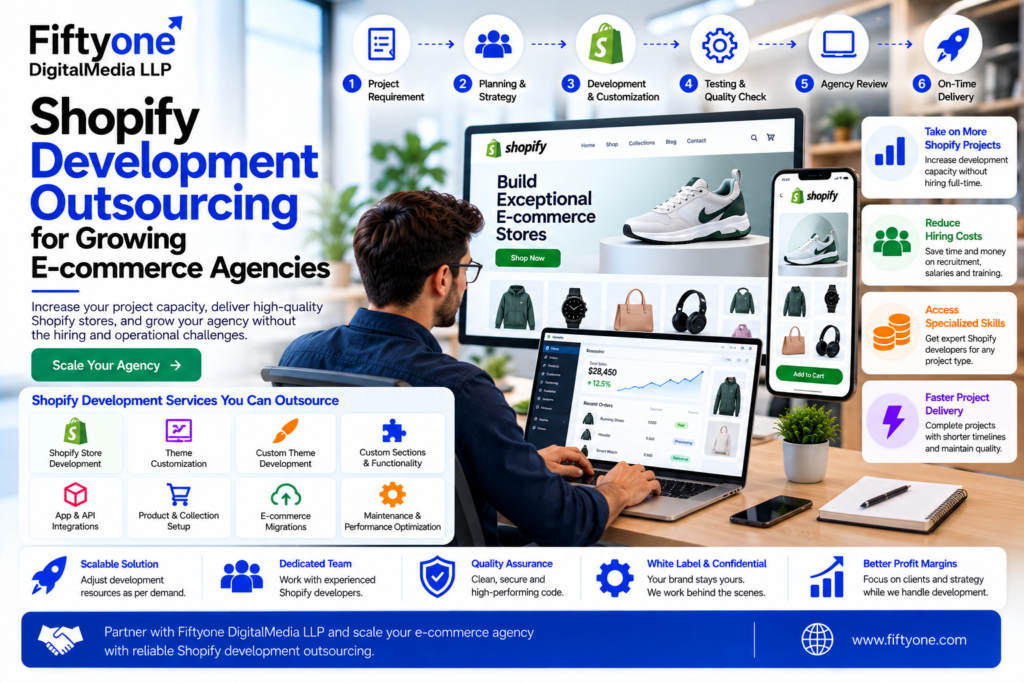
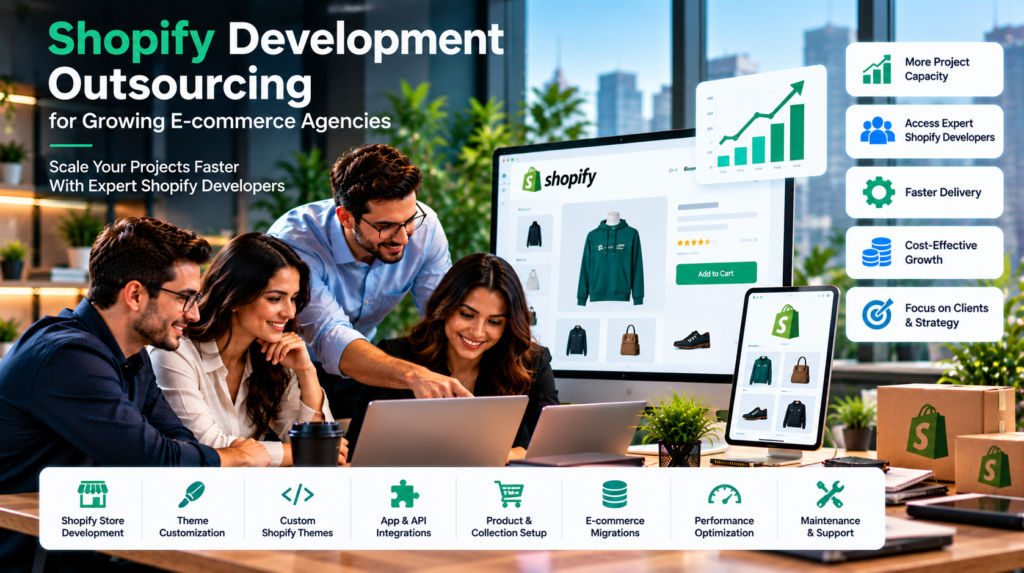
Depending on the agency’s requirements, outsourced Shopify development can include:
- Shopify store development
- Theme customization
- Custom Shopify themes
- Custom sections
- Shopify app integration
- API integrations
- Ecommerce migrations
- Product and collection setup
- Performance optimization
- Bug fixing
- Shopify maintenance
- Conversion-focused improvements
The agency can decide how much development work should be outsourced.
Some agencies outsource complete Shopify projects, while others use external developers only when their internal team reaches capacity.
Why Growing E-commerce Agencies Face Shopify Capacity Problems
Shopify has made ecommerce development more accessible, but larger client projects can still require substantial technical expertise.
An agency may have strong designers, marketers, SEO specialists, and account managers but only a small number of developers.
When multiple Shopify projects arrive simultaneously, this creates a bottleneck.
Developers may have to work on several stores at once, deadlines can become harder to maintain, and new projects may need to wait until existing work is completed.
Common challenges include:
Increasing Project Backlogs
More clients can mean more development tasks waiting in the pipeline.
Limited Specialist Availability
Some Shopify projects require specific technical experience that may not exist within the agency.
Recruitment Delays
Hiring a Shopify developer can take time, especially when the agency needs experienced technical talent.
Uneven Workloads
An agency may have high demand during one period and much lower development requirements later.
Reduced Focus on Growth
When agency owners and senior employees spend too much time managing technical delivery, they have less time for sales and strategic growth.
Outsourcing can help create additional capacity without making the agency’s internal team responsible for every technical requirement.
How Shopify Outsourcing Helps Agencies Scale
Shopify outsourcing can support agency growth in several ways.
Handle More Client Projects
Additional development resources can help agencies accept Shopify projects even when their internal team is already busy.
This means sales growth does not necessarily have to stop because of limited development capacity.
Increase Delivery Flexibility
An agency can increase external development support when project demand increases and reduce it when demand slows.
This can be more flexible than maintaining a large permanent development team.
Access Specialized Expertise
External Shopify developers can provide skills for complex themes, integrations, custom functionality, and ecommerce requirements.
Speed Up Project Execution
With additional development capacity, agencies can divide work more effectively and reduce the amount of time projects spend waiting for developer availability.
Expand Shopify Services
Agencies that currently offer ecommerce strategy, branding, SEO, or paid marketing can add Shopify development without creating an entirely new internal department.
Which Shopify Services Can Agencies Outsource?
Shopify outsourcing does not have to mean handing over an entire project.
Agencies can choose specific services based on their needs.
| Shopify Service | Typical Requirement | Outsourcing Opportunity |
|---|---|---|
| Store Setup | New Shopify store | High |
| Theme Customization | Existing theme changes | High |
| Custom Theme Development | Unique storefront | High |
| Custom Sections | Advanced page layouts | High |
| App Integration | Third-party functionality | High |
| API Integration | Connected systems | High |
| Store Migration | Moving from another platform | High |
| Performance Optimization | Faster storefront | High |
| Bug Fixing | Technical issues | High |
| Maintenance | Ongoing development | High |
This flexibility allows agencies to outsource only the areas where they need additional technical capacity.
Shopify Outsourcing vs. Hiring More Developers
When an agency experiences increasing Shopify demand, hiring is not the only option.
| Factor | Shopify Outsourcing | In-House Hiring |
|---|---|---|
| Recruitment | Usually not required | Required |
| Initial Commitment | Flexible | Higher |
| Resource Scaling | Faster | Slower |
| Specialist Access | Flexible | Depends on hiring |
| Fixed Payroll | Lower | Higher |
| Training | Reduced | Agency responsibility |
| Peak Workload | Easier to manage | Limited by team size |
| Project Flexibility | High | Moderate |
| Management | Shared | Internal |
| Best For | Variable or growing demand | Consistent high demand |
Neither model is universally better.
An established agency with a consistently large Shopify pipeline may eventually benefit from an internal team.
However, an agency with fluctuating demand can use outsourcing to increase capacity without immediately committing to additional permanent employees.
A hybrid model can also work well, where core development remains internal while external developers handle overflow and specialist projects.
How Shopify Outsourcing Can Improve Agency Profitability
The goal of outsourcing should not simply be to find cheaper developers.
The larger opportunity is to create a predictable and scalable delivery model.
An agency can create Shopify packages based on different client requirements and calculate development fulfillment costs into its pricing.
For example:
Shopify Launch Package
Designed for businesses launching their first online store.
Possible services include store setup, theme configuration, product structure, essential pages, and basic integrations.
Shopify Growth Package
Designed for established ecommerce businesses.
It can include custom sections, theme customization, conversion improvements, integrations, and performance optimization.
Shopify Custom Development Package
Designed for businesses requiring advanced functionality, custom integrations, or unique storefront experiences.
The agency controls the client-facing pricing while development fulfillment becomes part of the project’s operational cost.
Agencies should calculate their margins carefully by considering development costs, project management, revisions, quality assurance, software, and client acquisition costs.
How Agencies Can Build a Scalable Shopify Workflow
A strong workflow prevents outsourcing from becoming another management problem.
A practical Shopify process can follow these stages:
Client Discovery → Scope → Design → Development Brief → Shopify Development → QA → Client Review → Revisions → Launch → Maintenance
Client Discovery
Understand the client’s products, target audience, ecommerce objectives, competitors, and required functionality.
Project Scope
Document exactly what will be developed, including pages, features, integrations, and technical requirements.
Development Brief
Convert the approved requirements into clear tasks for the development team.
Development
The Shopify team implements the approved design and functionality.
Quality Assurance
The agency reviews the store before it reaches the client.
Client Review
The agency collects feedback and organizes revisions.
Launch
Once approved, the store is prepared for production.
Ongoing Support
Maintenance, improvements, integrations, and new functionality can continue after launch.
A repeatable workflow makes it easier to manage multiple Shopify projects simultaneously.
How to Maintain Shopify Project Quality
Outsourcing development does not remove the agency’s responsibility for quality.
Before delivering a Shopify project, agencies should check important areas such as:
- Mobile responsiveness
- Desktop layout
- Navigation
- Product pages
- Collection pages
- Cart functionality
- Checkout experience
- Forms
- Search
- App integrations
- Third-party functionality
- Image optimization
- Page speed
- Tracking
- Basic SEO implementation
A standard QA checklist can be reused across projects.
This becomes increasingly important as the number of Shopify stores handled by the agency grows.
How Shopify Outsourcing Supports Service Expansion
Shopify development can also help agencies move beyond a single-service business model.
For example, an agency that primarily provides paid advertising can add Shopify development for ecommerce clients.
A branding agency can combine brand identity with Shopify store development.
An SEO agency can offer Shopify development alongside ecommerce SEO.
A web design agency can provide complete Shopify design and development packages.
Fiftyone DigitalMedia LLP supports agencies looking to expand their digital delivery capabilities through Shopify and other development services.
The important point is that outsourcing allows agencies to introduce a new service without necessarily building every technical capability internally.
This can make service expansion faster and less operationally demanding.
How to Protect Client Relationships During Outsourcing
Outsourcing Shopify development should not mean outsourcing the client relationship.
The agency should remain the primary point of contact.
The agency should control:
Communication: Client conversations and feedback should remain organized through the agency.
Pricing: The agency determines its own commercial terms.
Strategy: Business and ecommerce objectives remain under agency control.
Approvals: The agency reviews important technical work before client delivery.
Project Direction: The agency decides priorities and manages expectations.
The development partner should focus primarily on technical execution.
This creates a simple structure:
Client → E-commerce Agency → Shopify Development Partner
This approach allows the agency to increase technical capacity while maintaining ownership of the client experience.
How to Choose a Shopify Development Outsourcing Partner
Choosing the right partner is critical because technical quality directly affects the agency’s reputation.
Agencies should evaluate:
Shopify Experience
The team should understand Shopify themes, ecommerce structures, apps, integrations, and development workflows.
Communication
The partner should provide clear updates and respond quickly to technical questions.
Quality Assurance
Projects should be tested before being delivered to the agency.
Scalability
The partner should be able to support both smaller stores and more complex Shopify projects.
Flexibility
The team should be capable of working on fixed projects, ongoing maintenance, or additional development tasks.
Confidentiality
Client information, store access, designs, credentials, and business data should be protected.
Reliable Delivery
Meeting agreed milestones is essential when the agency has promised deadlines to its clients.
The cheapest provider is not necessarily the best partner. A low fulfillment cost can become expensive if it leads to delays, poor quality, and excessive revisions.
Why Fiftyone Digitalmedia LLP Can Support Shopify Agencies
Fiftyone DigitalMedia LLP provides white-label development support for agencies, including Shopify store development, custom themes, app integrations, and ecommerce development. Its white-label offering is designed to allow agencies to use external development capacity while maintaining their own client-facing brand.
For a growing e-commerce agency, the value of a development partner goes beyond writing code. The partner should fit into the agency’s workflow, understand project requirements, maintain confidentiality, and deliver work according to agreed standards.
This type of partnership can help agencies increase Shopify delivery capacity while allowing their internal teams to focus on strategy, sales, account management, and client relationships.
Common Shopify Outsourcing Mistakes
Choosing Only on Price
Cheap development can create additional costs when projects require extensive corrections.
Giving Incomplete Requirements
Unclear briefs often lead to misunderstandings and unnecessary revisions.
Skipping Quality Assurance
Every Shopify project should be reviewed before being presented to the client.
Overpromising Delivery Times
Additional development capacity can improve speed, but projects still require realistic planning.
Outsourcing Without a Defined Workflow
Without clear responsibilities, communication can become complicated.
Ignoring Long-Term Support
Shopify stores often require ongoing improvements after launch. Agencies should plan maintenance and support from the beginning.
Frequently Asked Questions
1. What is Shopify development outsourcing?
Shopify development outsourcing means using an external Shopify development team to handle technical work for an agency or its clients.
2. Why should growing e-commerce agencies outsource Shopify development?
Outsourcing can help agencies increase development capacity, manage more projects, access specialist skills, and reduce pressure on internal developers.
3. Can agencies outsource custom Shopify theme development?
Yes. Custom themes, sections, layouts, integrations, and other Shopify development requirements can be outsourced.
4. Can Shopify outsourcing help agencies expand their services?
Yes. Agencies offering SEO, branding, advertising, design, or ecommerce strategy can add Shopify development without immediately building a complete internal development department.
5. Can agencies maintain control over Shopify clients?
Yes. Agencies can continue managing communication, pricing, strategy, approvals, and final delivery while the external team handles technical implementation.
6. Is Shopify outsourcing suitable for small agencies?
Yes. It can provide additional development capacity without requiring the agency to immediately hire full-time Shopify developers.
7. Can agencies outsource Shopify maintenance?
Yes. Ongoing maintenance can include bug fixes, customizations, integrations, performance improvements, and new functionality.
8. What should agencies look for in a Shopify development partner?
Agencies should evaluate Shopify expertise, communication, QA, scalability, confidentiality, flexibility, turnaround time, and the partner’s ability to follow the agency’s workflow.
Conclusion
Shopify development outsourcing gives growing e-commerce agencies a practical way to increase technical capacity without making every new project dependent on internal hiring.
With the right outsourcing model, agencies can handle more Shopify stores, access specialist development skills, reduce project backlogs, and expand their ecommerce service portfolio.
The key is to build a structured delivery process around clear requirements, reliable communication, quality assurance, defined responsibilities, and realistic timelines.
For agencies experiencing growing Shopify demand, outsourcing can become more than a temporary solution. It can become a scalable development model that supports long-term growth while allowing the agency to remain focused on sales, strategy, client relationships, and business development.
Agencies that build the right combination of internal expertise and external technical capacity can respond faster to market demand without allowing development bottlenecks to limit their growth.