Offshore SEO Services for Global Businesses

Introduction
Businesses no longer need to operate in a single market. Ecommerce companies, SaaS businesses, professional service providers, manufacturers, and digital agencies can attract customers from multiple countries through organic search. However, managing international SEO becomes more complex as businesses deal with different markets, competitors, search behavior, content requirements, and technical challenges.
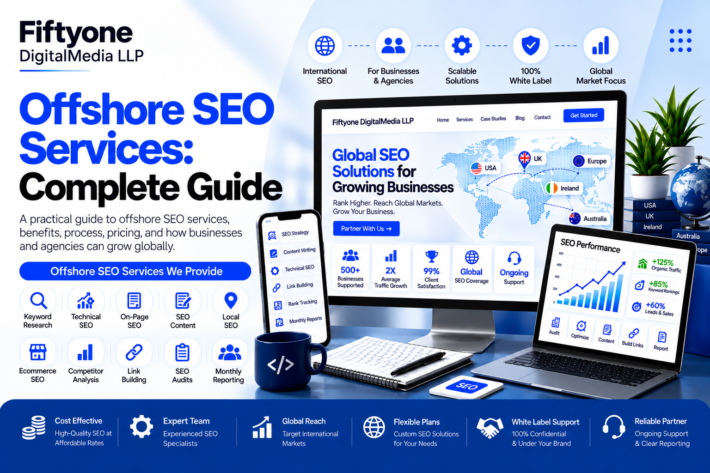
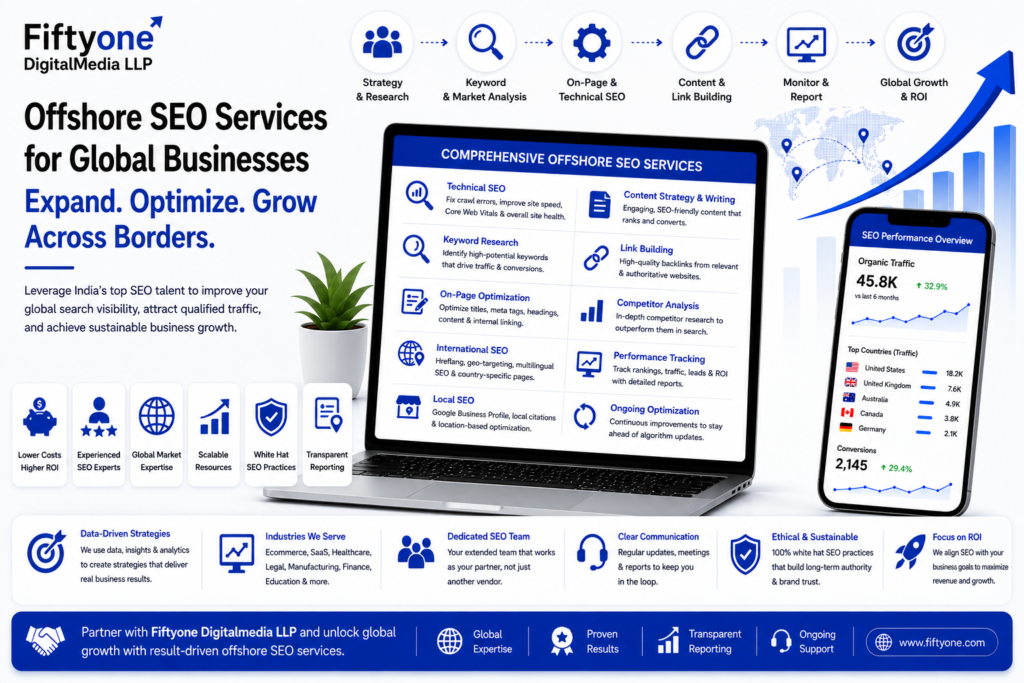
Offshore SEO services for global businesses provide access to specialized SEO expertise without requiring companies to build a large in-house SEO department. An experienced offshore SEO company can support technical SEO, international keyword research, content optimization, competitor analysis, link building, reporting, and market-specific SEO strategies while internal teams remain focused on broader business operations.
Fiftyone Digitalmedia LLP provides scalable offshore SEO support for businesses looking to improve international search visibility, attract qualified organic traffic, and build sustainable growth across competitive markets.
What Are Offshore SEO Services?
Offshore SEO involves outsourcing search engine optimization activities to an experienced team located in another country. The external team can manage complete SEO campaigns or support specific areas where the business requires additional expertise or capacity.
The model is particularly useful for businesses managing several websites, international markets, large content requirements, or continuous technical optimization. Instead of recruiting separate specialists for every SEO function, companies can access a broader team through one outsourcing relationship.
Offshore SEO services can include:
- Technical SEO
- Keyword research
- Competitor research
- On-page optimization
- Content optimization
- Link building
- Local SEO
- International SEO
- SEO audits
- Performance monitoring
- Search visibility reporting
- Conversion-focused optimization
The actual service structure should depend on business objectives rather than applying an identical SEO package to every company.
Offshore SEO Services vs In-House SEO
| Factor | Offshore SEO Services | In-House SEO |
|---|---|---|
| SEO Specialists | Access to multiple specialists | Requires individual hiring |
| Scalability | Resources can scale with demand | Scaling requires additional recruitment |
| Recruitment | Lower recruitment requirements | Higher hiring requirements |
| Technical SEO | Access to specialized expertise | Depends on internal team |
| International SEO | Can support multiple markets | Depends on internal experience |
| Flexibility | Flexible resource allocation | Fixed internal capacity |
| Management | Requires structured communication | Direct internal management |
| Long-Term Support | Scalable ongoing support | Full internal control |
The right model depends on business size, internal capabilities, budget, and long-term objectives. Some companies may benefit from a fully outsourced SEO model, while others may prefer a hybrid approach where internal marketing teams manage strategy and offshore SEO specialists handle execution.
Why Global Businesses Use Offshore SEO Teams
International businesses need continuous SEO execution. Search competitors change, websites expand, new content is published, technical problems appear, and search behaviour varies between markets. Managing these requirements with a small internal team can create resource limitations.
Offshore teams give businesses additional execution capacity without requiring permanent recruitment for every SEO function. Companies can expand resources as their websites, target markets, and content strategies grow.
This structure can provide several advantages:
- Access to specialized SEO professionals
- Flexible resource allocation
- Lower recruitment requirements
- Continuous campaign execution
- Support for larger websites
- Broader keyword research
- Scalable content optimization
- Technical SEO expertise
- International market support
- Detailed SEO reporting
The benefit comes from increasing SEO capacity without allowing fixed internal operating costs to expand at the same rate.
International Keyword Research
Global SEO cannot rely on translating one keyword list into several languages or targeting identical phrases across every country. Search behaviour, terminology, competition, commercial intent, and customer expectations can vary substantially between markets.
International keyword research should examine how potential customers actually search within each target market. Businesses need to understand informational queries, commercial searches, transactional terms, competitor visibility, and long-tail opportunities before deciding which pages to create or optimize.
A strong offshore SEO team can organize keyword research around:
- Target countries
- Search intent
- Product or service categories
- Commercial keywords
- Informational searches
- Competitor rankings
- Long-tail opportunities
- Existing website visibility
This creates a stronger foundation for international content and landing-page strategies.
Technical SEO for Global Websites
Technical problems become more damaging as websites increase in size. International businesses may manage thousands of URLs across product categories, services, languages, locations, and content sections. Poor technical implementation can create crawling, indexing, duplication, canonicalization, or performance problems across large portions of the site.
Technical SEO teams should regularly examine:
- Website crawlability
- Indexation
- XML sitemaps
- Robots directives
- Canonical tags
- Redirects
- Broken pages
- Internal linking
- Page performance
- Mobile usability
- Structured data
- Duplicate content
Technical audits should lead to prioritized actions. Producing a massive audit document without identifying which problems have the greatest search impact wastes resources.
Content Optimization for International Search Visibility
Publishing more content does not automatically generate international rankings. Content needs to match search intent, provide useful information, and connect logically with the website’s broader topical structure.
An offshore SEO team can analyze existing pages before recommending new content. In many cases, improving pages that already receive impressions can produce more value than continuously publishing new articles with no clear search strategy.
Content optimization can involve improving titles, headings, search intent alignment, supporting topics, internal links, FAQs, calls to action, and outdated information. Fiftyone Digitalmedia LLP can support businesses with ongoing SEO execution where content and technical optimization work together instead of operating as disconnected activities.
Offshore SEO for Competitive Global Markets
Businesses targeting the USA, UK, Australia, Canada, Europe, and other competitive regions cannot expect rankings simply because their website contains the correct keywords. Established competitors may already have stronger content libraries, backlinks, brand recognition, and domain authority.
Global SEO therefore requires a longer-term strategy that identifies realistic opportunities while gradually strengthening website authority.
Businesses should focus on:
- Commercial keyword opportunities
- Topical authority
- Competitor content gaps
- High-quality landing pages
- Relevant backlinks
- Technical performance
- Search intent
- Conversion optimization
The objective should be qualified organic growth rather than increasing traffic from irrelevant keywords.
Why Offshore SEO Can Reduce Operating Costs
Building a complete internal SEO department can require technical SEO specialists, content strategists, writers, link-building professionals, analysts, and SEO managers. For many businesses, maintaining every role internally is unnecessary or financially inefficient.
Offshore SEO allows companies to access several capabilities without independently recruiting every specialist. This can make SEO expenditure more flexible while giving businesses access to broader expertise.
However, choosing an offshore provider purely because it offers the lowest price is a bad strategy. Cheap SEO that produces low-quality content, spam links, or meaningless reports can damage organic performance instead of reducing marketing costs.
Scalable SEO for Growing Businesses
SEO requirements increase as a business expands. New services require landing pages, new countries require market research, ecommerce growth creates additional product and category pages, and larger websites generate more technical issues.
An offshore SEO model can expand alongside these requirements. Businesses can increase research, optimization, content, and technical resources when necessary without rebuilding the entire internal marketing department.
Fiftyone Digitalmedia LLP supports this type of scalable SEO execution for businesses that need ongoing search optimization across growing digital operations.
SEO Reporting for Global Campaigns
Global businesses need reporting that explains performance rather than presenting large quantities of disconnected metrics. Reports should connect search visibility with business objectives.
Useful measurements can include:
- Organic clicks
- Search impressions
- Keyword visibility
- Organic conversions
- Landing-page performance
- Country-level performance
- Indexed pages
- Technical SEO issues
- Backlink growth
- Conversion trends
Reporting should also explain what changed, why it matters, and which actions should be prioritized next. Ranking screenshots alone do not provide enough information to evaluate a global SEO campaign.
Why Choose Fiftyone Digitalmedia LLP
Global SEO requires consistent execution across technical optimization, content, research, authority building, and performance analysis. Businesses need an SEO partner capable of adapting its strategy as markets and search opportunities change.
Fiftyone Digitalmedia LLP provides offshore SEO support designed around scalable execution rather than isolated optimization tasks. Businesses can use external SEO resources while maintaining internal control over broader marketing and commercial objectives.
The focus should remain on building sustainable organic visibility, attracting relevant users, and creating an SEO structure capable of supporting expansion into additional markets.
Building an International SEO Strategy
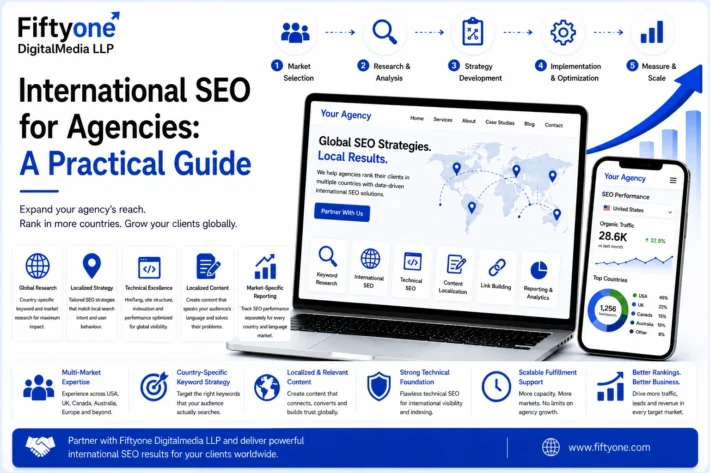
Global SEO needs a market-specific strategy. A business cannot optimize one website for several countries by targeting the same keywords everywhere. Search intent, competition, terminology, customer expectations, and purchasing behaviour can change between locations.
An offshore SEO team should first identify priority markets and then evaluate existing visibility, competitors, keyword opportunities, content gaps, and technical requirements for each location. Resources can then be allocated according to commercial potential rather than spreading SEO investment equally across every possible market.
Fiftyone Digitalmedia LLP can support this process through ongoing research, technical optimization, content planning, and performance analysis designed around the markets a business actually wants to grow.
Important Elements of Global SEO
International campaigns involve several connected SEO activities. Ignoring one area can restrict the performance of otherwise strong content.
- Country-specific keyword research
- Search intent analysis
- Competitor research
- International website architecture
- Technical SEO audits
- Content localization
- Internal linking
- Authority building
- Mobile optimization
- Page performance
- Conversion tracking
- Market-level reporting
These activities should operate under one strategy instead of being handled as unrelated SEO tasks.
International Content Requires More Than Translation
Directly translating existing content is not enough for effective international SEO. A keyword or phrase that performs well in one market may have different terminology, search demand, or commercial intent elsewhere.
Businesses should determine whether existing pages can be localized or whether specific markets require completely different landing pages and supporting content. Product information, service terminology, examples, calls to action, and customer concerns may also need adjustment.
Offshore SEO teams can support this process by researching search behaviour before content production begins. This reduces the amount of content created around keywords that have little commercial relevance in the intended market.
Link Building for Global Businesses
Backlinks remain useful when they come from relevant and credible websites. Offshore SEO should not be treated as an excuse to generate hundreds of low-quality links because they are inexpensive.
A better link acquisition strategy focuses on relevance, authority, context, and the quality of the referring website.
Useful approaches can include:
- Digital PR
- Industry publications
- Relevant guest contributions
- Resource-page opportunities
- Business partnerships
- Linkable research
- Original statistics
- Useful guides
- Competitor backlink analysis
The objective is to strengthen website authority naturally. Large quantities of irrelevant backlinks can create activity reports without creating meaningful SEO value.
How Offshore SEO Supports Multiple Markets
Managing SEO across several countries creates substantial operational work. Every market can require separate keyword tracking, competitor monitoring, content optimization, technical reviews, and reporting.
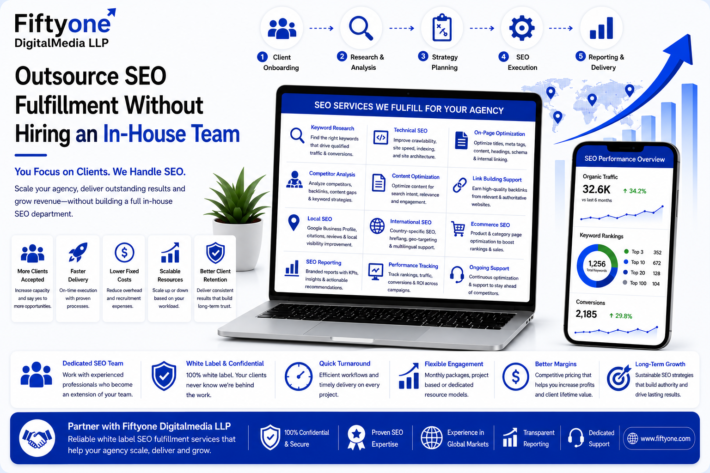
Offshore SEO provides additional capacity for executing these tasks consistently. Internal marketing leaders can remain responsible for commercial direction while the offshore team handles ongoing research and implementation.
Fiftyone Digitalmedia LLP can work within this structure by providing SEO resources for businesses that need continuous execution without expanding every SEO role internally.
Offshore SEO vs Building a Large In-House Team
An internal SEO team provides direct organizational control and can be effective for businesses with sufficient ongoing work. The problem is that a complete SEO operation requires several different capabilities.
Technical optimization, content strategy, keyword research, outreach, analytics, and reporting are not identical skills. Building a team capable of handling all of them creates recruitment and employment costs.
Offshore SEO offers a more flexible alternative when companies need broader capabilities without permanently hiring specialists for every SEO function. Some global businesses can also use a hybrid structure where internal managers control strategy while offshore professionals provide additional execution capacity.
Common Offshore SEO Mistakes
Outsourcing SEO does not automatically produce better rankings. Businesses frequently damage campaigns by choosing providers based entirely on low pricing or unrealistic promises.
Avoid:
- Guaranteed ranking promises
- Extremely cheap SEO packages
- Mass low-quality backlinks
- AI-generated content without review
- Keyword stuffing
- Identical strategies across countries
- Reporting only keyword positions
- Ignoring technical SEO
- Publishing content without search intent
- Focusing on traffic without conversions
- No competitor analysis
- No measurable objectives
An offshore provider should be able to explain why specific activities are being performed and how they contribute to broader organic growth.
How to Evaluate an Offshore SEO Provider
Businesses should examine the provider’s processes before signing a long-term agreement. A polished proposal means little if the company cannot explain how it approaches technical SEO, content, backlinks, reporting, and international markets.
Evaluate:
- SEO experience
- Technical capabilities
- International SEO knowledge
- Content quality standards
- Link-building practices
- Reporting transparency
- Communication process
- SEO tools and workflows
- Scalability
- Contract flexibility
- Performance measurement
- Long-term strategy
The provider should also explain what it will not do. Refusing spam links, keyword stuffing, and unrealistic ranking guarantees is more credible than promising immediate results.
SEO Should Generate Business Outcomes
Traffic is useful only when it supports meaningful business objectives. A global SEO campaign that generates thousands of irrelevant visits while producing no enquiries, sales, trials, or qualified leads is poorly targeted.
SEO reporting should therefore connect organic performance with commercial outcomes. Businesses should examine which countries, keywords, landing pages, and content types generate valuable visitors.
This allows SEO teams to invest more resources in areas demonstrating commercial potential while reducing effort on keywords that produce impressions but little business value.
Scaling Offshore SEO as the Business Expands
An international SEO strategy should be capable of growing alongside the company. A business may initially target one overseas market and later expand into several regions, requiring additional landing pages, research, content, technical implementation, and reporting.
A scalable offshore team can increase resources as these requirements grow. This avoids rebuilding the SEO operation every time another country or product category is introduced.
Fiftyone Digitalmedia LLP supports businesses that require this type of ongoing SEO capacity. The offshore structure can complement internal marketing teams while providing additional resources for execution-heavy activities.
Why Long-Term SEO Strategy Matters
SEO is not a one-time website modification. Competitors publish new content, websites change, search behaviour evolves, backlinks are gained and lost, and technical issues appear as sites expand.
Global businesses therefore need continuous monitoring and prioritization. The SEO team should regularly evaluate which pages are gaining visibility, which pages are declining, where competitors are improving, and which technical problems require attention.
Fiftyone Digitalmedia LLP can support long-term campaigns where SEO decisions are adjusted according to performance data rather than repeating the same monthly checklist indefinitely.
Frequently Asked Questions
What are offshore SEO services?
Offshore SEO services involve outsourcing SEO activities to a team located in another country. Services can include technical SEO, keyword research, content optimization, link building, competitor analysis, international SEO, and reporting.
Are offshore SEO services suitable for international businesses?
Yes. They can be useful for businesses requiring additional SEO resources across several countries, websites, products, or service categories.
Is offshore SEO cheaper than maintaining an in-house team?
It can reduce recruitment and fixed staffing requirements, but actual savings depend on the services required, team structure, location, and campaign complexity.
How long does offshore SEO take to generate results?
There is no fixed timeframe. Competition, website authority, technical condition, content quality, target market, backlinks, and existing search visibility all affect progress.
Can an offshore SEO company guarantee Google rankings?
No credible SEO provider can guarantee a specific Google ranking. Businesses should reject agencies making guaranteed first-position or immediate-ranking claims.
Conclusion
Offshore SEO Services for Global Businesses provide a scalable way to access technical SEO, content optimization, international keyword research, authority building, and performance analysis without requiring every SEO capability to be maintained internally.
The model is useful only when outsourcing is based on expertise rather than the cheapest available service. Global businesses should evaluate strategy, communication, content quality, technical capability, reporting, and link-building standards before selecting a provider.
With a structured strategy, offshore SEO can support sustainable international visibility while allowing internal teams to remain focused on broader marketing and business objectives.
Scale Your Global Organic Visibility
Fiftyone Digitalmedia LLP provides offshore SEO support for businesses targeting competitive international markets. A structured offshore SEO model can provide the additional resources required to manage technical optimization, content, research, reporting, and long-term organic growth across expanding markets.