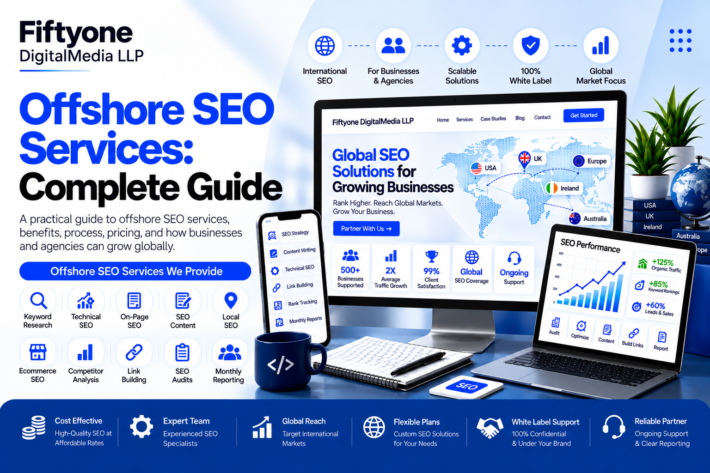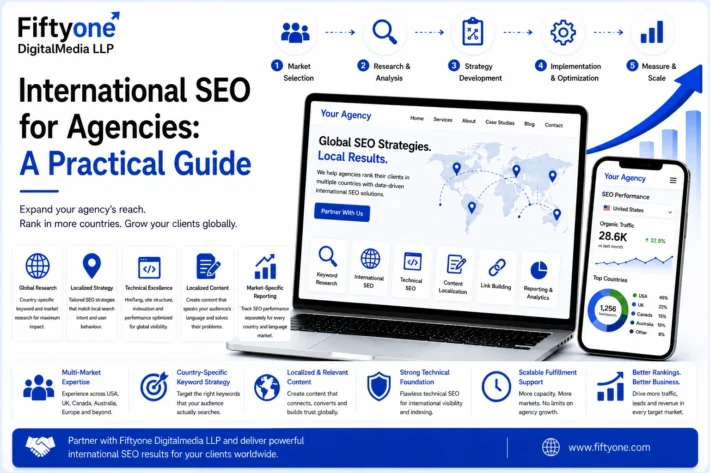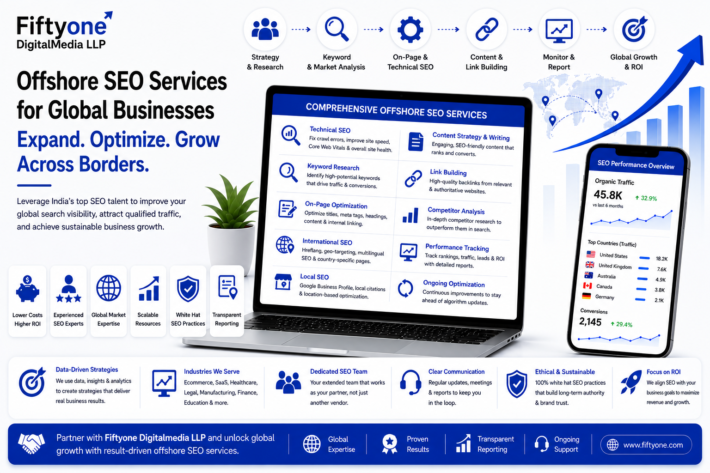
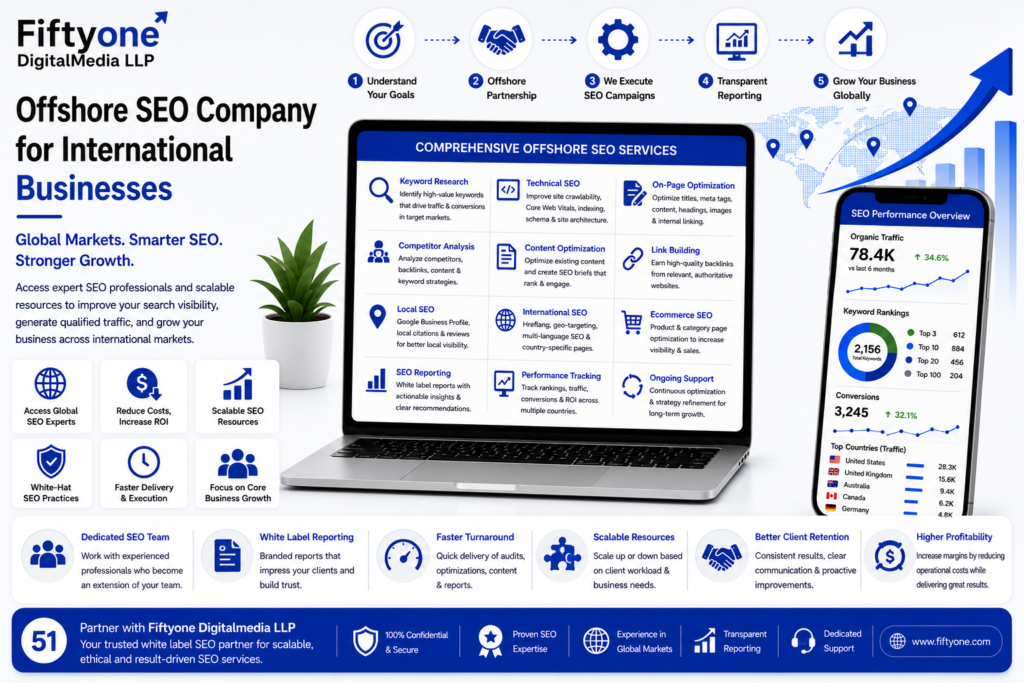
Offshore SEO Company for International Businesses

Introduction
Expanding internationally creates a completely different SEO challenge from ranking a business in a single domestic market. Companies need to understand different search behaviours, competitors, commercial keywords, customer expectations, website structures, and content opportunities across every country they want to target.
Building an internal SEO department capable of managing technical optimization, international keyword research, content strategy, competitor analysis, authority building, and reporting across multiple markets can become expensive and difficult to scale.
An Offshore SEO Company for International Businesses provides another model. Businesses can access specialized SEO resources from an external team while keeping control of their brand, marketing direction, products, and commercial strategy. Fiftyone Digitalmedia LLP supports this model by providing scalable SEO execution for businesses targeting competitive international search markets.
Why International Businesses Need a Different SEO Approach
A company targeting customers in one city or country can concentrate its resources on a relatively defined group of competitors and keywords. International businesses face a much larger search environment.
A keyword performing well in one country may have different competition or commercial value somewhere else. Competitors can also change completely between markets. Even when customers use the same language, terminology and purchasing behaviour may differ.
International SEO therefore requires businesses to evaluate each priority market separately instead of duplicating one SEO campaign across every country.
The strategy needs to answer several questions:
- Which countries have the strongest commercial potential?
- What keywords do customers use in each market?
- Which competitors dominate those searches?
- Which pages should target commercial intent?
- What content gaps currently exist?
- Does the website support international expansion?
- Where are technical SEO problems limiting visibility?
- Which markets deserve greater SEO investment?
These decisions should come before large-scale content production or link building.
What an Offshore SEO Company Actually Does
A proper offshore SEO company should provide more than monthly keyword reports and basic on-page changes. International businesses require continuous SEO execution across several connected areas.
An offshore team can manage technical audits, keyword research, competitor analysis, landing-page optimization, content planning, internal linking, authority development, and organic performance analysis.
The company can also work alongside an existing marketing department. Internal teams can retain responsibility for brand strategy and commercial decisions while the offshore team provides additional SEO execution capacity.
This creates a hybrid structure where businesses gain specialized resources without needing every SEO role permanently in-house.
International Keyword Research Based on Commercial Intent
International keyword research should not begin by collecting the highest-volume terms available. Search volume without commercial relevance can create traffic that contributes almost nothing to business growth.
SEO teams need to separate informational searches from keywords showing stronger purchasing, comparison, or service-selection intent.
Research should consider:
- Commercial keywords
- Transactional searches
- Service-related queries
- Product searches
- Comparison keywords
- Industry terminology
- Competitor keywords
- Long-tail searches
- Informational opportunities
- Country-specific variations
A strong keyword strategy then maps these searches to relevant service pages, product pages, category pages, landing pages, and supporting content.
Entering New International Markets Through Organic Search
Businesses expanding internationally often enter markets where established competitors already control valuable search positions. Trying to immediately compete for every major keyword can waste SEO resources.
A stronger strategy identifies realistic entry points. Long-tail commercial searches, underserved topics, competitor content gaps, specialized services, and existing pages close to stronger ranking positions can provide more achievable opportunities.
Businesses planning this type of expansion can also read How Offshore SEO Helps Businesses Expand Into International Markets, which covers how offshore SEO resources can support companies entering additional search markets.
This approach allows international SEO investment to be directed toward opportunities with genuine ranking and commercial potential.
Technical SEO Becomes Critical at International Scale
Technical problems become more expensive as websites grow. A problem affecting ten pages on a small business website may affect thousands of URLs on a large international platform.
Country pages, product categories, multilingual content, service pages, blog archives, parameters, redirects, and duplicated URLs can create crawling and indexing complications when the website structure is poorly managed.
Technical SEO should examine:
- Crawl accessibility
- Indexation
- Canonicalization
- XML sitemaps
- Redirect chains
- Broken URLs
- Internal linking
- Duplicate pages
- Mobile usability
- Website performance
- Structured data
- International targeting implementation
Technical audits should prioritize issues according to their potential search impact instead of treating every warning as equally important.
Offshore SEO Creates Scalable Execution Capacity
International SEO creates large amounts of recurring work. New landing pages need optimization, old content requires updates, technical problems appear, competitors change strategies, and additional countries create new research requirements.
A small internal marketing team can quickly become overloaded.
An offshore SEO structure gives businesses access to additional resources according to campaign requirements. Technical specialists can handle website issues while content and research resources work on other priorities.
Fiftyone Digitalmedia LLP can support this execution model by providing ongoing SEO resources that expand alongside international campaign requirements.
Content Strategy for Global Businesses
International businesses do not need hundreds of generic blog posts. They need content that strengthens commercial pages, answers relevant customer questions, fills competitor gaps, and builds authority around the topics connected with their products or services.
Existing website content should be evaluated before continuously creating new pages.
SEO teams should identify:
- Pages already receiving impressions
- Keywords ranking near stronger positions
- Weak commercial landing pages
- Outdated articles
- Content gaps
- Cannibalization problems
- Missing supporting topics
- Internal linking opportunities
Improving existing pages with demonstrated search potential can sometimes provide greater value than publishing another large batch of unrelated articles.
Competing in the USA and Other High-Competition Markets
International businesses targeting the USA face competitors that may already have years of content, backlinks, brand authority, and organic visibility. Entering these search results requires more than publishing optimized pages.
Businesses need to identify where established competitors are strong and where their search strategies leave opportunities.
This can involve competitor keyword analysis, content-gap research, backlink evaluation, SERP analysis, and examination of commercial landing pages.
Companies specifically targeting American customers can read Why USA Businesses Choose Offshore SEO Companies in India for additional context around using Indian offshore SEO resources for the US market.
SEO Authority Must Be Earned
International SEO becomes difficult when businesses attempt to manufacture authority through large quantities of cheap backlinks. Link volume alone does not create a strong search presence.
Authority building should focus on obtaining relevant mentions and links from websites that make sense within the company’s market or industry.
Useful strategies can include digital PR, industry contributions, original research, useful resources, partnerships, relevant outreach, and competitor backlink-gap analysis.
A smaller number of credible and contextually relevant links can provide a stronger foundation than hundreds of unrelated placements created only to increase backlink counts.
Offshore SEO Should Support Leads and Revenue
SEO campaigns frequently become obsessed with traffic numbers. That is a bad measurement model for international businesses.
A campaign generating 20,000 additional visitors has limited commercial value if those visitors have no realistic interest in the company’s products or services.
Businesses should connect SEO performance with:
- Qualified organic traffic
- Enquiries
- Product purchases
- Demo requests
- Sign-ups
- Organic conversions
- Commercial landing-page performance
- Country-level conversions
- Customer acquisition
Traffic remains useful, but it should be interpreted alongside commercial outcomes.
Why Offshore SEO Can Be More Efficient Than Building Everything In-House
International SEO requires different capabilities. Technical SEO, content strategy, analytics, keyword research, outreach, and competitor research are not interchangeable skills.
Maintaining specialists across every discipline internally can create substantial fixed expenses. Recruitment also becomes difficult when requirements change quickly.
Offshore SEO gives businesses a flexible resource structure. Additional specialists can support campaigns when required without forcing every capability into permanent internal positions.
The strongest model is often not completely outsourced or completely internal. Businesses can maintain strategic leadership internally while using an offshore team for specialized and execution-heavy SEO work.
Why India Is Used for Offshore SEO Services
India has developed a large digital-services ecosystem supporting businesses across SEO, website development, content, analytics, ecommerce, and related digital operations.
The advantage for international companies is not simply lower pricing. Access to broader resources can make it easier to build an SEO delivery structure across multiple disciplines.
However, businesses should reject the idea that every Indian SEO provider offers the same quality. Technical expertise, communication, content standards, link-building practices, reporting, and project management vary significantly between companies.
The provider needs to be evaluated on actual processes and execution quality.
Choosing an Offshore SEO Company Based on Capability
Do not choose an offshore SEO provider because it promises hundreds of backlinks, dozens of articles, or guaranteed rankings. Those promises say almost nothing about whether the campaign will generate commercially useful organic visibility.
Businesses should evaluate:
- International SEO experience
- Technical SEO knowledge
- Research quality
- Content standards
- Link-building methodology
- Reporting transparency
- Communication
- Market understanding
- Scalability
- Quality assurance
- SEO tools
- Strategic capability
The company should be able to explain why specific activities are recommended and which business objective they are intended to support.
Why Fiftyone Digitalmedia LLP
International SEO requires execution capacity combined with a clear understanding of search intent, technical foundations, content quality, and measurable business outcomes.
Fiftyone Digitalmedia LLP provides offshore SEO support for businesses that need additional resources across research, technical optimization, content improvement, competitive analysis, and ongoing organic search execution.
The offshore model allows international businesses to expand SEO capacity without making every new campaign requirement dependent on additional permanent recruitment.
The objective is not simply increasing rankings. SEO resources should be directed toward building relevant search visibility capable of supporting qualified traffic and long-term international business growth.
How an Offshore SEO Partnership Should Work
An offshore SEO relationship needs a defined operating structure. International campaigns involve research, technical work, content optimization, authority building, reporting, and continuous monitoring. Without clear ownership, tasks are delayed or repeated by different teams.
The internal marketing team can control business priorities, brand direction, approvals, and broader marketing decisions while the offshore team handles agreed SEO execution. Fiftyone Digitalmedia LLP can operate within this structure by providing additional SEO capacity without removing strategic control from the business.
A good workflow becomes more efficient over time because both teams understand responsibilities, approval processes, reporting requirements, and campaign priorities.
Build a Clear International SEO Workflow
SEO campaigns become difficult to scale when tasks are managed through disconnected emails and messages. International businesses need a centralized workflow where priorities and responsibilities remain visible.
A structured process can include:
- Market and competitor research
- Keyword opportunity analysis
- Technical SEO review
- Priority identification
- Content planning
- On-page optimization
- Implementation
- Quality review
- Authority development
- Performance measurement
- Reporting
- Strategy adjustments
The workflow should not remain fixed forever. Priorities need to change according to rankings, traffic, conversions, competitors, technical problems, and new market opportunities.
Measure Offshore SEO Through Commercial Performance
Keyword rankings alone are not enough to evaluate an international SEO campaign. A company can improve hundreds of keyword positions while generating little additional revenue if those searches have weak commercial intent.
Businesses should connect organic search performance with meaningful outcomes such as qualified enquiries, sales, trials, registrations, and other conversions.
Important measurements include:
- Organic clicks
- Search impressions
- Organic conversions
- Qualified leads
- Revenue from organic traffic
- Commercial keyword visibility
- Landing-page performance
- Country-level organic performance
- Conversion rates
- Technical SEO improvements
- Content performance
- Backlink growth
Metrics should help determine where additional SEO resources should be invested.
International SEO Reporting Must Show What Changed
SEO reports should explain performance rather than dump data into a document. International businesses need to understand which countries are improving, which landing pages are generating opportunities, where visibility has declined, and what actions are planned next.
A useful report should connect completed SEO work with measurable changes. If a landing page was optimized, the business should eventually be able to evaluate changes in impressions, clicks, keyword positions, engagement, and conversions.
Fiftyone Digitalmedia LLP can support ongoing reporting where performance information is used to determine future campaign priorities instead of repeating the same monthly activity list.
Calculate the Real ROI of Offshore SEO
The financial value of offshore SEO should not be calculated only by comparing monthly agency fees with internal employee salaries. Businesses should consider the complete operating structure.
Building SEO internally can require recruitment, salaries, training, specialist tools, management, content resources, outreach resources, and technical expertise. Offshore SEO can consolidate some of these requirements within an external delivery structure.
However, lower costs do not automatically create better ROI. Real value depends on whether the campaign generates commercially useful organic visibility.
Businesses should examine:
- Total SEO investment
- Internal management costs
- Organic leads
- Organic revenue
- Customer acquisition value
- Conversion improvements
- Cost per qualified lead
- Market-level performance
- Long-term organic growth
This produces a more useful picture than simply comparing hourly rates.
SEO Content Should Support Commercial Pages
A weak international content strategy publishes informational blogs continuously without establishing a connection to commercial landing pages. This may generate impressions while doing little to support actual products or services.
Content should build topical relevance around areas that matter commercially. Supporting articles can answer customer questions, address problems, compare solutions, and provide information around the buying journey.
Internal links should then connect useful informational resources with relevant commercial pages where appropriate.
This creates a content ecosystem rather than a disconnected collection of blog posts.
Use Competitor Analysis to Find Real Opportunities
International businesses should not copy competitor strategies blindly. Competitor analysis should identify opportunities rather than create imitation.
SEO teams can evaluate competitor rankings, landing pages, content depth, backlink profiles, site architecture, and keyword coverage to understand where competitors are strong and where gaps exist.
Useful findings can include:
- Keywords competitors rank for
- Missing commercial topics
- Weak competitor content
- Backlink opportunities
- Underserved long-tail searches
- Content format opportunities
- Strong competitor landing pages
- Search-result weaknesses
These findings can then influence content, technical improvements, and authority-building priorities.
Avoid Cheap Offshore SEO Packages
Extremely cheap SEO packages often depend on volume-based deliverables because those activities are easier to sell. Businesses may receive large numbers of backlinks, articles, directory submissions, or automated reports without a coherent strategy.
That activity can create the appearance of work without creating useful organic growth.
International businesses should avoid providers relying heavily on:
- Bulk backlink packages
- Automated content
- Keyword stuffing
- Generic monthly plans
- Irrelevant directory links
- Duplicate strategies
- Guaranteed rankings
- Automated audits without analysis
- Traffic guarantees
- Unclear deliverables
A legitimate offshore SEO company should be able to explain the purpose behind every major campaign activity.
How to Evaluate an Offshore SEO Company
Before signing a long-term contract, businesses need to examine actual delivery capabilities rather than relying on sales claims. Ask how technical issues are prioritized, how keywords are selected, how content is reviewed, how backlinks are acquired, and how campaign performance is measured.
For a complete evaluation process, read How to Evaluate an Offshore SEO Company Before Signing a Contract. This exact article is included in your published-blog list and directly matches the provider-selection stage.
Businesses should also review sample reports and deliverables before transferring major international campaigns to a new provider.
Common Offshore SEO Mistakes International Businesses Make
International SEO outsourcing fails when companies assume the external provider can operate effectively without sufficient business context. The SEO team needs to understand target customers, priority markets, profitable services, competitive positioning, and conversion objectives.
Common mistakes include:
- Selecting entirely on price
- Targeting too many countries immediately
- Ignoring commercial search intent
- Creating generic international content
- Buying low-quality backlinks
- Ignoring technical problems
- Using identical keywords across markets
- Tracking rankings without conversions
- Poor communication
- No quality review
- Unclear responsibilities
- Expecting immediate results
Fixing these operational mistakes can matter more than adding another SEO tool or increasing content volume.
Scale One Market Before Expanding Everywhere
Trying to dominate several international markets simultaneously can spread SEO resources too thin. Businesses should prioritize markets according to revenue potential, competition, existing visibility, operational capability, and customer demand.
A company might begin with one or two high-priority markets, establish a working SEO process, evaluate results, and then expand into additional regions.
This approach provides better information about which landing pages convert, which content attracts qualified visitors, and which search strategies deserve further investment.
Fiftyone Digitalmedia LLP can scale SEO resources as international requirements increase rather than forcing businesses to maintain maximum campaign capacity from the beginning.
When Should a Business Increase Offshore SEO Resources?
Additional resources should be introduced when genuine opportunities or workloads justify them. Increasing team size without a clear reason only increases campaign costs.
Expansion can make sense when:
- More international markets are being targeted
- Website size is increasing
- Technical issues are accumulating
- Content production needs are growing
- Competitors are gaining visibility
- New products or services are launching
- Existing pages show ranking potential
- Link acquisition requires additional support
- Reporting complexity is increasing
- Organic leads are producing positive returns
Resource allocation should follow opportunity rather than arbitrary monthly deliverables.
Long-Term Offshore SEO Creates Compounding Value
Paid acquisition generally requires continuous spending to maintain traffic. SEO can create assets that continue generating visibility after the initial optimization work, although rankings still require maintenance and competition can change.
Commercial landing pages, useful resources, backlinks, technical improvements, and strong internal linking can collectively strengthen a website over time.
This is why international SEO should be treated as an ongoing growth channel rather than a short campaign designed to produce immediate rankings.
Fiftyone Digitalmedia LLP can support this long-term structure through recurring technical analysis, content optimization, research, authority development, and performance monitoring.
Why Work With Fiftyone Digitalmedia LLP
An offshore SEO provider should increase execution capacity without creating additional operational confusion. International businesses need reliable processes, measurable reporting, relevant content, technical expertise, and scalable resources.
Fiftyone Digitalmedia LLP provides offshore SEO support across technical optimization, keyword research, competitor analysis, content improvement, authority development, and ongoing performance analysis.
The objective is to build relevant international search visibility that contributes to qualified traffic and business opportunities rather than concentrating entirely on vanity metrics.
Frequently Asked Questions
What is an offshore SEO company?
An offshore SEO company provides SEO services remotely from another country. Businesses can outsource technical SEO, research, content optimization, link-building support, reporting, and other search activities.
Why do international businesses use offshore SEO companies?
International businesses can access additional specialists, increase execution capacity, manage multiple markets, and reduce the need to recruit every SEO role internally.
How should offshore SEO performance be measured?
Businesses should evaluate organic visibility alongside qualified traffic, conversions, leads, revenue, landing-page performance, technical improvements, and country-specific results.
Is offshore SEO suitable for multiple countries?
Yes. However, each market should receive separate keyword, competitor, content, and search-intent research rather than duplicating one strategy internationally.
How long does international SEO take?
There is no fixed timeframe. Competition, website authority, technical condition, content quality, backlinks, existing visibility, and target keywords all influence how quickly meaningful improvements occur.
Conclusion
An Offshore SEO Company for International Businesses can provide the specialist resources required to manage increasingly complex international search campaigns without forcing companies to build every SEO capability internally.
The strongest partnerships combine market-specific research, technical SEO, commercially relevant content, competitor analysis, authority development, reporting, and continuous optimization. Cost savings matter, but they should never take priority over execution quality.
Businesses that treat offshore SEO as a scalable extension of their marketing operation can build a stronger foundation for sustainable international organic growth.
Grow Your International Organic Presence
Fiftyone Digitalmedia LLP provides offshore SEO services for businesses targeting international customers and competitive search markets. A scalable offshore structure can support technical SEO, content, research, authority development, and performance analysis while internal teams retain control over broader business strategy.