International SEO for Agencies: A Practical Guide
Introduction
International SEO becomes more complicated when an agency starts managing clients across multiple countries. A strategy that works for one market cannot simply be copied into another and expected to produce the same results.
Search behaviour, competition, language, terminology, purchasing intent, and search demand can vary significantly between countries. A US campaign may require a different keyword strategy from a campaign targeting the UK, Canada, Australia, or European markets.
For agencies, the challenge is not only ranking websites internationally. It is building a repeatable system that allows multiple markets to be researched, optimized, monitored, and reported without creating unnecessary operational complexity.
International SEO can become a scalable service when agencies combine market-specific research with consistent technical processes and clear campaign management.
What Is International SEO?
International SEO is the process of optimizing a website so search engines can understand which content should appear for users in different countries or language markets.
It can involve:
- Country-specific keyword research
- International content strategies
- Multilingual SEO
- Website structure
- Hreflang implementation
- Country targeting
- Localized content
- Technical SEO
- International link building
- Market-specific competitor analysis
The exact approach depends on whether the client is targeting different countries, different languages, or both.
An agency serving a company operating in the US, UK, Canada, and Australia may need separate research for each market even when all four use English.
Why Agencies Need a Different SEO Approach for Global Markets
International campaigns create additional variables that domestic campaigns may not have.
The same keyword can have different:
- Search volumes
- Commercial intent
- Competition
- Terminology
- Conversion rates
- SERP results
For example, users in two English-speaking countries may search for the same product or service using different terms.
That means agencies should avoid creating one keyword list and simply changing country names.
The strategy needs to be based on actual market research.
Start With Market Selection
Before creating international SEO campaigns, agencies should determine which markets deserve priority.
Not every country should be targeted simply because the client operates there.
Market selection can consider:
- Existing organic traffic
- Search demand
- Revenue potential
- Competition
- Customer location
- Product availability
- Conversion potential
- Existing brand awareness
A client may operate in ten countries but have meaningful commercial opportunities in only three. Those three markets should receive priority before resources are distributed across every location.
Agencies building international client acquisition strategies can also explore How to Get International Clients for Your Agency for a related approach to expanding beyond a single market.
Build Country-Specific Keyword Research
Keyword research is one of the most important parts of international SEO.
Agencies should research each target market separately rather than assuming that the same keywords will perform equally everywhere.
Research should consider:
- Local terminology
- Search intent
- Commercial keywords
- Long-tail searches
- Search demand
- Competitor rankings
- SERP features
- Product or service terminology
Even when countries share a language, users may use different words to describe the same product or service.
The goal is to identify the phrases that potential customers in each market actually use.
Understand Search Intent by Market
Search intent should be analyzed alongside keywords.
A keyword may appear commercially valuable but produce different results across markets.
Review the SERPs for each target country and determine whether users are primarily looking for:
- Information
- Products
- Services
- Local providers
- Comparisons
- Reviews
- Pricing
- Specific brands
This helps agencies create pages that match the expectations of each market instead of publishing identical content everywhere.
Choose the Right Website Structure
International websites need a structure that makes country and language targeting clear.
Common approaches include:
Country-Code Domains
Separate country domains can provide strong geographic signals but require more websites and greater maintenance.
Subdirectories
A structure such as country-specific folders can keep international content within one domain while separating markets logically.
Subdomains
Subdomains can separate regional content, although they create additional management considerations.
There is no universal structure that works for every client. The choice should consider the client’s resources, website architecture, number of markets, branding, and long-term SEO strategy.
Hreflang and International SEO
For multilingual or multi-regional websites, hreflang can help search engines understand which version of a page is intended for a particular language or region.
Incorrect implementation can create problems.
Agencies should check:
- Language codes
- Country codes
- Return references
- Canonical tags
- URL consistency
- Indexability
- Duplicate versions
Technical implementation should be tested carefully before large international sections are launched.
Localize Content Instead of Simply Translating It
Translation and localization are not the same.
A translated page may technically use the correct language but still feel unnatural to users in the target market.
Localization considers:
- Local terminology
- Cultural expectations
- Currency
- Measurements
- Examples
- Customer concerns
- Buying behaviour
- Calls to action
For agencies, this means international content should be reviewed for both linguistic accuracy and search intent.
International Link Building
Authority-building strategies also need to consider geography.
A backlink may be relevant from an SEO perspective but provide limited value for a particular international campaign if it has little connection to the target market or industry.
Agencies should consider:
- Topical relevance
- Website quality
- Geographic relevance
- Editorial context
- Authority
- Link placement
International link building should support the target market rather than becoming a volume-based activity.
Technical SEO Across Multiple Markets
Managing several country versions can multiply technical SEO requirements.
Agencies should regularly check:
- Indexation
- Canonicalization
- Hreflang
- Redirects
- XML sitemaps
- Internal links
- Duplicate content
- Page speed
- Mobile usability
- URL structures
A technical problem affecting one template can potentially affect multiple country versions simultaneously.
This makes technical monitoring particularly important for international websites.
Scale International SEO Through Fulfillment
International SEO can increase agency workload because every new market creates additional research, content, optimization, reporting, and technical requirements.
A structured fulfillment model can help agencies handle this workload without expanding their internal team for every new campaign.
External specialists can support:
- Keyword research
- Competitor research
- Technical audits
- Content optimization
- Internal linking
- Reporting
- Market research
The agency can retain strategy and client communication while using external resources for execution.
For agencies building this type of delivery structure, SEO Fulfillment for Agencies: A Complete Guide provides a broader framework for managing outsourced SEO execution.
Build One Strategy Framework, Not One Identical Strategy
International scalability does not mean creating completely separate processes for every country.
Agencies can standardize the overall framework:
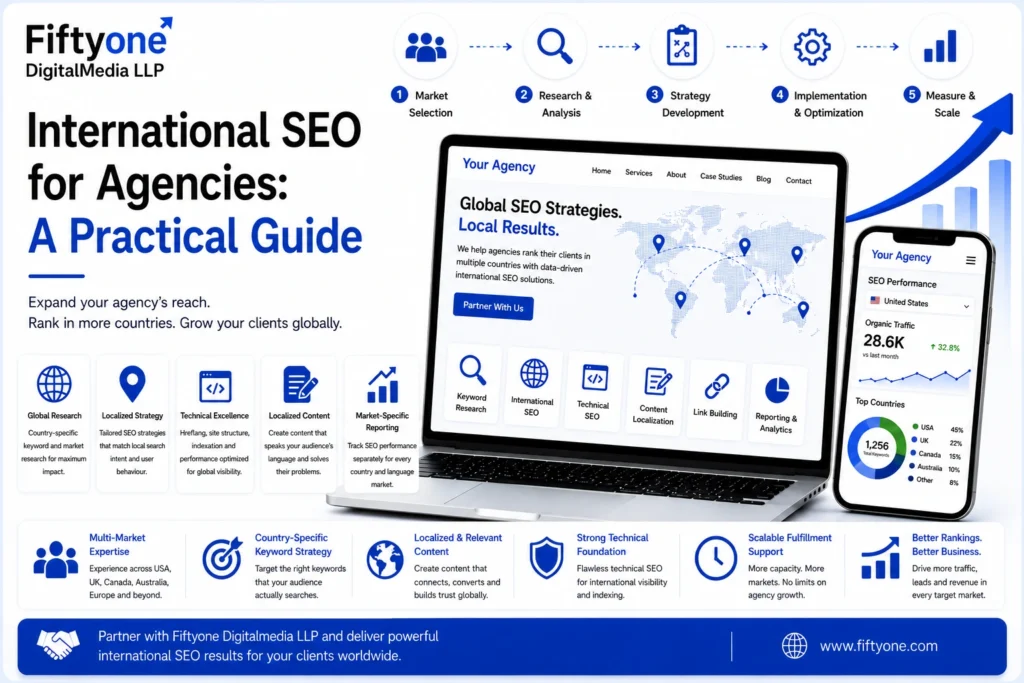
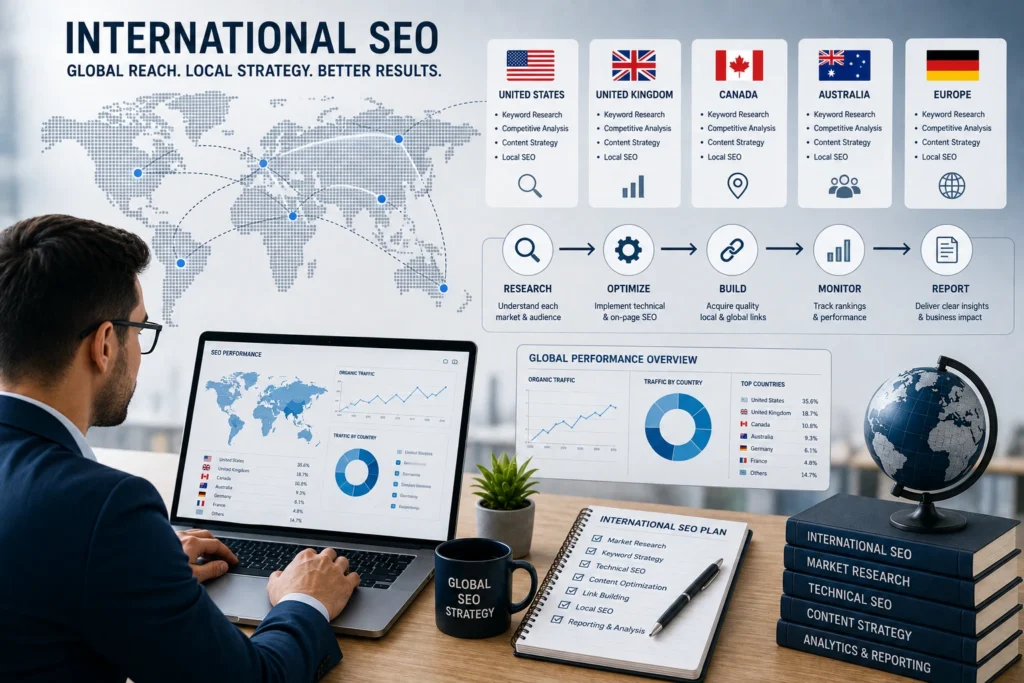
Research → Strategy → Technical SEO → Content → Authority → Reporting → Optimization
What changes is the market-specific data and implementation.
This creates consistency without forcing every country into the same SEO strategy.
Measure Performance by Market
International SEO reporting should separate countries instead of combining every market into one overall number.
Agencies can track:
- Organic clicks
- Impressions
- Rankings
- Conversions
- Organic revenue
- Landing-page performance
- Market-specific visibility
- Technical issues
- Content performance
This makes it easier to identify which markets are growing and which require strategic changes.
Build a Repeatable International SEO Workflow
International SEO becomes easier to manage when agencies create a consistent workflow that can be applied across markets without making every campaign identical.
A scalable workflow can include:
- Market research
- Country-specific keyword research
- Competitor analysis
- Technical assessment
- Content planning
- Localization
- On-page optimization
- Authority building
- Performance tracking
- Ongoing optimization
The framework remains consistent while the data, keywords, content, and competitive strategy change according to the target market.
This approach allows agencies to manage multiple countries without creating completely separate operating systems for every client.
Prioritize Markets Instead of Targeting Everywhere
One of the biggest international SEO mistakes is trying to target too many countries at once.
A client may want visibility across ten markets, but limited resources can make it difficult to build strong visibility everywhere.
A better approach is to prioritize markets based on:
- Revenue opportunity
- Search demand
- Existing traffic
- Competition
- Conversion potential
- Product availability
- Business expansion plans
Start with the markets offering the strongest commercial opportunity, then expand once the process is working.
Create Country-Specific Content Plans
International content should reflect the needs of the target market.
Instead of producing the same monthly content calendar for every country, agencies should identify market-specific opportunities.
Consider:
- Local search behaviour
- Market-specific questions
- Commercial terminology
- Competitor content gaps
- Local customer concerns
- Seasonal demand
- Product or service differences
This creates content that has a genuine reason to exist in each market rather than simply duplicating the same strategy across countries.
Localize Calls to Action
Calls to action should also reflect the target market.
A global website may need different:
- Currency
- Contact information
- Shipping details
- Service terminology
- Pricing references
- Trust signals
- Contact methods
These details can influence whether international visitors actually convert after finding a page through search.
SEO should therefore be connected to the complete customer journey rather than treated only as a traffic-generation activity.
Build Market-Specific Competitor Analysis
Competitor research should be performed separately for each major target market.
A company may compete against completely different websites in the US and UK even when the product or service is identical.
Agencies should identify:
- Ranking competitors
- Content gaps
- Commercial landing pages
- Keyword opportunities
- Backlink profiles
- SERP features
- Content formats
- Market-specific strengths
This provides a clearer picture of what is required to compete in each country.
Manage International SEO at Scale
Managing international campaigns manually can become difficult as the number of markets increases.
Agencies can improve efficiency by creating centralized systems for:
- Keyword tracking
- Technical monitoring
- Content planning
- Reporting
- Task management
- Market comparisons
- Performance reviews
The objective is to centralize operational management while keeping individual market strategies specific.
Use Market-Level Reporting
A single global SEO report can hide important differences between countries.
For example, overall organic traffic may increase while one important market is losing visibility.
Separate reporting allows agencies to identify:
- Which markets are growing
- Which markets are declining
- Which pages generate conversions
- Which countries have stronger rankings
- Where technical problems exist
- Which content performs best
This makes international SEO decisions more data-driven.
Choose an SEO Partner With International Capability
Agencies outsourcing parts of international SEO should evaluate whether the partner actually understands global search rather than simply offering SEO services from another country.
Ask about:
- Target-market experience
- Country-specific keyword research
- International technical SEO
- Content localization
- Competitor research
- Reporting
- Communication
- Scalability
A partner should be able to explain how its approach changes from one market to another.
For agencies evaluating external SEO support, How to Choose an Offshore SEO Partner provides a useful framework for assessing an offshore provider’s capabilities, communication, reporting, and scalability.
Common International SEO Mistakes
Using One Keyword Strategy Everywhere
Different countries can have different search terminology and commercial intent.
Translating Without Localizing
A direct translation may be grammatically correct but still fail to match how users in the target market search.
Targeting Too Many Markets
Spreading resources too thin can prevent any market from receiving enough attention.
Ignoring Technical Signals
Incorrect hreflang, canonical tags, redirects, or indexing controls can create international SEO problems.
Duplicating Content
Creating nearly identical pages with only country names changed provides little additional value.
Measuring Only Global Traffic
Combined traffic can hide poor performance in important individual markets.
International SEO for Ecommerce
International ecommerce SEO introduces additional considerations because product availability, currencies, shipping, taxes, inventory, and purchasing behaviour can differ between countries.
Agencies should consider:
- Country-specific product pages
- Currency handling
- Localized product descriptions
- International category structures
- Shipping information
- Regional search demand
- Product availability
An ecommerce strategy should connect search visibility with actual market availability. Ranking a product in a country where the product cannot be purchased provides limited commercial value.
International SEO for Service Businesses
Service businesses also need market-specific strategies.
A company offering software development, consulting, legal services, marketing, or professional services may target multiple countries but use different value propositions in each market.
Agencies should consider:
- Local service terminology
- Target industries
- Regional competitors
- Market-specific landing pages
- Local case studies
- Trust signals
- Country-specific commercial keywords
This can make international landing pages substantially more useful than generic global service pages.
Scale International SEO Without Building Separate Teams
Agencies do not necessarily need a separate SEO department for every country.
A centralized team can manage the overall SEO framework while specialists support specific markets when required.
For example:
Central SEO team
- Strategy
- Technical framework
- Reporting
- Project management
- Overall SEO direction
Market-specific resources
- Keyword research
- Localization
- Competitor research
- Content
- Local market insights
This structure can provide scalability without losing market relevance.
Use Data to Expand Into New Markets
Once one international campaign begins producing reliable results, its data can help identify opportunities in additional countries.
Look for:
- Search impressions from unexpected countries
- International conversions
- Queries appearing in new markets
- Existing rankings
- High-performing topics
- Organic traffic trends
A country that already produces relevant impressions may require less effort to develop than a completely new market.
This makes Search Console and analytics useful for identifying expansion opportunities rather than simply measuring existing traffic.
Why Fiftyone Digitalmedia LLP
Fiftyone Digitalmedia LLP supports agencies that need scalable SEO execution for international campaigns.
Agencies can use external resources for keyword research, technical SEO, competitor analysis, content optimization, internal linking, reporting, and other recurring SEO requirements while maintaining control over their own clients and strategy.
The focus is on providing additional fulfillment capacity without forcing agencies to build separate internal teams for every market.
Frequently Asked Questions
What is the biggest challenge in international SEO?
The biggest challenge is creating a scalable strategy that remains relevant to each market. Countries can differ in search behaviour, competition, terminology, content expectations, and technical requirements.
Should every country have a separate SEO strategy?
Not necessarily. Agencies can use one overall SEO framework while adapting keywords, content, competitors, and technical implementation to individual markets.
Is translating content enough for international SEO?
No. Translation changes language, while localization adapts content to the search behaviour, terminology, expectations, and commercial context of the target market.
How many countries should a business target first?
There is no universal number. Businesses should prioritize countries based on commercial opportunity, search demand, competition, resources, and customer availability.
Can agencies outsource international SEO?
Yes. Agencies can outsource execution such as keyword research, technical audits, content optimization, competitor research, and reporting while retaining strategic control.
Conclusion
International SEO gives agencies an opportunity to serve businesses across multiple markets, but success depends on treating each market as more than a translated version of another.
The strongest approach combines a repeatable SEO framework with country-specific research, localized content, appropriate technical implementation, market-level competitor analysis, and separate performance measurement.
Agencies should start with commercially valuable markets, build a repeatable workflow, measure results by country, and expand only when the delivery model can support additional markets.
With the right structure, international SEO can become a scalable agency service rather than a collection of disconnected country campaigns.
Build Scalable International SEO Campaigns
Fiftyone Digitalmedia LLP helps agencies expand SEO delivery for international businesses through scalable execution support. Agencies can maintain control over strategy, client relationships, and branding while using specialist resources to support global SEO campaigns.