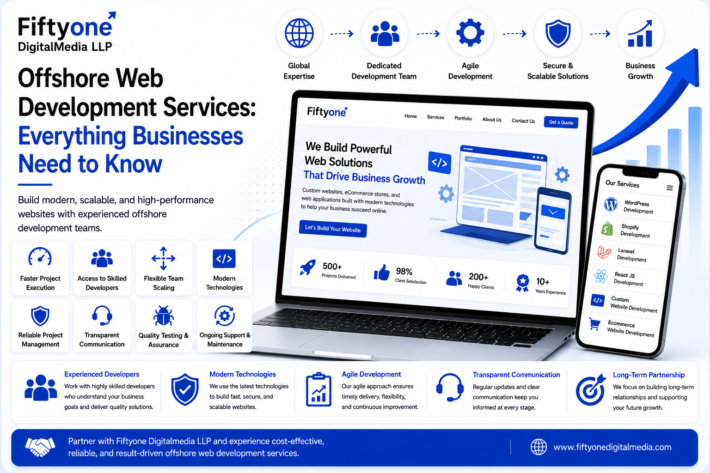
Offshore Web Development Company in India: Dedicated Team vs Fixed-Price Projects
Introduction
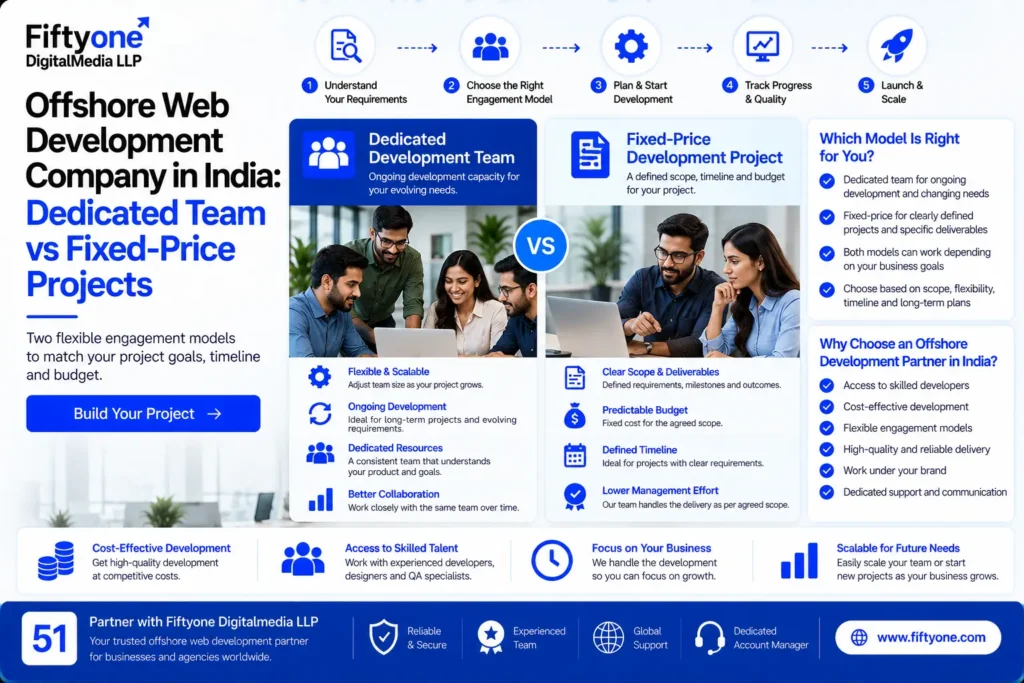
Choosing an offshore web development company in India involves more than comparing developer rates or reviewing portfolios. Agencies and businesses also need to decide how the work will be structured. Two common options are a dedicated development team and a fixed-price project.
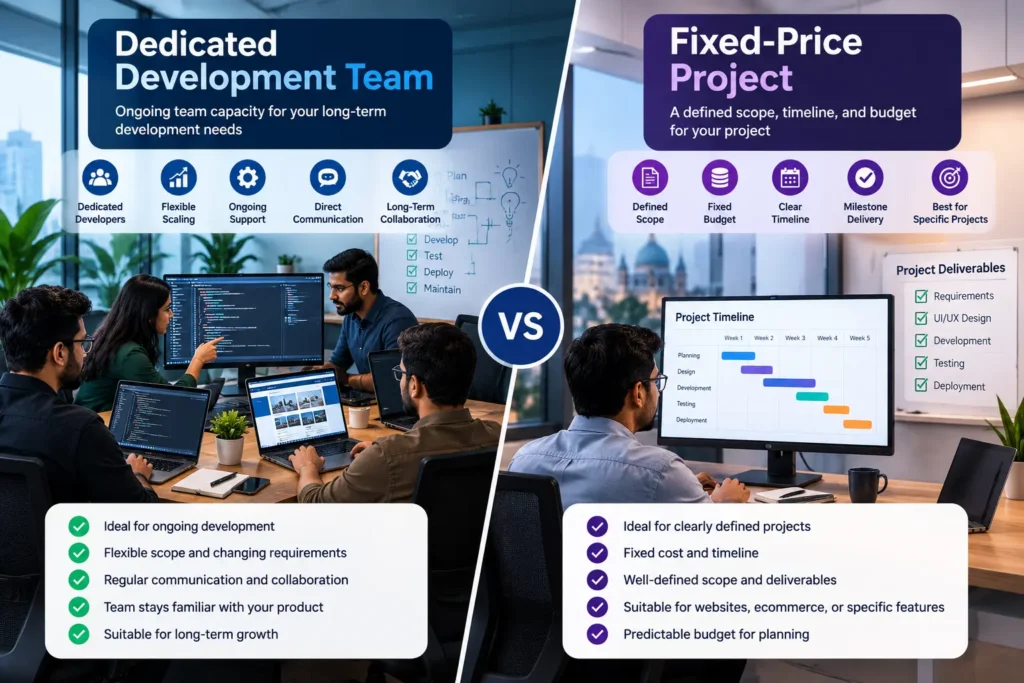
Both models can work well, but they are designed for different kinds of requirements. A fixed-price agreement is generally built around a defined scope, deliverables, and milestones. A dedicated team provides ongoing development capacity that can be directed as priorities evolve.
The difference affects more than billing. It influences how changes are handled, how much involvement is required from your side, who manages daily priorities, and how delivery responsibilities are divided.
For agencies serving clients in the USA, UK, Canada, Australia, and other international markets, selecting the right model can also shape how projects are estimated, managed, and presented to clients.
This guide compares dedicated teams and fixed-price projects, explains where each model fits, and outlines what to confirm before signing an agreement with an offshore development partner.
What Is a Dedicated Development Team?
A dedicated development team is an ongoing group of professionals assigned to work on a business’s product or development requirements. Depending on the engagement, the team may include developers, QA testers, a designer, a project coordinator, or a technical lead.
Instead of paying for one predefined deliverable, the client pays for an agreed level of team capacity over time. The client or its product owner typically sets priorities, while the offshore provider handles agreed staffing and delivery support.
This model is often considered when development work continues beyond a single launch. A business may need to release new features, maintain existing functionality, improve performance, resolve bugs, or respond to user feedback on a continuing basis.
The main consideration is that a dedicated team provides capacity—not an automatic guarantee of a particular outcome. The client still needs someone who can explain requirements, make decisions, review progress, and prioritize the backlog.
What Is a Fixed-Price Development Project?
In a fixed-price project, the client and provider agree on a defined scope, deliverables, timeline, and total project fee. The provider is responsible for delivering the agreed work according to the contract and acceptance criteria.
This model is commonly used for projects where requirements can be documented before development begins. Examples include a business website with approved page designs, a defined ecommerce store setup, a landing-page build, or a specific feature with clear functionality.
A fixed price can make the initial budget easier to plan. However, it does not mean every future change is included. If the client changes requirements or requests work outside the agreed scope, the provider may need to estimate the change separately.
The quality of the initial specification is therefore important. If essential details are missing, both sides may have different expectations about what the agreed price covers.
Dedicated Team vs Fixed-Price: Key Differences
| Factor | Dedicated team | Fixed-price project |
|---|---|---|
| What you purchase | Ongoing team capacity | A defined set of deliverables |
| Billing structure | Usually recurring, such as monthly | Agreed project fee |
| Scope | Can evolve through prioritization | Defined before work begins |
| Changes | Priorities can be adjusted within the engagement | Out-of-scope changes may require a change request |
| Client involvement | Regular direction and feedback are usually needed | More planning upfront; approvals still required |
| Best suited to | Ongoing development and changing roadmaps | Clearly defined, bounded projects |
| Main planning concern | Keeping the team aligned and productively engaged | Defining scope and acceptance criteria accurately |
The distinction is not that one model is universally more flexible or less expensive. The fit depends on how clearly the work can be defined and how likely requirements are to change. Recent industry comparisons similarly distinguish fixed-scope delivery from ongoing team capacity, while emphasizing the importance of matching the contract model to the project.
Atomquark.ai
+1
When a Dedicated Team May Be the Right Fit
A dedicated team may suit a business that has a continuing development roadmap rather than a single project with a fixed finish line.
For example, a SaaS company may need regular feature releases, integrations, testing, and maintenance. An agency may have several client projects arriving each month and need consistent development capacity. In these situations, a stable team can build familiarity with the product, codebase, workflows, and business requirements.
The model can also help when priorities need to change as the project progresses. The team can work through a prioritized backlog, with new tasks planned through an agreed process.
However, the client needs to provide direction. If there is no product owner or technical contact available to answer questions and review work, development can slow down even when the team is available.
Before choosing this model, consider whether your business can:
- Provide regular tasks and clear priorities.
- Make decisions without long approval delays.
- Review work and provide feedback consistently.
- Maintain a backlog that the team can work through.
- Commit to an engagement long enough to benefit from team continuity.
A dedicated team is not simply a way to hand over an unclear project and stop managing it. It works best when responsibilities are shared and the client remains involved in product direction.
When a Fixed-Price Project May Be the Right Fit
A fixed-price project may be suitable when the business knows what it needs and can describe the expected result before development starts.
Consider a company that needs a five-page corporate website with approved content, a confirmed design, a contact form, and a defined set of integrations. The deliverables can be documented, reviewed, and accepted against agreed criteria.
The same approach may work for a specific website migration, a contained ecommerce implementation, or a feature with stable requirements.
Fixed-price projects can reduce the need for daily task management because the provider coordinates delivery against the agreed scope. The client still needs to supply content, approve designs, answer questions, and test the completed work.
Before signing, make sure the proposal explains what is included and excluded. It should also cover milestones, acceptance criteria, revision limits, dependencies, and the process for approving changes.
A fixed-price model can become difficult when the project is still in discovery or when requirements are likely to change frequently. In that case, the initial estimate may not reflect the work that eventually becomes necessary.
How the Two Models Affect Budget Planning
The two models create different types of financial commitments.
With a dedicated team, the business plans for recurring capacity over an agreed period. This can make monthly spending easier to forecast, but the value depends on whether the team has enough prioritized work and receives timely decisions.
With a fixed-price project, the business agrees on a total fee for a specified scope. This can make the project budget easier to approve, but additional requests may increase the total cost or extend the timeline.
Neither structure removes the need to manage the budget. A dedicated team needs capacity planning and regular review. A fixed-price project needs scope control and a clear change process.
When comparing proposals, do not compare only the monthly team fee with the fixed project quote. They represent different purchasing arrangements. Compare the expected work, duration, responsibilities, and likely changes across the same business requirement.
Flexibility, Scope Changes, and Project Control
One of the most important differences appears after development begins.
In a dedicated team arrangement, the client can generally reprioritize work within the agreed capacity. For example, the team may shift from a planned feature to a critical bug fix. The change still needs to be communicated, assessed, and scheduled, but it does not necessarily require a new project contract.
In a fixed-price arrangement, the provider is delivering the agreed scope. If the client asks for a new feature, a different workflow, or a major design change, the request may need a separate estimate and approval.
This is not automatically a disadvantage. A formal change process can protect both parties from unclear expectations. It becomes a problem when the original scope was incomplete or when the client expects unlimited changes at the agreed price.
The key question is: how much is already known, and how much is likely to change?
If the answer is “most requirements are settled,” a fixed-price structure may be easier to manage. If the answer is “we expect to learn and reprioritize as we build,” ongoing capacity may be more suitable.
What Agencies Should Confirm Before Outsourcing
For agencies, the engagement model affects both delivery and the client relationship. The agency should confirm how the offshore provider will work with its internal team, how progress will be reported, and who is responsible for client communication.
Before committing, clarify:
Team and roles: Who will work on the project, what skills are included, and who handles delivery coordination?
Ownership: Who owns the code, designs, documentation, and other work products? How will repository access and handover be handled?
Quality assurance: What testing is included, who reviews defects, and how are issues tracked?
Communication: What meetings, progress updates, and response times are included?
Security and confidentiality: How will client credentials, data, and project files be handled? Are confidentiality and intellectual-property terms documented?
Support after delivery: What warranty, maintenance, or post-launch support is included, and what requires a separate agreement?
These details matter in both models. A fixed-price contract needs precise deliverables and acceptance terms; a dedicated-team contract needs clear roles, capacity, access, and operating processes.
For additional articles on web development outsourcing and agency delivery, you can browse the 51Digitalmedia blog archive.
Can Agencies Combine Both Models?
Yes. Some projects benefit from a staged approach rather than choosing one model for every phase.
A business may begin with a defined discovery or planning project. That phase can establish requirements, technical risks, architecture, and a prioritized roadmap. Once the ongoing work becomes clearer, the business may move to a dedicated team for continued development.
A different project may use a fixed-price agreement for the initial website launch, followed by a separate monthly arrangement for maintenance and new features.
A hybrid structure should still define where one phase ends and the next begins. Clarify what discovery produces, how the next phase will be estimated, and whether the same team will continue.
This can be particularly useful when the business has a clear initial objective but expects its product or website to evolve after launch.
How to Choose the Model for Your Project
Use the following questions to narrow down the engagement structure:
Is the scope stable? If deliverables, features, and acceptance criteria can be documented clearly, fixed-price may be worth considering. If requirements are still evolving, ongoing team capacity may provide more room to adapt.
Will development continue after launch? If you expect regular feature work, maintenance, and improvements, a dedicated team may provide continuity. If the requirement ends with a defined deliverable, a project agreement may be sufficient.
Who will manage priorities? A dedicated team needs an available product owner or decision-maker. If your business cannot provide regular direction, a managed project arrangement may better match your internal capacity.
How important is a defined total project fee? Fixed-price provides an agreed fee for the stated scope. A dedicated team usually involves recurring payments, so you need to plan for duration and capacity.
What happens if requirements change? Review the change process before signing. Understand whether changes can be prioritized within existing capacity or require a revised scope and estimate.
The goal is not to select a model based on what sounds more modern. It is to choose a structure that matches the project’s certainty, duration, and management needs.
How Fiftyone Digitalmedia LLP Supports Offshore Web Development
Fiftyone Digitalmedia LLP supports agencies and businesses looking for offshore web development services for international projects. The appropriate delivery structure depends on the requirements, expected duration, technical complexity, and level of ongoing support needed.
For a clearly defined website or development task, the scope can be organized around deliverables and milestones. For continuing development requirements, agencies can discuss a longer-term arrangement based on the roles and capacity needed.
Before beginning, both sides should agree on project ownership, communication, quality checks, access, timelines, and post-delivery responsibilities. These details help make the engagement model practical rather than relying on the label alone.
Frequently Asked Questions
What is the main difference between a dedicated team and a fixed-price project?
A dedicated team provides ongoing development capacity, usually for a recurring fee. A fixed-price project is based on a defined scope and agreed project fee. The first allows priorities to evolve within the engagement, while the second relies more heavily on agreed deliverables and change control.
Is a dedicated development team suitable for a small project?
It can be, but it may not be necessary if the work is short, clearly defined, and has a limited set of deliverables. Agencies should compare the setup and ongoing coordination involved with the actual project requirements.
What happens if project requirements change under a fixed-price agreement?
Changes outside the agreed scope may require a formal change request, revised cost, or timeline adjustment. The contract should explain how changes are assessed and approved before development begins.
Can an offshore web development company provide both engagement models?
Many providers offer more than one engagement structure, but availability varies. Ask the company to explain its team setup, project management responsibilities, billing, and contractual terms for each option.
Conclusion
A dedicated team and a fixed-price project solve different development needs. A dedicated team provides ongoing capacity for products and roadmaps that continue to evolve. A fixed-price project is structured around a defined scope, deliverables, and agreed fee.
For agencies and businesses considering an offshore web development company in India, the decision should begin with the work itself. Assess how clearly the requirements can be defined, how long development is expected to continue, how much flexibility is needed, and who will manage priorities.
Before signing, confirm the scope or team capacity, responsibilities, ownership, quality checks, communication process, and change-management terms. A well-matched engagement model makes expectations clearer for both the client and the delivery partner.
Fiftyone Digitalmedia LLP supports agencies and businesses with offshore web development services. Discuss your project requirements and delivery expectations to determine which engagement structure may fit your work.
CTA: Explore the 51Digitalmedia blog archive for related web development and outsourcing articles, or contact the team to discuss your project.