How to Choose the Right Offshore Development Partner for Long-Term Success

Introduction
Choosing an offshore development partner is a long-term business decision, not simply a way to reduce development costs. The company you select can directly influence project quality, delivery timelines, security, scalability, and client satisfaction. A weak partnership can create communication gaps and technical problems, while the right team can become a reliable extension of your internal operations.
Businesses and digital agencies should therefore evaluate offshore companies based on technical capability, communication, development processes, security standards, and long-term support. Fiftyone Digitalmedia LLP works with businesses and agencies that need dependable development resources without the cost and complexity of continuously expanding an internal technical team.
Start With Your Project Requirements
Before comparing offshore development companies, clearly define what you actually need. Hiring a development team without a clear project scope makes it difficult to evaluate expertise, estimate costs, establish timelines, or measure performance.
Your requirements should identify:
- Project objectives
- Required technologies
- Core website or application features
- Expected development timeline
- Available budget
- Third-party integrations
- Security requirements
- Required team size
- Maintenance expectations
Clear requirements allow potential partners to provide realistic proposals rather than generic development packages.
Evaluate Technical Expertise Carefully
Technical expertise should be evaluated according to your project rather than the number of technologies listed on an agency’s website. A company claiming expertise in dozens of frameworks is irrelevant if its developers cannot demonstrate strong experience with the technology your project requires.
Review previous projects, development architecture, coding practices, testing procedures, and the experience of the developers who will actually work on your project. Ask how the team approaches scalability, security, integrations, performance optimization, and future upgrades.
Fiftyone Digitalmedia LLP focuses on matching development resources with specific project requirements instead of applying the same technology stack to every client.
Check the Company’s Development Capabilities
A strong offshore partner should be capable of supporting different stages of development rather than disappearing after the initial build.
Important capabilities include:
- Front-end development
- Back-end development
- WordPress development
- Ecommerce development
- Custom web applications
- API integrations
- UI/UX implementation
- Quality assurance
- Performance optimization
- Website maintenance
- Technical support
Having these capabilities under one development partner simplifies project management and reduces dependency on multiple vendors.
Businesses considering an outsourcing model can also read How Offshore Development Saves 60% Project Costs to understand where offshore teams can reduce operational expenses without cutting essential development processes.
Examine Their Previous Work and Relevant Experience
A portfolio should show more than attractive screenshots. Examine whether previous projects demonstrate functionality, responsiveness, performance, usability, and technical complexity relevant to your requirements. An offshore company with experience solving similar business problems is generally easier to integrate into an existing workflow.
Industry experience can also matter for projects involving specialized workflows, customer journeys, ecommerce processes, or complex integrations. However, relevant technical capability should carry more weight than simply finding a company that has previously worked in your exact industry.
A credible offshore partner should be able to explain what it built, which problems occurred during development, how those problems were solved, and what responsibilities its team handled.
Evaluate Communication Before Signing a Contract
Communication problems can destroy an offshore development relationship even when the developers are technically capable. Before signing a contract, determine who will manage communication, how frequently updates will be provided, and which tools will be used to manage tasks and approvals.
Evaluate:
- Response time
- English communication skills
- Dedicated project management
- Meeting availability
- Time-zone overlap
- Progress reporting
- Task management process
- Issue escalation procedures
The goal is not constant meetings. The goal is predictable communication that gives your team enough visibility to make decisions without micromanaging development.
Look for a Scalable Engagement Model
Your development requirements can change significantly over time. A project may begin with a small website and later require additional developers, ecommerce functionality, integrations, mobile features, or ongoing maintenance. Your offshore partner should be capable of adapting without forcing you to search for another company whenever requirements increase.
A scalable partnership allows businesses to expand or reduce development resources according to workload. This is particularly valuable for digital agencies managing multiple clients because project volumes can fluctuate throughout the year.
Fiftyone Digitalmedia LLP provides flexible development support designed to help agencies and businesses increase technical capacity as their project requirements grow.
Do Not Choose Based on Price Alone
The cheapest offshore development proposal is rarely the best basis for a long-term partnership. Extremely low pricing can hide inexperienced developers, weak testing, poor project management, limited support, or rushed development practices. Fixing badly developed software later can cost considerably more than selecting a competent partner initially.
Instead of comparing hourly rates alone, evaluate the complete value of the engagement. Consider development quality, communication, turnaround time, technical expertise, scalability, testing, security, and post-launch support.
A reliable offshore partner should reduce overall development costs through operational efficiency, not by sacrificing the quality required to deliver a stable product.
Check Security and Intellectual Property Protection
Security should be evaluated before any development work begins. An offshore team may receive access to source code, databases, hosting accounts, APIs, business documentation, and other sensitive resources. The contract should clearly define confidentiality, data handling, intellectual property ownership, access permissions, and what happens to project data after the engagement ends.
Fiftyone Digitalmedia LLP follows structured development processes that help businesses maintain control over their digital assets while working with an offshore team.
Evaluate Quality Assurance and Testing
Development is incomplete without proper testing. Before selecting a partner, understand how the company identifies bugs and verifies functionality before delivering a project.
- Functional testing
- Responsive testing
- Cross-browser testing
- Performance testing
- Security checks
- Integration testing
- User interface testing
- Pre-launch quality assurance
A company that treats testing as an optional final step can create expensive problems after launch.
Understand the Development Workflow
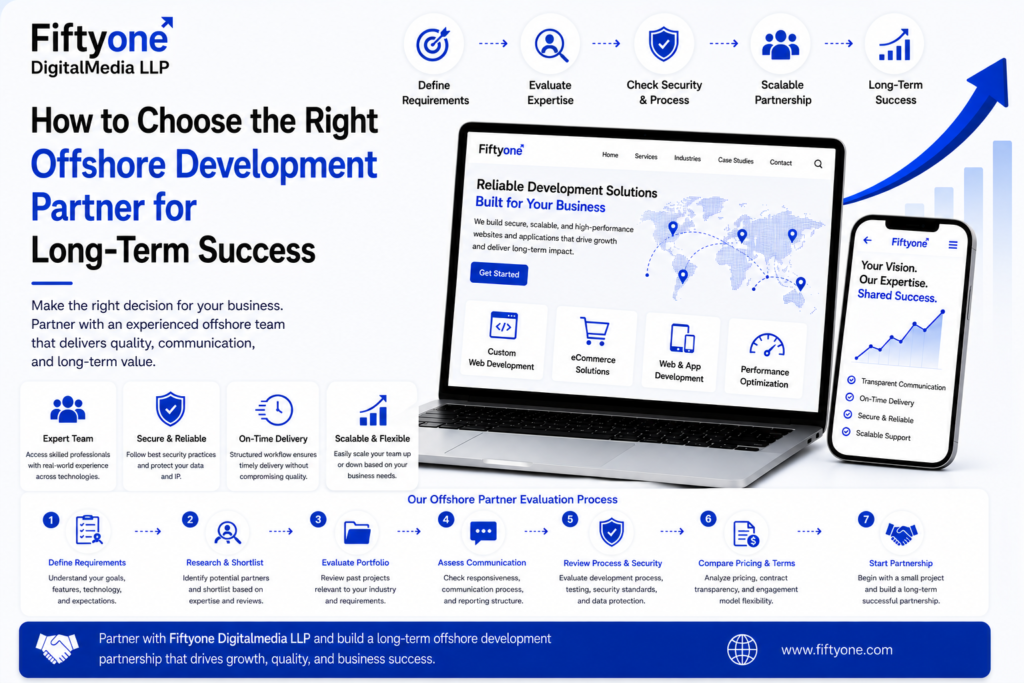
A reliable offshore development partner should have a documented process for moving a project from requirements to deployment. You should know how tasks are assigned, how progress is reviewed, when testing occurs, and how revisions are managed.
A structured workflow normally includes:
- Requirement analysis
- Technical planning
- Resource allocation
- Development milestones
- Internal reviews
- Quality assurance
- Client feedback
- Final deployment
- Post-launch support
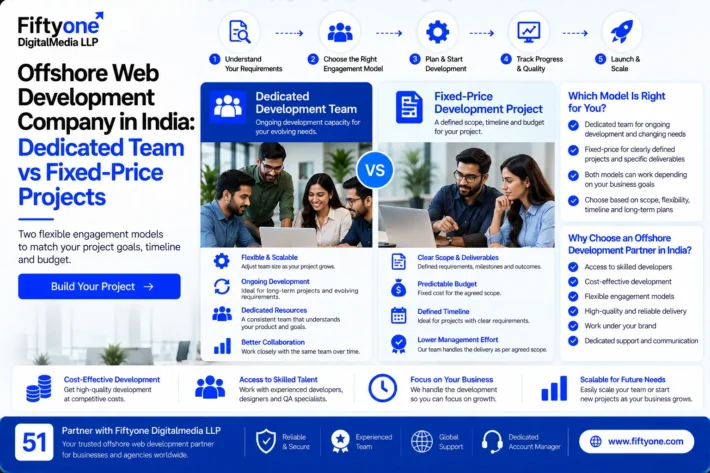
Agencies planning to build a larger outsourced team should also read How to Build a Dedicated Offshore Development Team in India to understand how dedicated resources can support increasing project volumes.
Look for Transparency in Pricing and Contracts
A development contract should clearly explain what you are paying for. Vague pricing creates disputes when additional features, revisions, maintenance, or unexpected development work appears later.
Before signing, review the project scope, payment structure, milestone terms, revision policy, ownership rights, maintenance responsibilities, termination conditions, and additional development rates. The offshore company should also explain what is excluded from the quoted price.
Transparent contracts make long-term relationships easier because both sides understand their responsibilities before development begins.
Warning Signs You Should Not Ignore
Some warning signs should immediately reduce confidence in a potential offshore development company.
- Unrealistically low pricing
- Guaranteed delivery without requirement analysis
- No verifiable portfolio
- Poor communication
- Unclear project ownership
- No defined testing process
- Refusal to sign an NDA
- No dedicated project contact
- Hidden development charges
- No post-launch support
Do not ignore these problems simply because the proposal is cheaper. Weak processes usually become more expensive once development starts.
Evaluate Long-Term Support
The relationship should not automatically end when a website or application launches. Digital products require updates, security improvements, bug fixes, performance optimization, integrations, and new functionality as business requirements change.
A long-term offshore partner already understands your technology, architecture, and business requirements. This reduces the time required to implement future changes and avoids repeatedly onboarding new developers. Fiftyone Digitalmedia LLP supports agencies and businesses that need ongoing technical resources rather than development limited to a single project.
Compare Offshore Development With Local Hiring
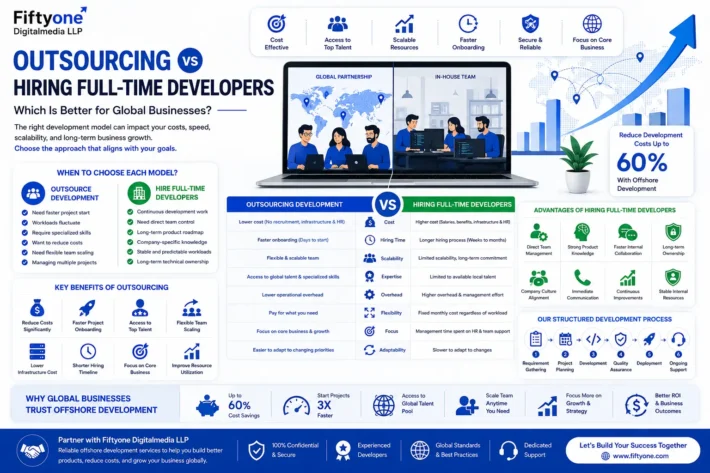
Building an internal development department gives businesses direct control, but recruitment, salaries, infrastructure, software, training, and employee retention increase operating costs. Offshore development provides an alternative for companies that need technical capacity without committing to continuous internal hiring.
The right model depends on project volume, budget, management capacity, and the level of control required. Businesses evaluating the financial difference can explore Offshore Development vs Local Hiring: Cost Comparison for a closer look at how the two approaches affect development expenses.
How to Make the Final Decision
Do not select a company after evaluating only its proposal. Compare shortlisted partners against the same criteria so that pricing does not dominate the decision.
Review technical expertise, portfolio relevance, communication quality, security standards, development workflow, testing procedures, scalability, contract transparency, and post-launch support. A small paid test project can also reveal how effectively the team communicates and delivers before you commit to a larger engagement.
The best offshore development partner is not necessarily the cheapest or largest company. It is the team capable of consistently meeting your technical and operational requirements.
Why Choose Fiftyone Digitalmedia LLP
A long-term offshore relationship requires consistent delivery, clear communication, technical capability, and flexibility. Fiftyone Digitalmedia LLP works with agencies and businesses that need development support without continuously expanding internal teams.
The focus is on building scalable working relationships rather than completing isolated development tasks. From website and ecommerce development to custom solutions and ongoing technical support, Fiftyone Digitalmedia LLP helps clients increase development capacity while maintaining control over projects and customer relationships.
Frequently Asked Questions
What should I check before hiring an offshore development company?
Evaluate technical expertise, previous work, communication, security practices, testing procedures, pricing transparency, scalability, and post-launch support.
How do I know if an offshore development company is reliable?
Review its portfolio, development processes, communication quality, contractual terms, project management approach, and ability to explain previous development work clearly.
Should I choose the cheapest offshore development company?
No. Price should be compared alongside development quality, technical expertise, security, communication, testing, and long-term support.
Is an NDA necessary for offshore development?
An NDA can be important when external developers receive access to confidential business information, source code, client information, or proprietary systems.
Can an offshore development team work as a long-term partner?
Yes. A dedicated offshore team can support ongoing development, maintenance, upgrades, integrations, and changing project requirements over an extended period.
Conclusion
Choosing the right offshore development partner requires more than comparing hourly rates. Technical expertise, communication, security, testing, transparency, scalability, and long-term support determine whether the relationship can deliver sustainable value.
A strong partner should operate as an extension of your existing business rather than simply completing assigned tasks. Taking the time to evaluate these factors before signing a contract reduces development risk and creates a stronger foundation for long-term collaboration.
Ready to Build a Long-Term Offshore Partnership?
Fiftyone Digitalmedia LLP provides offshore development support for agencies and businesses that need scalable technical resources, structured project execution, and ongoing development assistance. A clearly defined partnership can help your business increase delivery capacity without creating unnecessary internal overhead.