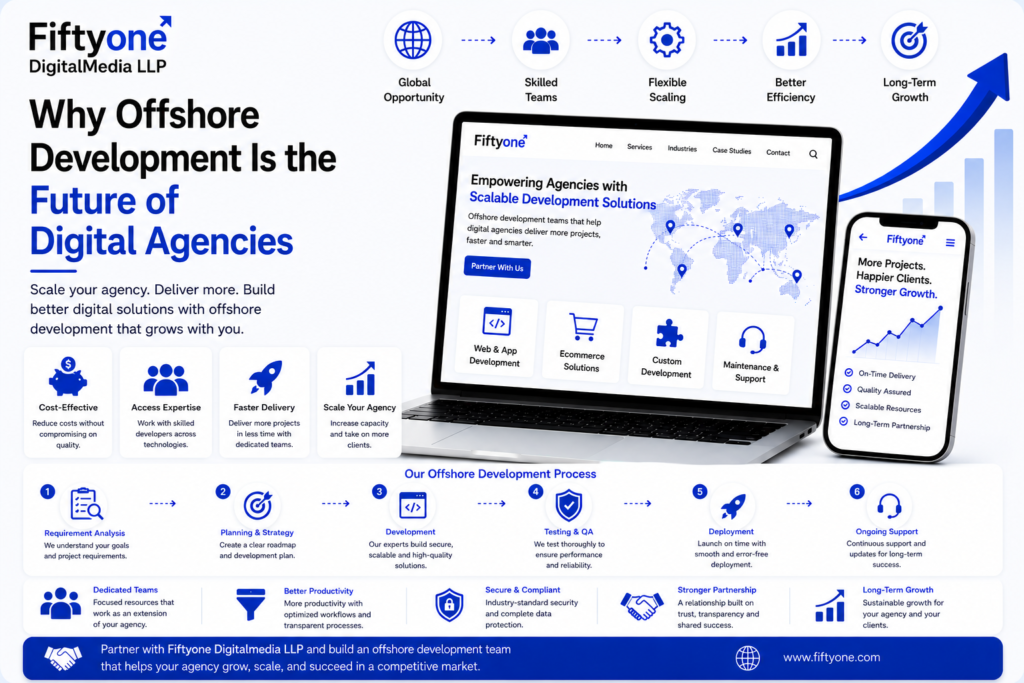
Why Offshore Development Is the Future of Digital Agencies
Introduction
Digital agencies are operating in a market where clients expect faster delivery, broader technical capabilities, competitive pricing, and ongoing support. An agency that previously focused on basic websites may now receive requests for ecommerce stores, custom applications, API integrations, performance optimization, maintenance, and advanced development. Expanding an internal team every time these requirements increase creates significant operational pressure.
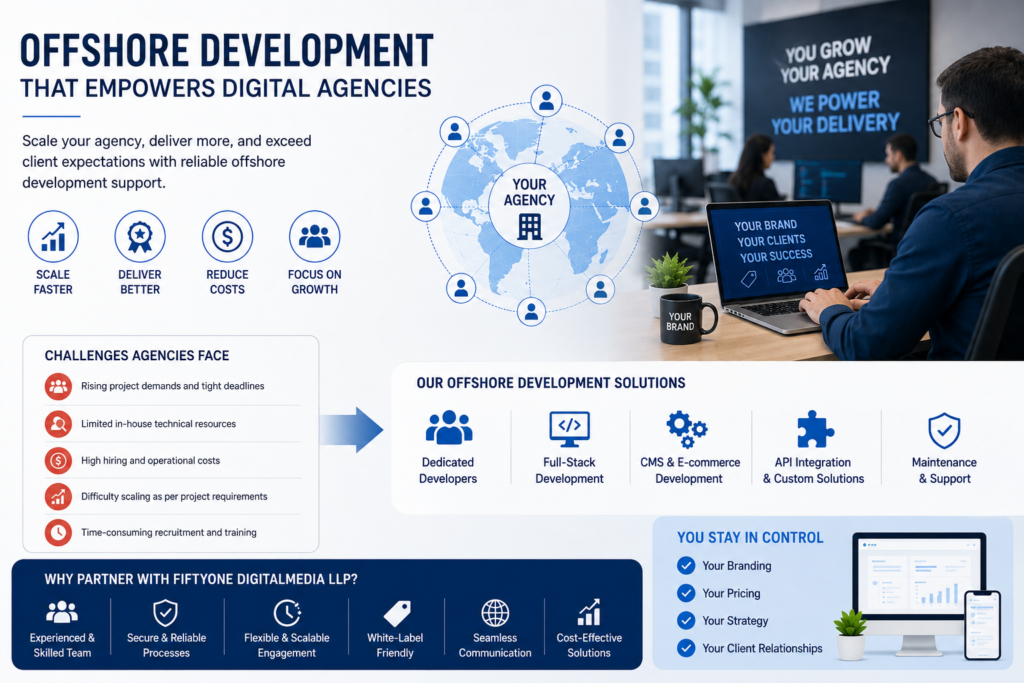
Offshore development provides agencies with a different growth model. Instead of making permanent recruitment the only way to increase capacity, agencies can access external development resources according to project demand. Fiftyone Digitalmedia LLP works with agencies that need scalable technical support while maintaining control over their branding, pricing, strategy, and client relationships.
Digital Agencies Need a More Flexible Delivery Model
Traditional agency expansion depends heavily on hiring. More clients create more work, which requires more employees, management, infrastructure, and operational expenses. That structure becomes difficult when workloads fluctuate or clients require specialized technologies that the existing team cannot provide.
Offshore development creates a more flexible delivery system. Agencies can increase technical capacity during periods of high demand without permanently increasing their internal workforce. This flexibility is becoming increasingly valuable as agencies compete for larger projects while trying to maintain healthy operating margins.
Why Offshore Development Fits Modern Agency Growth
The offshore model addresses several problems that growing agencies commonly face:
- Increasing development workloads
- Expensive technical recruitment
- Limited internal specialization
- Tight client deadlines
- Fluctuating project volumes
- Growing maintenance requirements
- Need for faster project execution
- Pressure to maintain competitive pricing
- Difficulty scaling internal resources
- Demand for broader development services
Instead of solving each problem through additional permanent hiring, agencies can build an external technical resource structure that expands alongside project demand.
Access to Specialized Development Skills
Modern digital projects frequently require several technical skills rather than a single web developer. An ecommerce project may involve custom front-end development, payment integrations, API connections, performance optimization, responsive testing, security improvements, and ongoing maintenance.
An offshore development partner can give agencies access to specialists across multiple technologies without requiring separate recruitment for every capability.
Common resources can include:
- WordPress developers
- WooCommerce developers
- Shopify developers
- PHP developers
- Laravel developers
- React developers
- Front-end developers
- API integration specialists
- Quality assurance professionals
- Website maintenance teams
This broader technical capability allows agencies to compete for projects that would otherwise fall outside their internal expertise.
Offshore Development Supports Faster Scaling
Agency growth becomes difficult when sales increase faster than delivery capacity. Winning more projects is useless if the development department cannot execute them without creating delays, rushed work, or quality problems.
Offshore development allows agencies to add technical resources without waiting through lengthy recruitment and onboarding cycles. Existing internal employees can remain focused on their core responsibilities while additional development work is distributed to external specialists.
A relevant published article on this broader outsourcing model is How Outsourcing Helps Businesses Grow Faster. This exact title is present in your published-blog list.
Lower Fixed Costs Create More Flexible Agencies
Building a large internal development department creates fixed expenses regardless of how much client work is available. Salaries, recruitment, employee benefits, equipment, software, training, and management costs continue during slower periods.
Offshore development can shift part of this expense toward a more flexible model. Agencies can structure technical resources around actual workloads and project requirements rather than maintaining excess internal capacity throughout the year.
The objective should not be choosing the cheapest developers available. Sustainable cost advantages come from improving resource utilization while maintaining development quality, communication, testing, and reliability.
Offshore Teams Can Become an Extension of the Agency
The future of offshore development is not simply sending isolated tasks to unknown developers. Strong agency partnerships involve integrating external developers into established workflows so that they understand project requirements, quality standards, communication procedures, and delivery expectations.
Fiftyone Digitalmedia LLP supports this approach by working as an external technical resource for agencies rather than requiring them to restructure their client-facing operations. The agency can continue controlling client relationships while development work is completed behind the scenes.
Agencies Can Expand Services Without Building Every Skill In-House
A digital agency may begin with web design and later receive demand for ecommerce development, custom functionality, website maintenance, software integrations, or more advanced applications. Rejecting these projects limits revenue opportunities, but hiring specialists before sufficient demand exists creates unnecessary fixed costs.
Offshore development gives agencies another option. They can expand technical capabilities according to real client demand and gradually build a broader service portfolio.
This approach can help agencies:
- Accept more technically complex projects
- Introduce additional development services
- Serve larger clients
- Support existing customers for longer
- Increase recurring maintenance revenue
- Reduce dependence on individual developers
- Enter new technical service categories
- Build more scalable delivery operations
Why India Plays a Major Role in Offshore Development
India has developed a large technology-services ecosystem serving businesses and agencies across international markets. For digital agencies, the attraction is not limited to development cost. Access to developers across different technologies makes it possible to build teams around specific project requirements.
The offshore model works best when agencies evaluate providers based on development quality, communication, security, project management, testing, and reliability rather than location or pricing alone.
Fiftyone Digitalmedia LLP provides offshore development support from India for agencies seeking additional technical capacity across ongoing digital projects.
How Offshore Development Is Changing Agency Operations
The traditional agency model depends heavily on maintaining a large internal workforce. That structure becomes expensive when client demand changes or projects require technologies outside the team’s existing expertise. Offshore development gives agencies a more adaptable operational model where technical capacity can be increased according to actual workload.
This does not mean agencies should replace every internal developer. A stronger model combines internal leadership and client-facing expertise with external technical resources. Fiftyone Digitalmedia LLP can support this structure by handling development execution while agencies retain control over project strategy, branding, pricing, and customer relationships.
Dedicated Offshore Teams Create Long-Term Capacity
A dedicated offshore team can become more valuable as an agency’s project volume increases. Instead of finding a different developer whenever new work arrives, agencies can build an ongoing relationship with developers who understand their preferred technologies, workflows, quality requirements, and delivery standards.
Key advantages include:
- Consistent technical resources
- Less repeated onboarding
- Better understanding of agency standards
- Easier workload distribution
- Predictable project workflows
- Access to specialized developers
- Faster communication
- Long-term technical continuity
- Easier resource scaling
This model is particularly useful for agencies handling recurring website development, ecommerce, maintenance, and custom development work.
Quality Control Will Determine Offshore Success
Offshore development only works when quality control is built into the delivery process. Increasing the number of available developers has little value if projects repeatedly require corrections after delivery.
Agencies should establish clear coding standards, responsive requirements, testing procedures, staging environments, browser compatibility checks, security reviews, and approval processes. Responsibilities should also be defined before development begins so that both teams understand who handles development, testing, revisions, and final approval.
A structured offshore relationship therefore depends on processes rather than simply assigning tasks. Agencies that standardize their workflows can scale technical delivery without allowing quality to decline as project volume increases.
Communication Must Be Structured
Distance itself is not the main communication problem in offshore development. Poorly documented requirements and unclear responsibilities create much larger problems.
Agencies should establish:
- One primary communication channel
- Dedicated project contacts
- Documented project requirements
- Clear milestones
- Defined approval stages
- Regular progress updates
- Issue escalation procedures
- Centralized task management
The objective is not constant communication. The objective is giving both teams enough information to execute projects without repeated confusion or unnecessary meetings.
Offshore Development vs Expanding In-House Teams
Hiring internally gives an agency direct access to employees and can make sense when workloads are predictable and specific technical capabilities are required continuously. The limitation is that every additional employee increases fixed operational costs and creates recruitment, onboarding, training, and management responsibilities.
Offshore development provides a different structure. Agencies can use external resources to handle changing workloads while keeping a smaller core internal team. This can be particularly useful when technical demand varies significantly between projects.
A related article already published in your provided list is Why Businesses Worldwide Prefer Offshore Development Teams from India. It covers dedicated development teams, offshore developers, global development services, and development outsourcing.
How Offshore Development Supports Agency Profitability
Agency profitability depends on more than increasing revenue. Delivery costs must remain controlled as project volume grows. If every new client requires immediate permanent recruitment, additional revenue can quickly be absorbed by higher operating expenses.
An offshore model can give agencies greater control over resource allocation. Development capacity can be aligned more closely with active projects instead of maintaining unnecessary resources during slower periods.
Fiftyone Digitalmedia LLP supports agencies that need this type of flexible development structure. The goal is to provide technical capacity that supports growth without forcing agencies to build every development capability internally.
Choosing the Right Offshore Development Partner
The offshore development market contains companies with very different levels of technical capability. Agencies should therefore evaluate potential partners carefully instead of selecting the lowest quotation.
Important factors include:
- Relevant development experience
- Technical expertise
- Portfolio quality
- Communication standards
- Security practices
- NDA availability
- Development workflow
- Quality assurance
- Resource scalability
- Pricing transparency
- Post-launch support
A relevant resource from your published list is Offshore Development Company Checklist Before Hiring. The exact title is present in the uploaded list and directly covers the evaluation of offshore development companies.
The Future Is a Hybrid Agency Model
The strongest long-term model for many digital agencies is likely to be hybrid rather than completely in-house or completely outsourced. Internal teams can retain responsibilities requiring direct client knowledge, strategic decisions, creative leadership, and account management, while offshore specialists provide additional technical execution.
This structure gives agencies greater control than completely outsourcing operations while avoiding the fixed cost of building every capability internally. It also allows agencies to change their technical resource mix as client requirements evolve.
Fiftyone Digitalmedia LLP can operate within this model as an external development resource supporting agencies across website development, ecommerce, custom functionality, integrations, and ongoing technical requirements.
Frequently Asked Questions
Why is offshore development becoming important for digital agencies?
Offshore development allows agencies to access additional technical resources, manage changing workloads, broaden their development capabilities, and scale without depending entirely on permanent recruitment.
Will offshore development replace in-house developers?
Not necessarily. Many agencies can use a hybrid structure where internal employees handle core responsibilities while offshore developers provide additional capacity and specialized expertise.
Is offshore development suitable for small agencies?
Yes. Smaller agencies can use offshore resources to access technical capabilities without building a large development department before sufficient project demand exists.
How can agencies maintain offshore development quality?
Agencies should define technical standards, document requirements, establish testing procedures, use staging environments, and create clear review and approval processes.
What should agencies check before selecting an offshore company?
Technical expertise, relevant experience, communication, security, quality assurance, scalability, contract terms, pricing transparency, and ongoing support should all be evaluated.
Conclusion
Offshore development is becoming an important part of the future agency delivery model because it provides flexibility that traditional hiring alone cannot always offer. Agencies can access specialized developers, increase technical capacity, manage changing workloads, and broaden their services without making every stage of growth dependent on permanent recruitment.
The model still requires strong processes. Offshore development becomes valuable when agencies combine external technical resources with clear communication, quality control, project management, and internal strategic leadership. Used correctly, it can create a scalable delivery infrastructure capable of supporting long-term agency growth.
Build a Scalable Development Model
Fiftyone Digitalmedia LLP provides offshore development support for digital agencies that need additional technical capacity without continuously expanding internal teams. A structured offshore partnership can help agencies manage more client projects while retaining control over strategy, branding, and customer relationships.